
Search All Items
- Filters:
- Language
- English 5312
- Spanish 43
- ENGLISH 2
- English 1
- census_013 1
- Type
- Image 3851
- Still Image 1035
- Text 445
- Text 22
- Textual 2
Search Results 2311 to 2320 of 5424
-
Caption: "400 Pound Turtles Ready for Shipment -- Key West July 2, 1934." Several slaughtered sea turtles on a wharf in Key West. Turtle meat and eggs were popular food items in the early-to-mid twentieth century; turtle fat was especially prized for making turtle soup. Turtle kraals (corrals) and a cannery were built as the Key West area began to develop. However, the turtle population plummeted in the Florida Keys and surrounding areas as the twentieth century progressed and demand for turtle meat, eggs, and fat increased. The Key West turtle fishing industry halted after the Endangered Species Act was passed in 1971. Turtle populations have since started to recover. The cannery now serves as the Key West Turtle Museum.
Date: 7/2/1934
-
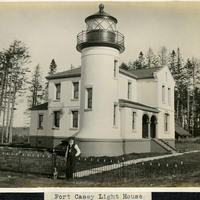
Caption: "Fort Casey Light House [sic]," c. 1905. Located on Whidbey Island in Puget Sound, the Admiralty Head Lighthouse was built overlooking Admiralty Inlet in 1903. It replaced an earlier structure that had to be moved in 1890 to accommodate the construction of Fort Casey. The second lighthouse, shown here, was built with thick walls in order to withstand earthquakes and the concussion of guns at Fort Casey. The man shown in the photograph is likely Charles H. Davis, who was appointed keeper of the lighthouse in 1900 and served until his death in 1914. The lighthouse, deactivated in 1922, has since been restored by Washington State Parks, and is part of the Fort Casey State Park. See also 96-07-08-alb03-065.
Date: 1905
-
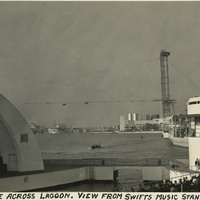
Caption: "Sky Ride Across Lagoon. View from Swifts Music Stand. Chicago Fair, Sept. 18, 1934." One of the 628-foot towers making up the Sky Ride, an aerial tramway which carried fair goers in small gondolas or trams (visible in the center of the photograph) over the harbor around which the Century of Progress Exposition was held. Over 4.5 million passengers enjoyed the views from the Sky Ride before it was demolished after the conclusion of the exposition in 1934. The Exposition, a world fair attended by thirty-nine million people, celebrated Chicago's one-hundred year anniversary of incorporation. Originally planned to only run from May to November in 1933, it was such a success that its organizers decided to keep it running for a second season from May through October the following year. The central theme of the Exposition was technological innovation, with a motto of "Science Finds, Industry Applies, Man Conforms."
Date: 9/18/1934
-
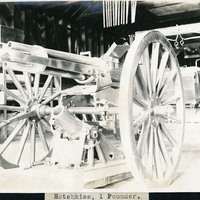
Caption: "Hotshkiss [sic], 1 pounder." The United States purchased artillery from the French arms firm, Hotchkiss, in the late 19th and early 20th centuries. The arms firm was created by American gunsmith, Benjamin B. Hotchkiss, who moved to France in 1867 to set up the factory. The heavy artillery was first used by the United States against the Nez Perce in 1877. In 1890, they were used at the Wounded Knee Massacre, and also for the attack on San Juan Hill during the Spanish-American War.
Date: Undated
-
Caption: "Main [sic] Memorial, ial [sic -- cut off in original photograph] Monument and National Hotel. Havana. July 4, 34." Designed by McKim, Mead and White, the Hotel Nacional in Havana opened in 1930. In the foreground is the Monument to the Victims of the USS Maine, two columns topped by an eagle with outstretched wings, built in 1925 to memorialize the American sailors who died in an explosion on the USS Maine in 1898. The eagle and other features of the monument were removed in 1961 as symbols of imperialism.
Date: 7/4/1934
-
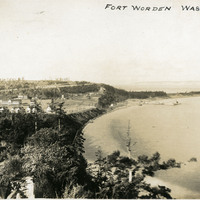
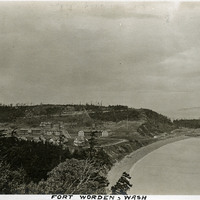
Caption: "Fort Worden, Wash." Washington, c. 1908.Construction of Fort Worden in Port Townsend, Washington, on Admiralty Inlet of Puget Sound began in 1898, and by 1902 it was serving as an active U.S. Army base. Fort Worden was part of the "triangle of fire", three coastal defense fortifications (Fort Casey, Fort Worden, and Fort Flagler) guarding the entrance to Puget Sound. The U.S. sold the property to the state of Washington in 1957. In 1973, the fort and surrounding area opened as Fort Worden State Park.
Date: 1908
-
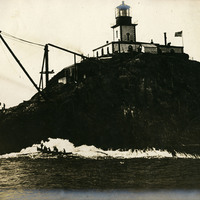
No Caption: c. 1898. View of Tillamook Rock Lighthouse and the small basalt rock upon which it sits, over one mile into the ocean from Tillamook Head. Built between 1880-1881, the treacherous ocean currents and often inclement weather associated with the area earned the lighthouse its nickname "Terrible Tillie" or "Tillie." This photograph was taken before the roof of the lighthouse was raised by five feet in 1898, to help prevent damage to the roof and the interior by crashing waves. The lighthouse was decommissioned in 1957.
Date: 1898
-
Caption: "Fort Worden, Wash.," c. 1909. Panoramic view of Fort Worden in Port Townsend, Washington, on Admiralty Inlet of Puget Sound. Construction began on the fort in 1898. By 1902 it was serving as an active U.S. Army base. Fort Worden was part of the "triangle of fire," three coastal defense fortifications (Fort Casey, Fort Worden, and Fort Flagler) guarding the entrance to Puget Sound. The U.S. sold the property to the state of Washington in 1957. In 1973, the fort and surrounding area opened as Fort Worden State Park.
Date: 1909
-
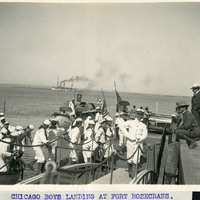
Caption: "CHICAGO BOYS LANDING AT FORT ROSECRANS." View of US Navy sailors coming ashore at Fort Rosecrans. The flagship of the US fleet in the Pacific at the time, the USS Chicago was called to the fort after a boiler explosion on the USS Bennington killed sixty-six and wounded dozens more. A board of inquiry into the cause of the explosion was convened on board the Chicago. The board found that no error on the part of the Bennington's crew contributed to the explosion.
Date: 1905
-
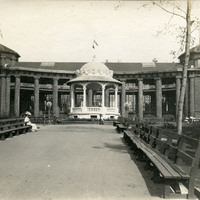
No Caption: View of the Forestry Building at the Alaska-Yukon-Pacific Exposition. Grace McCarthy is seated on a bench in front of the building, in a light-colored dress and hat. Made out of unpeeled logs, the Forestry Building was demolished in the 1930s. Held in Seattle to celebrate the development of the Pacific Northwest, the fair attracted 3.7 million visitors over the course of its run from June to October 1909. Although most of the fair's buildings have since been destroyed, several of them now serve as part of the University of Washington campus.
Date: 1909