
Search All Items
- Filters:
- Language
- English 5312
- Spanish 43
- ENGLISH 2
- English 1
- census_013 1
- Type
- Image 3851
- Still Image 1035
- Text 445
- Text 22
- Textual 2
Search Results 2321 to 2330 of 5424
-
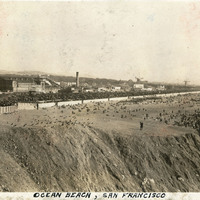
Caption: "Ocean Beach, San Francisco," c. 1925. Panorama of Ocean Beach, showing crowds not only at the beach but also at San Francisco's Playland, a series of seaside attractions and rides including a carousel, Fun House, and the Big Dipper rollercoaster. Entrepreneurs began erecting concessions and "thrill" rides at the location in the late nineteenth century. By 1913 the area was known as Chutes at the Beach. In 1923, brothers George and Leo Whitney began to purchase the attractions, eventually coming to own the entirety of what became known as Playland. The amusement park was torn down in 1972.
Date: 1925
-
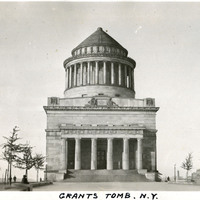
Caption: "Grants Tomb. N.Y." The remains of Ulysses S. Grant, 18th President of the U.S. and Commanding General of the Union Army during the last year of the Civil War, were laid to rest in this elaborate tomb, designed by architect John Duncan. Grant died in 1885, but construction on the granite and marble structure did not begin until 1891. Grant's remains were transferred to the tomb on April 27, 1897. The tomb is the largest mausoleum in North America. See also 96-07-08-alb11-209.
Date: 8/10/1934
-
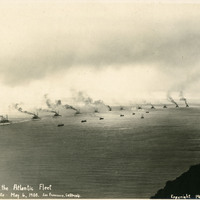
Caption: "The Arrival of the Atlantic Fleet at the Golden Gate -- May 6, 1908. San Francisco, California." and "Copyright 1908, Chas. Weidner, S.F." This photograph, by Charles Weidner, shows the U.S. Navy's Atlantic Fleet, consisting of sixteen battle cruisers and various support vessels, steaming toward the Golden Gate and San Francisco Bay. President Theodore Roosevelt ordered the Atlantic Fleet (later called the "Great White Fleet" because the ships were painted white with gold trim) on a tour around the world, beginning in December 1907, to show American goodwill and also demonstrate the power of the U.S. Navy. The Fleet reached the Golden Gate, entrance to San Francisco Bay, on May 6, 1908.
Date: 5/6/1908
-
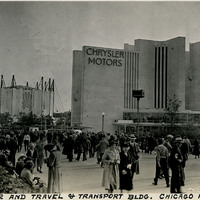
Caption: "Chrysler and Travel & Transport Bldg. Chicago Fair. Sept. 16, 1934." View of two buildings at the Century of Progress Exposition in Chicago. The Chrysler Motors building dominates the photograph, while the Travel and Transport Building can be seen at the left. The latter building featured a catenary roof, the first one built in the US. The Exposition, a world fair attended by thirty-nine million people, celebrated Chicago's one-hundred year anniversary of incorporation. Originally planned to only run from May to November in 1933, it was such a success that its organizers decided to keep it running for a second season from May through October the following year. The central theme of the Exposition was technological innovation, with a motto of "Science Finds, Industry Applies, Man Conforms." None of the buildings constructed for the fair are still extant today, having been built as temporary facilities.
Date: 9/16/1934
-
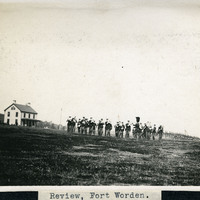
Caption: "Review, Fort Worden.," c. 1908-1912. Shows a military band playing or preparing to play, with rows of troops assembled in the background on the right side of the photograph. Fort Worden is located in Port Townsend, Washington, on Admiralty Inlet of Puget Sound. Construction began on the fort in 1898, and by 1902 it was serving as an active U.S. Army base. Fort Worden was part of the "triangle of fire," three coastal defense fortifications (Fort Casey, Fort Worden, and Fort Flagler) guarding the entrance to Puget Sound. The U.S. sold the property to the State of Washington in 1957. In 1973, the fort and surrounding area opened as Fort Worden State Park.
Date: 1908
-
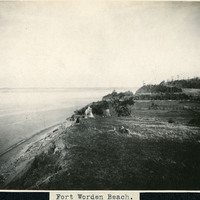
Caption: "Fort Worden Beach.," c. 1908-1912. Ocean shore scene at Fort Worden, near Port Townsend. Construction began on the fort in 1898, and by 1902 it was serving as an active U.S. Army base. Fort Worden was part of the "triangle of fire," three coastal defense fortifications (Fort Casey, Fort Worden, and Fort Flagler) guarding the entrance to Puget Sound. The U.S. sold the property to the state of Washington in 1957. In 1973, the fort and surrounding area opened as Fort Worden State Park.
Date: 1908
-
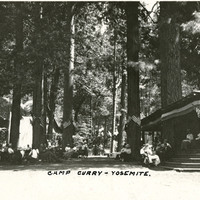
Caption: "Camp Curry- Yosemite," c. 1917. Yosemite's Half Dome Village, established by David and Jennie Curry in 1899, was originally called Camp Curry, and later Curry Village. It was designed to provide cheaper accommodations for Yosemite tourists than the resort hotels. The couple rented out furnished tents and provided amenities such as a dining tent. As time progressed, the amenities increased, and some hard-sided cabins created. This photograph shows a bustling scene around a large wood cabin with a wide covered porch. As a result of a legal dispute over trademarked names in the park, Curry Village changed its name to Half Dome Village in 2016.
Date: 1917
-
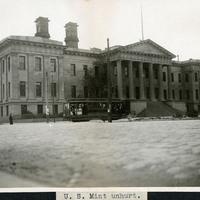
Caption: "U.S. Mint unhurt," c. 1906. Pictured is the U.S. Mint building in San Francisco, which opened in 1874, after the original 1854 building was outgrown, which had been established to serve the gold mines during the California Gold Rush. The building suffered little damage after the 1906 earthquake. The facility served as the San Francisco U.S. Mint until 1937, when workers moved to a larger and more modern building. In 1961, the old U.S. Mint, known as the "Granite Lady," was designated a National Historic Landmark.
Date: 1906
-
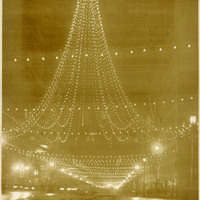
No Caption: The photograph has a hand-written inscription stating: "Portola Electric Bell Copyright 1909 Pillsbury Picture Co. No. 800." Installed on the intersection of Third and Market Streets in San Francisco, the Portola Electric Bell contained two thousand bulbs and rose 125 feet above the street. It was part of the Portola Festival of 1909, a grand celebration devised to commemorate the discovery of San Francisco Bay by Gaspar De Portola, and for the public to celebrate the future of the rebuilt city after the 1906 earthquake and fires.
Date: 1909
-
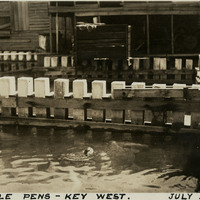
Caption: "Turtle Pens -- Key West. July 2, 1934." View of turtle kraals, or turtle corrals, used in the turtle fishing industry in Key West. Green turtles were kept in these pens prior to slaughter or transport. Turtle meat and eggs were popular food items in the early-to-mid twentieth century; turtle fat was especially prized for making turtle soup. However, the turtle population plummeted in the Florida Keys and surrounding areas as the twentieth century progressed and demand increased. The turtle kraals and nearby canneries closed when the Endangered Species Act was passed in 1971. Populations have since started to recover. The cannery near the kraals shown in this photograph now serves as the Key West Turtle Museum.
Date: 7/2/1934