
Search All Items
- Filters:
- Language
- English 5312
- Spanish 43
- ENGLISH 2
- English 1
- census_013 1
- Type
- Image 3851
- Still Image 1035
- Text 445
- Text 22
- Textual 2
Search Results 2341 to 2350 of 5424
-
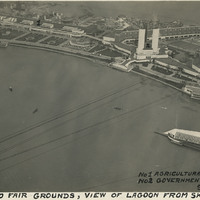
Caption: "Chicago Fair Grounds, View of Lagoon from Sky Ride. No 1 Agricultural Building. No2 Government Building. Sept. 17, 1934." Bird's eye view of a portion of the fair grounds for Chicago's Century of Progress Exposition. Two of the fair's structures have been labeled in this photograph, including the Agriculture Building, a long low structure, and the Federal Building, featuring three towers representing the three branches of the federal government. The Exposition, a world fair attended by thirty-nine million people, celebrated Chicago's one-hundred year anniversary of incorporation. Originally planned to only run from May to November in 1933, it was such a success that its organizers decided to keep it running for a second season from May through October the following year. The central theme of the Exposition was technological innovation, with a motto of "Science Finds, Industry Applies, Man Conforms." None of the buildings constructed for the fair are still extant today, having been built as temporary facilities.
Date: 9/17/1934
-
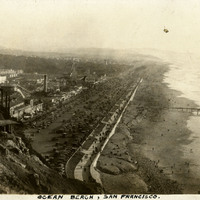
Caption: "Ocean Beach, San Francisco," c. 1925. Panorama of Ocean Beach, showing crowds not only at the beach but also at San Francisco's Playland, a series of seaside attractions and rides including a carousel, Fun House, and the Big Dipper rollercoaster. Entrepreneurs began erecting concessions and "thrill" rides at the location in the late nineteenth century. By 1913 the area was known as Chutes at the Beach. In 1923, brothers George and Leo Whitney began to purchase the attractions, eventually coming to own the entirety of what became known as Playland. The amusement park was torn down in 1972.
Date: 1925
-
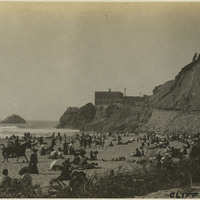
Caption: " Cliff House #3." View of people on Ocean Beach and walking up the road to the (fourth) Cliff House in the distance, San Francisco, c. 1910. The original Cliff House was built in 1858. The second was built in 1863 and was destroyed by fire on Christmas day in 1894. The third Victorian- style Cliff House was completed in 1896, and although it survived the 1906 earthquake and fires, it burned to the ground in 1907. A fourth Cliff House (pictured) was then built with steel-reinforced concrete and opened in 1909.
Date: 1910
-
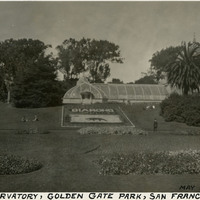
Caption: "Conservatory, Golden Gate Park, San Francisco, May 14, 1934." View of one wing of the Conservatory of Flowers in Golden Gate Park. A planting bed in front of the wing has been planted with flowers in such a way as to portray the California flag and the letters "California Diamond Jubilee, 1850-1925." The date on this photograph may not be accurate, given the dates included in the flower bed. The Conservatory of Flowers is the oldest building in Golden Gate Park, dating to 1879. The Victorian-style building has housed rare and exotic plants since its completion.
Date: 5/14/1934
-
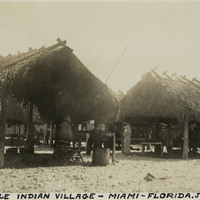
Caption: "Seminole Indian Village -- Miami -- Florida. June, [sic] 30, 1934." Several shelters with roofs of thatched grass or brush, with several unidentified women and children scattered throughout the photograph. The Seminoles are a Native American tribe from Florida, although most of the tribe had been forcibly relocated from Florida to Oklahoma by 1842. Fewer than 200 remained in Florida after the Third Seminole War ended in 1858, but a resurgence of the tribe occurred in the early to mid twentieth century. The Florida Seminole tribe received federal recognition in 1957.
Date: 6/30/1934
-
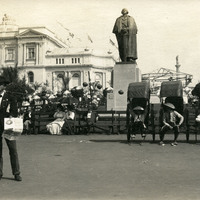
No Caption: A statue of George Washington (Lorado Taft, artist) dominates this photograph of fair-goers at the Alaska-Yukon-Pacific Exposition. Rickshaws and their drivers rest near the statue while waiting for their next fare. Held in Seattle to celebrate the development of the Pacific Northwest, the fair attracted 3.7 million visitors over the course of its run from June to October 1909. Although most of the fair's buildings have since been destroyed, several of them now serve as part of the University of Washington campus.
Date: 1909
-
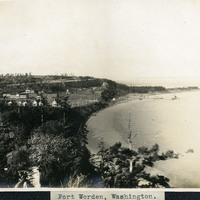
Caption: "Fort Worden Wash.," c. 1908. Overview of Fort Worden in Port Townsend, Washington, on Admiralty Inlet of Puget Sound. Construction began on the fort in 1898, and by 1902 it was serving as an active U.S. Army base. Fort Worden was part of the "triangle of fire," three coastal defense fortifications (Fort Casey, Fort Worden, and Fort Flagler) guarding the entrance to Puget Sound. The U.S. sold the property to the state of Washington in 1957. In 1973, the fort and surrounding area opened as Fort Worden State Park.
Date: 1908
-
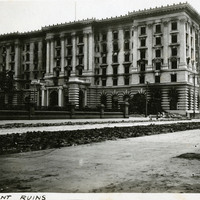
Caption: "Fairmount Ruins." Shows the damage from the 1906 earthquake fire to the Fairmont Hotel on Nob Hill in San Francisco, 1906. Although construction was mostly finished in 1906, the advent of the San Francisco earthquake and fire of that year damaged the hotel's interior and delayed opening until 1907. It was the first hotel in what is now the Fairmont Hotels and Resorts chain. In 1945, the San Francisco hotel was host to an international conference that culminated in the formation of the United Nations.
Date: 1906
-
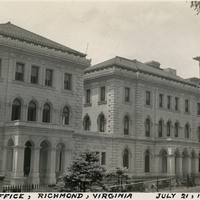
Caption: "Post Office, Richmond, Virginia, July 21, 1934." View of the Richmond Custom House and Post Office. The Custom House, the first federal building in Richmond, was designed by Ammi Burnham Young in 1858. The post office was located on the first floor (for easy access by citizens), the custom house occupied the second floor, and the third floor held a federal courtroom. The building was expanded between 1887 and 1889 to include two short wings on either side of the facade. A story was added to the building in 1910, and wings added in 1910 and 1930, so that now the building occupies the entire block.
Date: 7/21/1934
-
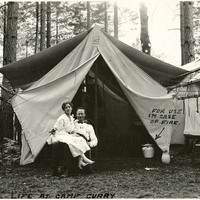
Caption: "Life At Camp Curry," c. 1917. Two unidentified people pose in front of their tent at Camp Curry. An arrow points to an enameled pail just inside the tent, labeled "For Use in Case of Fire." Yosemite's Half Dome Village, established by David and Jennie Curry in 1899, was originally called Camp Curry, and then later Curry Village. It was designed to provide cheaper accommodations for Yosemite tourists than the resort hotels. The couple set up furnished tents and provided amenities such as a dining tent. As attendance at the park increased, the couple constructed more facilities with more modern amenities. In 2016, as a result of a legal dispute over trademarked names in the park, Curry Village changed its name to Half Dome Village.
Date: 1917