
Search All Items
- Filters:
- Language
- English 5312
- Spanish 43
- ENGLISH 2
- English 1
- census_013 1
- Type
- Image 3851
- Still Image 1035
- Text 445
- Text 22
- Textual 2
Search Results 2351 to 2360 of 5424
-
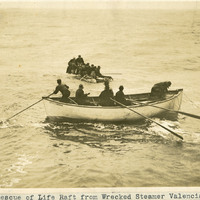
Caption: "Rescue of Life Raft from Wrecked Steamer Valencia." Photograph showing a boat crew about to rescue 18 people on a life raft. On Monday, January 22, 1906, the passenger liner Valencia ran aground on a reef during a storm off the southwestern coast of Vancouver Island (an area notorious for ship wrecks). Although the shore was only about fifty yards away, heavy seas and rock cliffs prevented the passengers and crew from making their way safely to land. Circumstances prevented rescue vessels from coming to the stricken ship's aid until Wednesday January 24th. The steamship City of Topeka rescued 18 men on a life raft, shown in this photograph. The official death toll was 136: seven officers, 33 crewmen, and 96 passengers (including seventeen women and eleven children -- all of the women and children on board perished). Only 37 people survived the wreck.
Date: 1/24/1906
-
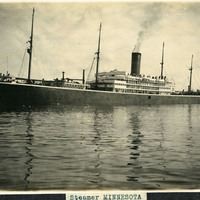
Caption: "Steamer MINNESOTA," c. 1909. View of the steamship Minnesota II, built in 1903. She was said to be the largest U.S. merchant ship afloat at the time. Operated by the Great Northern Steamship Company, she sailed between the U.S. and markets in Asia until 1915. In 1917 the Minnesota II began operating in the Atlantic between the U.S. and the United Kingdom. The U.S. Navy commissioned her as a troop ship in 1919, changing her name to Troy. She brought over 14,000 U.S. troops home from war-torn Europe. She never resumed active service after this, being scrapped in 1923. See also 96-07-08-alb08-111.
Date: 1909
-
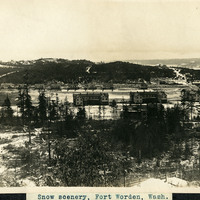
Caption: "Snow scenery, Fort Worden, Wash.," c. 1908. Overview of Fort Worden in Port Townsend, Washington, on Admiralty Inlet of Puget Sound. Construction began on the fort in 1898. By 1902 it was serving as an active U.S. Army base. Fort Worden was part of the so-called "triangle of fire," three coastal defense fortifications (Fort Casey, Fort Worden, and Fort Flagler) guarding the entrance to Puget Sound. The U.S. sold the property to the State of Washington in 1957. In 1973, the fort and surrounding area opened as Fort Worden State Park.
Date: 1908
-
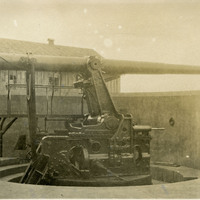
No Caption: c. 1910. Side view of a heavy coastal defense disappearing gun. Retracting or disappearing guns were a form of artillery developed in the nineteenth century in which heavy artillery guns were placed on rotating carriages that allowed retraction of the weapon after firing, to enable reloading while under enemy fire.
Date: 1910
-
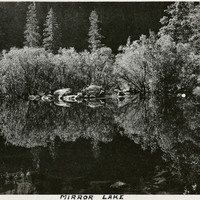
Caption: "Mirror Lake," c. 1917. Mirror Lake in Yosemite National Park, on Tenaya Creek, is the remains of a glacial lake that used to fill most of the valley. Its calm waters provide near-perfect reflections of the surrounding natural splendor.
Date: 1917
-
Drawing of Wells Fargo Building restoration, Columbia Historic State Park, by Paul Johnson, under direction of Alfred Eichler. Built. The drawing, combined with a cutaway photograph, was made in order to show restoration work done. Project for Department of Natural Resources - Beaches and Parks.
Date: 1954
-
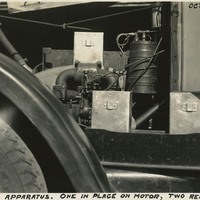
Caption: "Cooking Apparatus. One in Place on Motor, Two Removed. Oct. 10, 1934." This photograph shows three metal boxes used by the McCarthys for cooking during their five-month cross-country auto trip. One of the boxes is set on the engine of their automobile to heat the contents.
Date: 10/10/1934
-
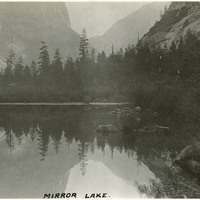
Caption: "Mirror Lake," c. 1917. Mirror Lake in Yosemite National Park, on Tenaya Creek, is the remains of a glacial lake that used to fill most of the valley. Its calm waters provide near-perfect reflections of the surrounding natural splendor.
Date: 1917
-
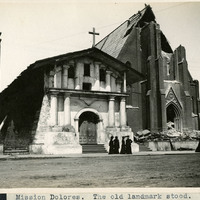
Caption: "Mission Dolores. The old landmark stood," 1906. Mission Delores, the oldest intact building still standing in San Francisco today, suffered little damage from the 1906 earthquake. The parish church next to it was greatly damaged and rebuilt as the Mission Dolores Basilica, opened in 1918.
Date: 1906
-
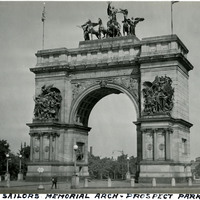
Caption: "Soldiers and Sailors Memorial Arch - Prospect Park - Brooklyn," c. 1925. (John H. Duncan, architect) The Soldiers' and Sailors' Arch was built between 1889 and 1892, and dedicated on October 21st, 1892 to honor the "Defenders of the Union, 1861-1865."
Date: 1925