
Search All Items
- Filters:
- Language
- English 5312
- Spanish 43
- ENGLISH 2
- English 1
- census_013 1
- Type
- Image 3851
- Still Image 1035
- Text 445
- Text 22
- Textual 2
Search Results 2361 to 2370 of 5424
-
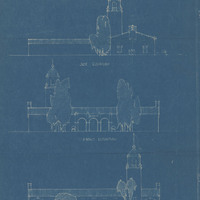
Design and drawing of California State Building for Nevada Highways Exposition in Reno, Nevada, by Alfred Eichler, c. 1926; from packet of designs and plans by Eichler for the Transcontinental Highways Exposition of 1927. Built. Initial appropriation of $100,000 was reduced to $50,000, so only one half of the plan was built. The tower was eliminated.
Date: 1921
-
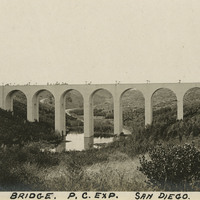
Caption: "Cabrilla [sic] Bridge. P.C. Exp. San Diego. July 18, 1915," Built for the 1915 Panama-California Exposition, the Cabrillo Bridge continues to provide access between Balboa Park and the uptown area of San Diego. See also 96-07-08-alb01-161.
Date: 1915
-
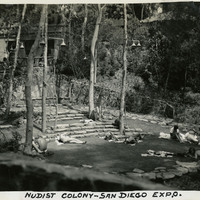
Caption: "Nudist Colony - San Diego Expo.," c. 1935. The Zoro Garden Nudist Colony, named for the Persian mystic, Zoroaster, was an unusual and controversial attraction that featured partially nude men and women performing as nudists. Exposition visitors were charged twenty-five cents to watch the "nudists" perform ceremonies and other activities. Today, the sunken Zoro Garden in Balboa Park is a butterfly garden.
Date: 1935
-
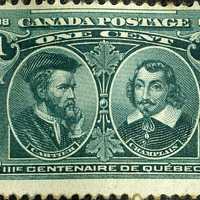
No Caption: Canadian one-cent postage stamp commemorating the three-hundred year anniversary of the founding of Quebec in 1608. This stamp features portraits of Jacques Cartier and Samuel de Champlain, early explorers of Canada. Cartier was the first to claim Canada for the French crown in 1534, while Champlain founded New Canada and Quebec City in 1608.
Date: 1908
-
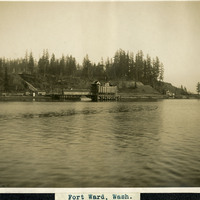
Caption: "Fort Ward, Wash.," c. 1908-1912. View from Puget Sound of a wharf and other buildings of Fort Ward. Originally known as Bean Point, Fort Ward was established by the U.S. Army Coastal Artillery Corps in 1890. Re-named Fort Ward in 1903, the facility included four coastal batteries designed to assist in protecting Puget Sound and the nearby Naval Shipyard from enemy attack. Fort Ward was placed on inactive status in the 1920s, but was revived by the U.S. Navy during World War II. The Navy discovered the fort's location was ideal for listening to radio communications from Japan, and it subsequently became a top secret listening post with a link directly to Washington, D.C. The Navy continued the fort's use as a listening post until 1956, when it was again taken over by the U.S. Army. The Army subsequently stopped all activity in 1958, ultimately selling portions of the fort to the Washington State Park System in 1960. It is now a state park.
Date: 1908
-
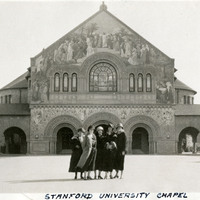
*Caption: "Stanford University Chapel," c. 1920. Five unidentified women standing in front of the Stanford Memorial Chapel on the campus of Stanford University. Designed by Charles A. Coolidge and dedicated in 1903, the church was commissioned by Jane Stanford as a memorial to her husband, Leland Stanford. See also 96-07-08-alb04-202 and 96-07-08-alb05-063.
Date: 1920
-
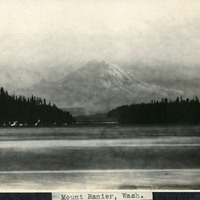
Caption: "Mount Ranier [sic], Wash.," c. 1908-1912. View of Mount Rainier, the highest peak in the Cascade Range and in the state of Washington, and part of the eastern rim of the Pacific Ring of Fire. Although it is now dormant, it is considered to be a high-risk volcano.
Date: 1908
-
Caption: "Morro Castle -- Havana -- Cuba. July 4, 1934." Morro Castle, also called Castillo de los Tres Reyes Magos del Morro, has guarded the entrance to Havana's harbor since 1589. Various additions have been built over the years, including the Faro Castillo del Morro Lighthouse, added in 1846. Morro Castle currently houses the offices of the Havana Harbormaster, and operates as a museum.
Date: 7/4/1934
-
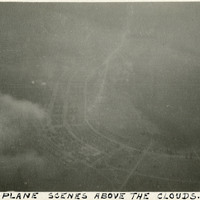
Caption: "Aeroplane [sic] Scenes Above the Clouds.," c. 1915-1920. Photograph taken in an unidentified location, from what appears to have been a biplane (given the small portion of wing that is visible on the left side of the photograph). The locale is unknown.
Date: 1915
-
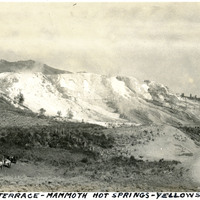
Caption: "Jupiter Terrace - Mammoth Hot Springs - Yellowstone Park," c. 1923. Jupiter Terrace is part of the Lower Terraces of Mammoth Hot Springs. A group of riding horses is seen at lower left, and a road flanks what appear to be observation points at the bottom right.
Date: 1923