
Search All Items
- Filters:
- Language
- English 5312
- Spanish 43
- ENGLISH 2
- English 1
- census_013 1
- Type
- Image 3851
- Still Image 1035
- Text 445
- Text 22
- Textual 2
Search Results 2391 to 2400 of 5424
-
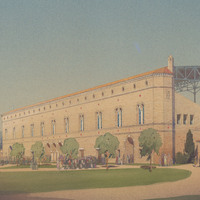
Final design of Grandstand, State Fair, Stockton Boulevard, Sacramento. Design, drawing, and water color rendering by Alfred Eichler. Built to this design, 1926-1927. Water color rendering made in transparent color with a little Chinese white mixed; the sky was blown in using an air brush. Project for Department of Finance - Fairs and Expositions.
Date: 1926
-
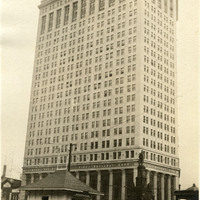
Caption: "First National Bank Bldg. - Detroit," c. 1925. When this building, designed by architect Albert Kahn in the Neoclassical style, was completed in 1922, it was Detroit's tallest structure. This photograph was taken before construction in 1926-27 of a twenty-five story addition adjacent to the building in this photograph.
Date: 1925
-
Image withheld due to copyright considerations. For more information, please contact the California State Archives Reference Desk at ArchivesWeb@sos.ca.gov or (916) 653-2246. No Caption: From a postcard of Gay's Lion Farm in El Monte showing Charles Gay riding "Pluto," an adult African Lion, c. 1935.
Date: 1935
-
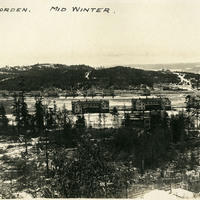
Caption: "Fort Worden. Mid Winter." Construction of Fort Worden in Port Townsend, Washington, on Admiralty Inlet of Puget Sound began in 1898, and by 1902 it was serving as an active U.S. Army base. Fort Worden was part of the "triangle of fire", three coastal defense fortifications (Fort Casey, Fort Worden, and Fort Flagler) guarding the entrance to Puget Sound. The U.S. sold the property to the state of Washington in 1957. In 1973, the fort and surrounding area opened as Fort Worden State Park.
Date: 1909
-
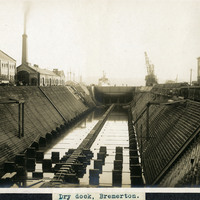
Caption: "Dry dock, Bremerton.," c. 1908-1912. View of a dry dock at the Puget Sound Naval Shipyard in Bremerton, Washington. Established in 1891 as a naval station, it became Naval Yard Puget Sound in 1901. During World War I the shipyard constructed hundreds of ships to support the war effort, while in World War II, the shipyard was dedicated primarily to repairing damaged ships. Today, it contains a portion of the U.S. Navy's mothball fleet (ships retired but retained in case of future need), as well as building, repairing, and maintaining sea-going vessels of all kinds.
Date: 1908
-
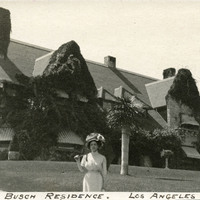
Caption: "Annheuser Busch Residence. Los Angeles," c. 1906. Unidentified woman standing in front of Tudor-style mansion, with several gables and chimneys covered in ivy. Built in 1898 in Pasadena and designed by Frederick Roehrig, the Ivy Wall (the mansion's nickname) was purchased by Adolphus Busch in 1905. Busch gradually bought up much of the surrounding property, and subsequently created the first Busch Gardens. After his death in 1913, his wife Lily continued to develop the gardens. Lily died in 1928. Over the next two decades, the gardens were gradually sold off to real estate developers. The Ivy Wall itself was torn down in 1952.
Date: 1906
-
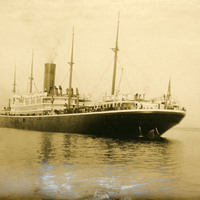
No Caption: c. 1909. View of the steamship Minnesota II, built in 1903. She was said to be the largest U.S. merchant ship afloat at the time. Operated by the Great Northern Steamship Company, she sailed between the U.S. and markets in Asia until 1915 when she was sold. In 1917 the Minnesota II began operating in the Atlantic between the U.S. and the United Kingdom. The U.S. Navy commissioned her as a troop ship in 1919, changing her name to Troy. She brought over 14,000 U.S. troops home from war-torn Europe. She never resumed active service after this, being scrapped in 1923.
Date: 1909
-
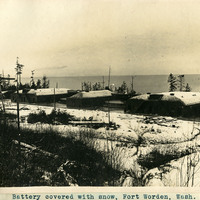
Caption: "Battery covered with snow, Fort Worden, Wash.," c. 1908-1912. Shows the three batteries at Fort Worden covered in a blanket of snow, with the ocean or Puget Sound in the distance. Construction began on the fort in 1898, and by 1902 it was serving as an active U.S. Army base. Fort Worden was part of the "triangle of fire," three coastal defense fortifications (Fort Casey, Fort Worden, and Fort Flagler) guarding the entrance to Puget Sound. The U.S. sold the property to the state of Washington in 1957. In 1973, the fort and surrounding area opened as Fort Worden State Park.
Date: 1908
-
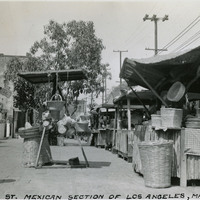
Caption: "Olvera St. Mexican Section of Los Angeles, May 18, 1934." View of the Olvera Street Market in Los Angeles. In 1926, Christine Sterling began efforts to preserve the buildings on and around Olvera Street (one of the oldest parts of Los Angeles). After several years of struggle and fundraising, Olvera Street was closed to automobile traffic in 1929, and opened as the Paseo de Los Angeles in 1930. The street and its market quickly became popular tourist sites, promoters touting the area as "A Mexican Street of Yesterday in a City of Today."
Date: 5/18/1934