
Search All Items
- Filters:
- Language
- English 5312
- Spanish 43
- ENGLISH 2
- English 1
- census_013 1
- Type
- Image 3851
- Still Image 1035
- Text 445
- Text 22
- Textual 2
Search Results 2411 to 2420 of 5424
-
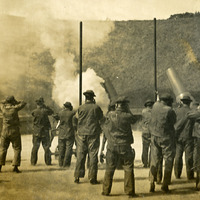
No caption, c. 1910. Large-caliber mortars with associated gun crews at target practice. At least one gun has just been, or is about to be, fired, given that the men are all holding their hands against their ears. See also 96-07-08-alb05-105 and 107.
Date: 1910
-
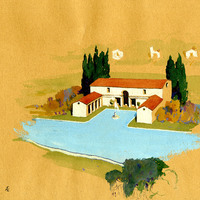
Design and drawing of California State Building for Nevada Highways Exposition in Reno, Nevada, by Alfred Eichler, c. 1926; from packet of designs and plans by Eichler for the Transcontinental Highways Exposition of 1927. Built. Initial appropriation of $100,000 was reduced to $50,000, so only one half of the plan was built. The tower was eliminated.
Date: 1925
-
Image withheld due to copyright considerations. For more information, please contact the California State Archives Reference Desk at ArchivesWeb@sos.ca.gov or (916) 653-2246. Caption: "San Francisco Oakland Bay Bridge, Nov. 12, 1936." View of the western, suspension span of the San Francisco-Oakland Bay Bridge at dusk.
Date: 11/12/1936
-
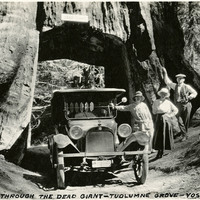
Caption: "Driveway Through the Dead Giant - Tuolumne Grove - Yosemite," c. 1917. Grace (next to automobile) and William (far right) McCarthy pose with their vehicle and an unidentified woman in the tunnel of "The Dead Giant," the remains of a giant sequoia in the Tuolumne Grove. The tunnel was cut into the trunk in 1878.
Date: 1917
-
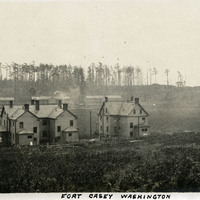
Caption: "Fort Casey Washington," c. 1909. Overview of several buildings at Fort Casey, located on Whidbey Island in Puget Sound. Construction began on the fort in 1897. Fort Casey was part of the "triangle of fire," three coastal defense fortifications (Fort Casey, Fort Worden, and Fort Flagler) guarding the entrance to Puget Sound. The area is now a state park.
Date: 1909
-
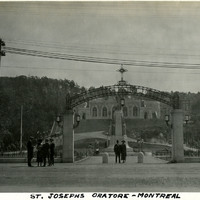
Caption: "St. Josephs Oratore [sic] - Montreal," c. 1925. William and Grace McCarthy beneath the entry arch to the complex containing St. Joseph's Oratory, a Roman Catholic basilica and shrine. Work on the building began in 1924, and continued until 1967. Only the first level of the building had been completed when this photograph was taken.
Date: 1925
-
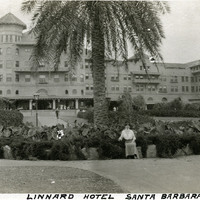
Caption: "Linnard Hotel Santa Barbara.," c. 1920. Grace McCarthy sitting in front of the Hotel Potter. Opened in 1903 by Milo M. Potter, the hotel sold in 1919 to the Santa Barbara Hotel Company, controlled by D.M. Linnard. The famous luxury resort burned down in 1921. See also 96-07-08-alb04-097.
Date: 1920
-
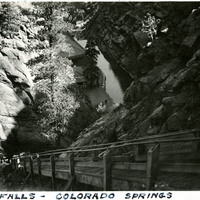
Caption: "Seven Falls - Colorado Springs," c. 1923. View from the top of a narrow wooden staircase, looking back down onto a resort building and a small creek. The stairs lead to a series of seven cascading waterfalls of South Cheyenne Creek. The area has been a privately-owned tourist attraction since the 1880s.
Date: 1923
-
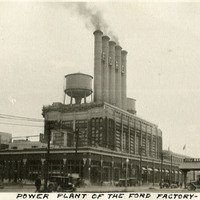
Caption: "Power Plant of the Ford Factory - Detroit," c. 1925. View of the power house at Ford's Highland Park Plant (considered to be the birthplace of the industrial assembly line). The plant's five smoke stacks have a "FORD" sign across them, flanked by two water towers.
Date: 1925
-
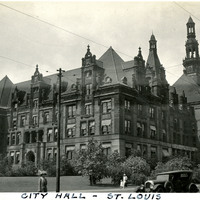
Caption: "City Hall - St. Louis," c. 1923. Grace McCarthy poses in front of the St. Louis City Hall, while a man mows the lawn and an adult and child stroll on the sidewalk. The French Renaissance Revival style building, designed by George Richard Mann, has been home to the city's governmental offices since 1898.
Date: 1923