Search All Items
- Filters:
- Language
- English 6853
- Spanish 18
- ENGLISH 3
- English 2
- census_013 1
- contra_costa_schedule_1_volume_1 1
- Type
- Image 3886
- Still Image 2484
- Text 441
- Text 54
- Textual 2
- Image of the California Census from the records of the office of the California Secretary of State 1
Search Results 2421 to 2430 of 6969
-
Caption: "Call Building," c. 1906. The remains of the Call building after the 1906 earthquake and fire. Completed in 1898 and designed by civic leader Claus Spreckels, the Call building on the corner of 3rd and Market streets was one of the first skyscrapers in San Francisco, built to house the San Francisco Call newspaper offices. While the structure withstood the 1906 earthquake, the interior caught fire and sustained considerable damage. After major renovations, the building is today known as The Central Tower.
Date: 1906
-
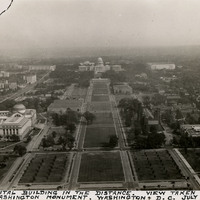
Caption: "U.S. Capitol Building in the distance. View Taken from the Washington Monument. Washington, D.C. July 27, 1934." Bird's eye view of a portion of the National Mall, between the Washington Monument and the U.S. Capitol Building.
Date: 7/27/1934
-
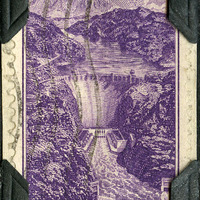
No Caption: A 1935 three-cent U.S. Postage stamp, featuring Boulder Dam, now known as Hoover Dam, which was constructed between 1931 and 1936. The concrete arch-gravity dam is located in the Black Canyon of the Colorado River on the border between Clark County, Nevada, and Mojave County, Arizona. A National Historic Landmark, the dam provides hydroelectric power, water storage, flood control, and recreation at Lake Mead, the reservoir created by the dam's construction.
Date: 1935
-
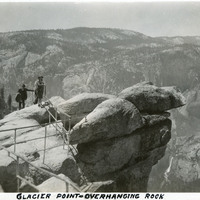
Caption: "Glacier Point - Overhanging Rock," c. 1935. Grace McCarthy poses for a photograph at Glacier Point's iconic overhanging rock. Glacier Point, on the south wall of the valley 3,200 feet above what is now known as Half Dome Village, provides panoramic views of the valley and many of its features. By the time this photograph was taken, safety railings had been installed at the Point to prevent visitors from tumbling over the cliff while trying to get the best views.
Date: 1935
-
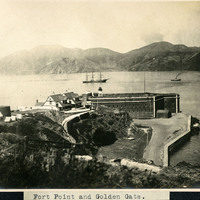
Caption: "Fort Point and Golden Gate," c. 1906. Fort Point in the foreground, with ships in the bay. Fort Point was part of an effort by the U.S. government to protect the Golden Gate, entrance to the San Francisco Bay. Built between 1853-1861 of brick and mortar, the fort included emplacements for 141 guns but never fired a weapon in defense of the Bay.
Date: 1906
-
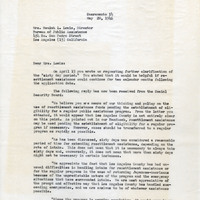
Correspondence from Charles M. Wollenberg (by Bertha S. Underhill) to Beulah L. Lewis regarding discussion of sixty-day limit on assistance
Date: May 20, 1946