
Search All Items
Search Results 2511 to 2520 of 6218
-
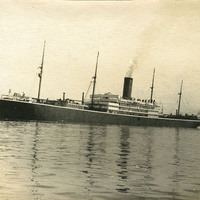
Caption: "Steamer Minnesota, Seattle.," c. 1909. View of the steamship Minnesota II, built in 1903. She was said to be the largest U.S. merchant ship afloat at the time. Operated by the Great Northern Steamship Company, she sailed between the U.S. and markets in Asia until 1915. She was sold at that time, and in 1917 began operating in the Atlantic between the U.S. and the United Kingdom. The U.S. Navy commissioned her as a troop ship in 1919, changing her name to Troy. She brought over 14,000 U.S. troops home from war-torn Europe. She never resumed active service after this, being scrapped in 1923. See also 96-07-08-alb08-166.
Date: 1909
-
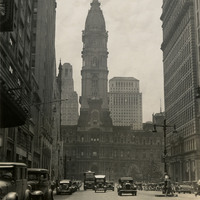
Caption: "City Hall, Broad St. Philadelphia, PA. July 31, 1934." Street scene along Broad Street in Philadelphia, with the City Hall building visible in the middle of the photograph. Philadelphia's City Hall was built in 1901, designed by architect John McArthur, Jr. At completion, the building was the world's tallest inhabitable structure. It is the largest municipal building in the world, with almost 700 rooms. A 37-foot-tall statute of William Penn (founder of Philadelphia) adorns the peak of the structure, created by Alexander Milne Calder.
Date: 7/31/1934
-
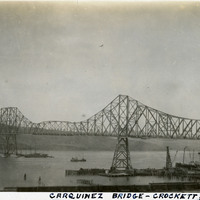
Caption: "Carquinez Bridge -- Crockett, Cal." This photograph shows the original Carquinez Bridge, built to span the Carquinez Strait and thereby contribute to a direct route between Sacramento and San Francisco. The steel cantilevered bridge, designed by Robinson & Steinman, was constructed in 1927. It is no longer extant, having been replaced by two parallel bridges constructed in 1958 and 2003. The structure of the original bridge was removed in 2007. See also 96-07-08-alb11-307 with caption: "Carquinez Bridge, Crockett, California. Oct. 9, 1934."
Date: 10/9/1934
-
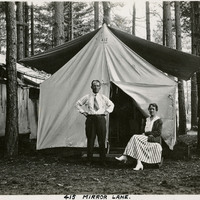
Caption: "Mirror Lane - Camp Curry," c. 1917. William and Grace McCarthy pose in front of their tent at what was then called Camp Curry. Yosemite's Half Dome Village, established by David and Jennie Curry in 1899, was originally called Camp Curry, and then later Curry Village. It was designed to provide cheaper accommodations for Yosemite tourists than the resort hotels. The couple rented out furnished tents and provided amenities such as a dining tent. As time progressed, the amenities increased, and some hard-sided cabins created.
Date: 1917
-
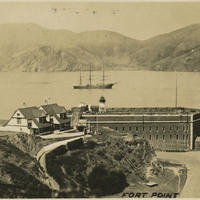
Caption: "Fort Point." c. 1906. See also 96-07-08-alb06-009 with caption: "Fort Point and Golden Gate," and 96-07-08-alb03-118, San Francisco. Fort Point in the foreground, with ships in the bay. Fort Point was part of an effort by the U.S. government to protect the Golden Gate, entrance to the San Francisco Bay. Built between 1853-1861 of brick and mortar, the fort included emplacements for 141 guns but never fired a weapon in defense of the Bay.
Date: 1906