Search All Items

Note: Check the about page for more information on the data sources used in this search

Search Results 2531 to 2540 of 6250

  • McCarthy Album 06, Photograph 161

    No Caption: A scene from the 1909 Portola Festival, a grand celebration devised to commemorate the discovery of San Francisco Bay by Gaspar De Portola, and for the public to celebrate the future of the rebuilt city after the 1906 earthquake and fires.

    Date: 1909

  • McCarthy Album 06, Photograph 188

    Caption: "A Typical Italian Refugee Camp," c. 1906. Makeshift hut with four unidentified men standing in doorway. After the earthquake and fire that destroyed much of San Francisco in April 1906, hundreds of thousands of people were left homeless. Many of these people established temporary refugee camps, using debris from the destruction to cobble together shelters.

    Date: 1906

  • McCarthy Album 11, Photograph 270

    Caption: "Chrysler and Travel & Transport Bldg. Chicago Fair. Sept. 16, 1934." View of two buildings at the Century of Progress Exposition in Chicago. The Chrysler Motors building dominates the photograph, while the Travel and Transport Building can be seen at the left. The latter building featured a catenary roof, the first one built in the US. The Exposition, a world fair attended by thirty-nine million people, celebrated Chicago's one-hundred year anniversary of incorporation. Originally planned to only run from May to November in 1933, it was such a success that its organizers decided to keep it running for a second season from May through October the following year. The central theme of the Exposition was technological innovation, with a motto of "Science Finds, Industry Applies, Man Conforms." None of the buildings constructed for the fair are still extant today, having been built as temporary facilities.

    Date: 9/16/1934

  • McCarthy Album 07, Photograph 201

    Caption: "Hasting [sic] Residence - Benicia," c. 1915, was a grand home built for Daniel N. Hastings, a prominent landowner. The home, completed in 1881 at the tremendous cost of $350,000, including furnishings, was called "Hastings' folly," because it nearly bankrupted its owner. It was dismantled in 1937.

    Date: 1915

  • McCarthy Album 05, Photograph 194

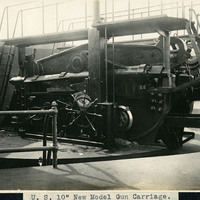
    Caption: "12" Disappearing Gun," c. 1915. Side view of a coastal defense gun. Retracting or disappearing guns were a form of artillery developed in the nineteenth century in which heavy artillery guns were placed on rotating carriages that allowed retraction of the weapon after firing, to enable reloading while under enemy fire.

    Date: 1915

  • McCarthy Album 05, Photograph 063

    Caption: "Stanford Chapel," c. 1912-1915. Façade of Stanford Memorial Chapel, designed by Charles A. Coolidge and dedicated in 1903. The church was commissioned by Jane Stanford as a memorial to her husband, Leland Stanford. See also 96-07-08-alb04-202 and 215.

    Date: 1915

  • McCarthy Album 04, Photograph 066

    Caption: "Bullion Bend Monument," c. 1920. William and Grace McCarthy standing in front of an automobile, near a stone monument. Bullion Bend, located between Pollock Pines and Whitehall in the historic Highway 50 corridor, was the scene of a stagecoach robbery in 1864 in which silver bullion was stolen by robbers claiming to need the money in order to support the Confederate Army.

    Date: 1920

  • McCarthy Album 09, Photograph 300

    Caption: "Nevada Falls [sic] - Yosemite," c. 1917. Nevada Fall is a 594-foot high waterfall upstream of Vernal Fall on the Merced River, in the Little Yosemite Valley. This photograph, taken at a point next to the fall's path of descent, shows the upper portion of the fall.

    Date: 1917

  • McCarthy Album 04, Photograph 116

    Caption: "Coronado Tent City," c. 1915-1916. Grace McCarthy and two unidentified people in an automobile near a row of small beach shacks with thatched roofs and striped fabric walls and doorways. The Coronado Hotel is visible in the background. Established in 1900 for travelers who could not afford to stay in the resort hotel, the Coronado Tent City consisted of a grid of streets lined with furnished tents, near the sea shore. It also featured restaurants, a library, soda fountain, theater, bandstand, and other recreational facilities.

    Date: 1915

  • McCarthy Album 11, Photograph 295

    Caption: "Church Butte [sic], near Green River, Wyoming. Oct. 2, 1934." The Church Buttes in Wyoming consist of sandstone eroded by wind and weather into a butte approximately 1,000 feet in diameter and rising up to 100 feet above the surrounding valley floor. Located along the Overland Route used by emigrants to the West Coast, the formation gained additional notoriety for being a camp site for Brigham Young and the first Mormon party to head west, as well as a relay site for the Pony Express.

    Date: 10/2/1934