
Search All Items
- Filters:
- Language
- English 6020
- Spanish 194
- ENGLISH 2
- English 1
- census_013 1
- Type
- Image 3854
- Still Image 1909
- Text 426
- Text 22
- Textual 2
Search Results 2571 to 2580 of 6281
-
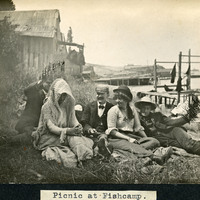
Caption: "Picnic at Fishcamp," c. 1908, shows William McCarthy (third from right) with unidentified people posing for a photograph at Fishcamp in Mariposa County.
Date: 1908
-
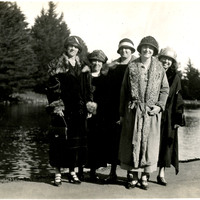
No caption: Grace McCarthy (far left) poses with four unidentified women in front of a small body of water, c. 1925.
Date: 1925
-
No caption, c. 1920. Group of unidentified people in swim suits posing on a river bank. William McCarthy is standing in the middle row, third from the left.
Date: 1920
-
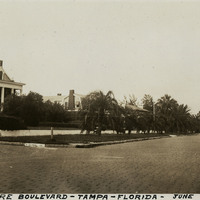
Caption: "Bay Shore [sic] Boulevard -- Tampa -- Florida -- June 27, 1934." Street scene along Bayshore Boulevard in Tampa, showing a cobbled street lined by large residences.
Date: 6/27/1934
-
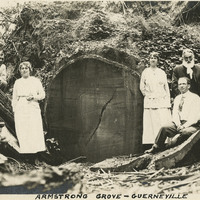
Caption: "Armstrong Grove - Guerneville," c. 1915, shows William (seated on right) and Grace McCarthy (standing beside him), posing next to a giant fallen tree with three unidentified people.
Date: 1915
-
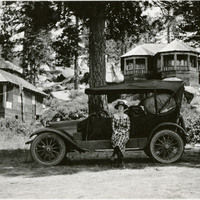
No caption, c. 1927. Grace McCarthy seated on the running board of an automobile parked at a resort in the Sierra Nevada Mountains, near the California-Nevada border.
Date: 1927
-
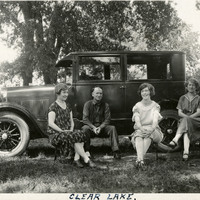
Caption: "Clear Lake.," c. 1920. William (second from left) and Grace (far right) McCarthy seated around an automobile in a picnic area or campground, with two unidentified women.
Date: 1920
-
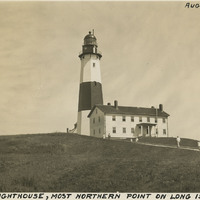
Caption: "Montauk Lighthouse, Most Northern Point on Long Island, N.Y., Aug. 18, 1934." The Montauk Lighthouse, first lit in 1797, was the first lighthouse built in New York. Ezra L'Hommedieu designed the building as well as choosing its site on the eastern edge of Long Island. A renovation in 1860 raised the lighthouse to its current height of more than 110 feet. A larger lantern was installed at that time as well. Electrified in 1940, it is now a National Historic Landmark as well as an active lighthouse.
Date: 8/18/1934
-
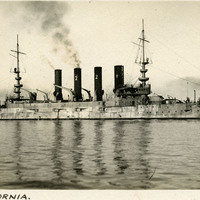
Caption: "U.S.S. California," c. 1906. This photograph shows the second U.S. Navy ship to bear the Golden State's name. Launched in 1904 and commissioned in 1907, this Pennsylvania-class armored cruiser served in the Pacific fleet. Her name was changed in 1914 to the USS San Diego, in order to free up the name for a new, Tennessee-class battleship. The USS San Diego went on to serve in both the Pacific and Atlantic fleets during World War I, until being sunk off the coast of New York by a German mine in 1918, with a loss of six lives.
Date: 1906
-
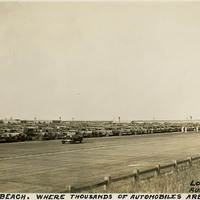
Caption: "Jones's [sic] Beach. Where Thousands of Automobiles are Parked. Long Island, N.Y. Aug. 17, 1934." Photograph of a large parking area full of automobiles on Jones Beach Island. The Long Island State Park Commission began to develop the area for a park in the 1920s, dredging enough sand to connect several of the barrier islands south of Long Island and raising the elevation of the islands by fourteen feet to create one large park. It opened to the public in 1929. It is now a state park, with an estimated six million visitors each year.
Date: 8/17/1934