
Search All Items
- Filters:
- Language
- English 6020
- Spanish 194
- ENGLISH 2
- English 1
- census_013 1
- Type
- Image 3854
- Still Image 1909
- Text 426
- Text 22
- Textual 2
Search Results 2601 to 2610 of 6281
-
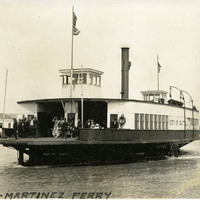
Caption: "Benicia-Martinez Ferry," c. 1913. View of the City of Seattle, a steam-powered ferry built in 1888. Purchased in 1913 by the Martinez and Benicia Ferry and Transportation Company, the City of Seattle served as a ferry between Benicia and Martinez until being requisitioned by the U.S. Navy in 1944.
Date: 1913
-
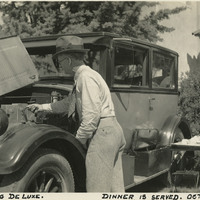
Caption: "Touring De Luxe. Dinner is Served. Oct. 10, 1934." William McCarthy is cooking a meal in metal boxes on the engine of his Studebaker sedan, while Grace McCarthy is seated to the right at a small folding table awaiting dinner.
Date: 10/10/1934
-
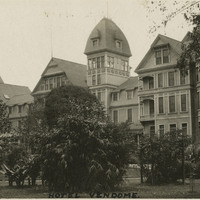
Caption: "Hotel Vendome," c. 1910, was a luxury hotel in San Jose that opened in 1889. It was purchased by a real estate syndicate in 1930 and subsequently demolished in order to subdivide the property into lots for residential housing. See also 96-07-08-alb03-100 and 96-07-08-alb05-115.
Date: 1910
-
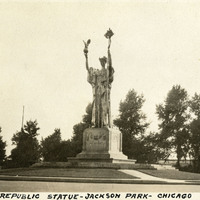
Caption: "Republic Statue - Jackson Park - Chicago," c. 1923. Designed by Chester French (sculptor), this version of the Statue of the Republic has stood in Chicago's Jackson Park since its construction in 1918. It is a one-third replica of a statue at the World's Columbian Exposition, held at Chicago in 1893.
Date: 1923
-
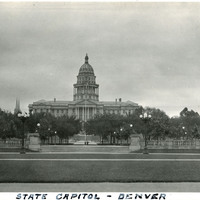
Caption: "State Capitol - Denver," c. 1923. The Colorado State Capitol in Denver is a Neoclassical building built from Colorado rose onyx, a stone so rare that all known reserves were used in the capitol's construction. Designed by Elijah E. Myers, it was first occupied in 1894.
Date: 1923
-
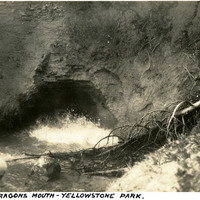
Caption: "Dragons Mouth - Yellowstone Park," c. 1923. This hot spring originates deep underground. Rising gas and steam create pressure bubbles within the mud of the cavern. When they burst against the cave roof, they emit a growling, booming sound. Steam also drifts from the cavern entrance, creating the illusion of smoke from a dragon's mouth.
Date: 1923
-
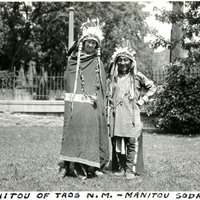
Caption: "Chief Manitou of Taos N. M. - Manitou Soda Springs," c. 1923. Grace McCarthy, wearing a Native American headdress and beaded blanket, stands next to a smiling Pedro Cajete in traditional dress. Mr. Cajete, better known to many as Chief Manitou, was a Native American of the Tewa tribe near Santa Fe, New Mexico, who was hired to promote tourism in the Manitou Springs/Colorado Springs area of Colorado. He often sold trinkets and posed for photographs with tourists near the mouth of Manitou Cave, resulting in his moniker Chief Manitou.
Date: 1923
-
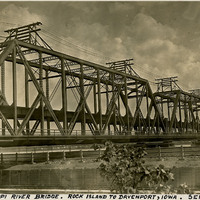
Caption: "Mississippi River Bridge. Rock Island to Davenport, Iowa. Sept. 25, 1934." View of the Government Bridge spanning the Mississippi River between Rock Island and Davenport, Iowa. Built in 1896 and designed by Ralph Modjeski, the bridge in this photograph was the fourth bridge constructed at the site, replacing earlier structures made obsolete by the increasing volume and changing character of traffic. This double-decker bridge connected the U.S. arsenal on Rock Island with Davenport, Iowa, and featured a double rail road track, a separate deck for automobiles, and a swing section. The bridge is still in use today.
Date: 9/25/1934
-
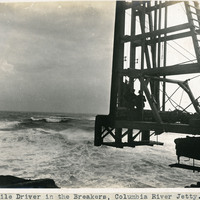
Caption: "Pile Driver in the Breakers, Columbia River Jetty.," c. 1910. View of a large pile driver used in the construction of the jetty system at the mouth of the Columbia River. This is likely at the end of the so-called South Jetty, extending more than six miles into the ocean from Point Adams on the Oregon side of the river mouth. The jetty system at the mouth of the Columbia River was constructed between 1885 and 1917. Designed to funnel water from the Columbia River in a more concentrated fashion into the Pacific Ocean, the jetty system helped create a deeper, more stable shipping channel.
Date: 1910
-
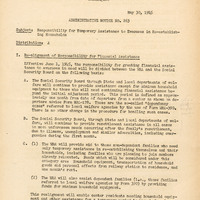
Summary by D. S. Myer of considerations for resettlement; Sections; Realignment of Responsibility for Financial Assistance, General Considerations, Determination of Eligibility and Amount of Grants, Approval or Disapproval of Applications, Payment of Grants, Assistance to Dependent Families, Services from Local Public Agencies
Date: May 30, 1945