
Search All Items
- Filters:
- Language
- English 6020
- Spanish 194
- ENGLISH 2
- English 1
- census_013 1
- Type
- Image 3854
- Still Image 1909
- Text 426
- Text 22
- Textual 2
Search Results 2611 to 2620 of 6281
-
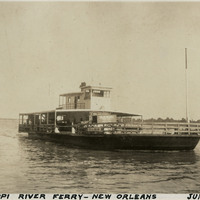
Caption: "Mississippi River Ferry -- New Orleans, June 14, 34." A ferry owned by the Bisso family carrying automobiles and their owners across the Mississippi River near New Orleans. Ferries were extremely important to commerce and other activities along the Mississippi River before the construction of bridges capable of carrying automobile traffic.
Date: 6/14/1934
-
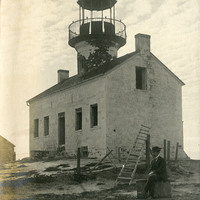
No Caption: View of the dilapidated Old Point Loma Lighthouse. An unidentified man sits in front of it. Lighted for the first time in 1855, this lighthouse sat on a high cliff above Point Loma near San Diego. Unfortunately, its high elevation resulted in fog or low-lying clouds often obscuring the light. The lighthouse was replaced by a new facility (Point Loma Light -- see 96-07-08-alb08-211 and 226) in 1891. The old lighthouse deteriorated over the years, until being restored in the early 1930s. It is now a museum.
Date: 1905
-
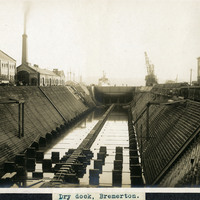
Caption: "Dry dock, Bremerton.," c. 1908-1912. View of a dry dock at the Puget Sound Naval Shipyard in Bremerton, Washington. Established in 1891 as a naval station, it became Naval Yard Puget Sound in 1901. During World War I the shipyard constructed hundreds of ships to support the war effort, while in World War II, the shipyard was dedicated primarily to repairing damaged ships. Today, it contains a portion of the U.S. Navy's mothball fleet (ships retired but retained in case of future need), as well as building, repairing, and maintaining sea-going vessels of all kinds.
Date: 1908
-
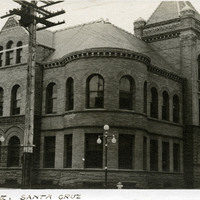
Caption: "Court House, Santa Cruz," c. 1912-1915. Image of the courthouse building constructed in Santa Cruz in 1896. The building was periodically renovated, the most extensive occurring after the 1906 earthquake, when much of the courthouse had to be rebuilt. In 1967, the county removed its court facilities to a new building. The old courthouse was subsequently remodeled, opening in 1972 as an office and retail building. Heavy damages sustained in 1989 as a result of the Loma Prieta earthquake necessitated the building's demolition. Please note that this photograph appears to be reversed, as this is a mirror image of the structure.
Date: 1915
-
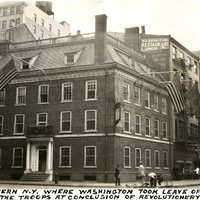
Caption: "Frances [sic] Tavern N.Y. Where Washington Took Leave Of Offices And Disbanded The Troops At Conclusion Of Revolutionery [sic] War." Built as a family home for Etienne "Stephen" DeLancey in 1719, this building was converted to use as a tavern in 1762. It served many important functions before, during, and after the Revolutionary War, but several fires in the nineteenth century erased the building's original appearance. The Sons of the Revolution purchased the property in 1904 and embarked upon extensive restoration plans in 1907, supervised by William Mersereau. The building is now used as a museum and art gallery. See also 96-07-08-alb11-203.
Date: 8/5/1934
-
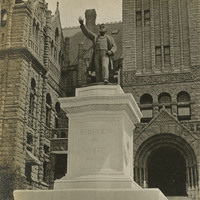
No Caption: c. 1915, shows a monument with a statue of Stephen M. White on the grounds of the Los Angeles County Courthouse. Stephen M. White, a former Los Angeles district attorney, served in the California Senate, as well as acting Lieutenant Governor from 1887-1891. He also served in the United States Senate from 1893 -1899. White was also responsible for the creation of Los Angeles Harbor in San Pedro. The monument was moved in 1989 to the entrance of Cabrillo Beach near the harbor where it resides today.
Date: 1915
-
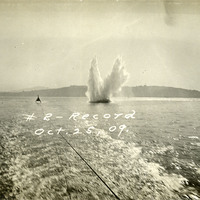
Caption: "#2 -- Record Oct 25, 09." This postcard shows plume of seawater thrown up by a mortar shell during target practice at Fort Point. The facilities at Fort Point were part of an effort by the U.S. government to protect the Golden Gate, entrance to the San Francisco Bay. Built between 1853-1861, the fort included emplacements for 141 guns but never fired a weapon in defense of the Bay. Its name was officially changed in 1882 to Fort Winfield Scott. This only lasted four years, however, for in 1886 the fort was officially downgraded to a sub-post of the San Francisco Presidio and the name discontinued. It was resurrected in 1912, however, with the establishment of a coastal artillery fortification at the Presidio, called, once again, Fort Winfield Scott.
Date: 1909-10-25
-
A series of short notations about hospital patients under the supervision of Dr. Reid. Volumes one through four in this series run chronologically, starting in 1852 and ending in 1856. The entries include details such as patient name, nationality, and age, as well as mental disposition. A researcher with an interest in a particular hospital patient may find Reidà¿s journals useful. Dr. Robert K. Reid's medical journals do not include private thoughts about the medical profession or details about Reid's role as a physician at Stockton State Hospital. The fifth volume in the series contains Dr. Reid's Meteorological Observations. Beginning in 1850, Reid recorded daily meteorological observations, including three daily temperature recordings, taken at 8 a.m., 2 p.m., and 8 p.m.. He also recorded cloud, wind, and rain observations, and in 1853, began recording daily barometric pressures. Dr. Robert K. Reid's Meteorological Observations journal continues through 1856.
Date: 1850-1856
-
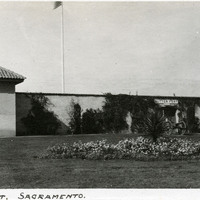
Caption: "Sutter [sic] Fort. Sacramento.," c. 1920. A gun tower at Sutter's Fort, and a gate bracketed by two cannons. John Sutter established the fort in 1839, calling it New Helvetia. After the discovery of gold at one of Sutter's mills (at Coloma, on the American River), almost all of the fort's inhabitants left for the gold fields in the foothills. The fort deteriorated until being restored from 1891-1893. The fort is now the site of a State Historic Park. See also 96-07-08-alb05-118.
Date: 1920
-
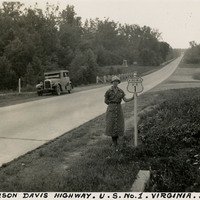
Caption: "Jefferson Davis Highway. U.S. No. 1. Virginia. July 20, 34." Grace McCarthy is standing next to a U.S. Route 1 sign along a highway in Virginia. The Jefferson Davis Highway project was begun by the United Daughters of the Confederacy (UDC). As auto tourism increased across the U.S., so to did the need for roads on which to drive. Private interests such as the UDC began to develop routes across the country, but with no central administrating organization the routes were haphazard and confusing. The UDC planned a route that was to stretch from Virginia across the southern U.S. to San Diego, but the entire route never materialized. The federal government stepped in to impose a numbering system on various routes across the nation. That portion of the planned Jefferson Davis Highway through Virginia was numbered as U.S. Route 1.
Date: 7/20/1934