
Search All Items
- Filters:
- Language
- English 6020
- Spanish 194
- ENGLISH 2
- English 1
- census_013 1
- Type
- Image 3854
- Still Image 1909
- Text 426
- Text 22
- Textual 2
Search Results 2631 to 2640 of 6281
-
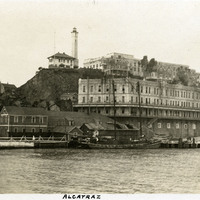
Caption: "Alcatraz," c. 1920. Image of lighthouse, main prison building (at top of hill), residences, and wharf facilities at Alcatraz Island prior to its designation as a federal penitentiary in 1934. Built in 1859 by the U.S. Army for coastal defense purposes, the fort at Alcatraz began serving as a prison in 1861. It ceased function as a defense fortification and became the Pacific Branch of the U.S. Military Prison in 1907. Over the next two decades the facilities on the island were modified and modernized.
Date: 1920
-
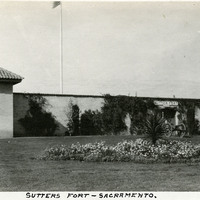
Caption: "Sutters [sic] Fort - Sacramento," c. 1920, shows a gun tower at Sutter's Fort, and a gate bracketed by two cannons. John Sutter established the fort in 1839, calling it New Helvetia. After the discovery of gold at one of Sutter's mills (at Coloma, on the American River), almost all of the fort's inhabitants left for the gold fields in the foothills. The fort deteriorated until being restored from 1891-1893. The Native Sons of the Golden West were influential in the restoration. The fort is now the site of a State Historic Park. See also 96-07-08-alb05-117 and 118.
Date: 1920
-
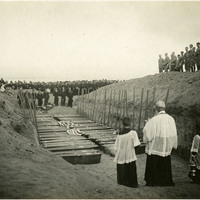
No Caption: See also 96-07-08-alb08-217 with caption: "Last Rites," shows a grave site with dozens of caskets ready for burial. A priest and two altar boys stand at one side of the caskets, while a large group of US Navy sailors looks on from the other side. While sailing from port in San Diego on the morning of July 21, 1905, the boiler of the USS Bennington exploded, killing sixty-six of her crew. The victims were laid to rest in the cemetery at Fort Rosecrans.
Date: 1905
-
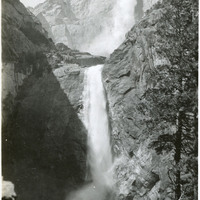
Caption: "Yosemite Falls," c. 1917. Both Upper and Lower Yosemite Falls can be seen in this photograph, taken at a location near the base of Lower Yosemite Fall. The highest waterfall in Yosemite National Park, it is made up of two successive cascades falling a total of 2,425 feet from the top of the Upper Fall to the base of the Lower Fall. The Upper Fall alone is 1,430 feet high, and is one of the top twenty highest waterfalls in the world.
Date: 1917
-
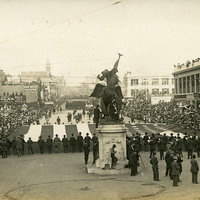
No Caption: A view of the large crowds surrounding an enormous United States flag and the Spanish-American War Memorial (Douglas Tildon, sculptor) at the Portola Festival of 1909. The Portola Festival was a grand celebration devised to commemorate the discovery of San Francisco Bay by Gaspar De Portola, and for the public to celebrate the future of the rebuilt city after the 1906 earthquake and fires.
Date: 1909
-
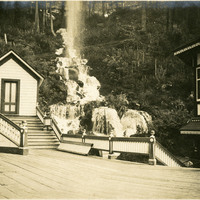
No Caption: See also 96-07-08-alb03-070 with caption: "Shasta Springs." Waterfall, hillside, and buildings at Shasta Springs, c. 1910. Shasta Springs, just north of Dunsmuir, California, in the Trinity Mountains, was a resort area in the late nineteenth and early twentieth centuries. It centered around natural springs, which became a featured stop on the Southern Pacific Railroad's Shasta Route. The resort operated until the 1950s, when it was purchased by private interests.
Date: 1910
-
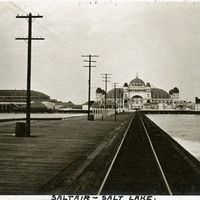
Caption: "Saltair -- Salt Lake." View of the first Saltair resort pavilion and surrounding buildings. Constructed in 1893 and designed by Richard K.A. Kletting, the pavilion hovered above the Great Salt Lake on more than 2,000 posts and pilings. The resort was a popular spot for Mormon families, only fifteen miles from Salt Lake City and overseen by Church leaders. The Church sold the building in 1906. It was later destroyed by fire in 1925, but a second pavilion was quickly built.
Date: 1916
-
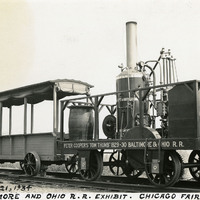
Caption: "Sept. 21, 1934, Baltimore and Ohio R.R. Exhibit. Chicago Fair." Shows a replica of the Tom Thumb, an early steam locomotive built by Peter Cooper in 1830 for the Baltimore and Ohio Railroad. This replica was displayed at the Century of Progress Exposition in Chicago, a world's fair celebrating the city's one-hundred year anniversary of incorporation. This photograph was loose in the box with Album 11.
Date: 9/21/1934
-
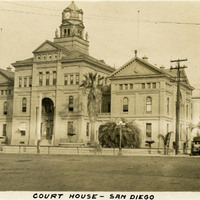
Caption: "Court House -- San Diego," c. 1910. View of the second courthouse built by San Diego County, completed in 1889. Designed by architectural firm Cornstock & Trotsche of San Francisco, this elaborate building featured a bell and clock tower, statues of four presidents, and 42 stained-glass windows honoring each state in the Union at the time of installation. The tower was removed in 1939. Twenty years later, the entire building was demolished in favor of a newer facility.
Date: 1910
-
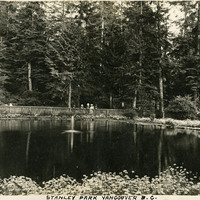
Caption: "Stanley Park Vancouver B.C.," c. 1908-1912. Shows a pond with central fountain, surrounded by lush vegetation including evergreen trees. A group of people stands at the pond's edge in the distance. The City of Vancouver opened Stanley Park in 1888. The 405-hectare park is even now thickly forested, and remains Vancouver's largest park. It is located on the northern edge of the city, surrounded on three sides by Vancouver Harbor and English Bay.
Date: 1908