Search All Items
- Filters:
- Language
- English 6020
- Spanish 194
- ENGLISH 2
- English 1
- census_013 1
- Type
- Image 3854
- Still Image 1909
- Text 426
- Text 22
- Textual 2
Search Results 2651 to 2660 of 6281
-
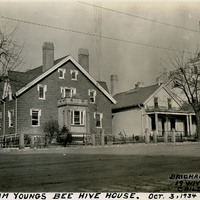
Caption: "Brigham Youngs [sic] Bee Hive House. Brigham Young had 19 Wives and 52 Children. Oct. 3, 1934." Street scene in Salt Lake City, Utah. Brigham Young, founder of the Church of Jesus Christ of Latter Day Saints built the so-called "Beehive House" in 1854 to house himself and several of his wives (Young practiced polygamy). The Beehive House is visible in the photograph at the far right, with a widow's walk featured on its roofline. Designed by Salt Lake Temple architect Truman O. Angell, the Beehive House has since been used as a residence for several dignitaries of the Mormon Church, as well as a boarding home for young Mormon women. The house was restored in the late 1950s and is now a museum. See also 96-07-08-alb11-301.
Date: 10/3/1934
-
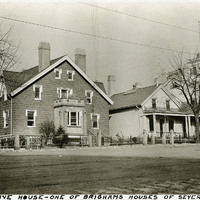
Caption: "The Bee Hive House -- One of Brighams Houses of Several Wives." Street scene in Salt Lake City, Utah. Brigham Young, founder of the Church of Jesus Christ of Latter Day Saints (the followers of which are known as Mormons) built the so-called "Beehive House" in 1854 to house himself and several of his wives (Young practiced polygamy). The Beehive House is visible in the photograph at the far right, with a widow's walk featured on its roofline. Designed by Salt Lake Temple architect Truman O. Angell, the Beehive House has since been used as a residence for several dignitaries of the Mormon Church, as well as a boarding home for young Mormon women. The house was restored in the late 1950s and now operates as a museum. See also 96-07-08-alb11-301.
Date: 1934-10-03
-
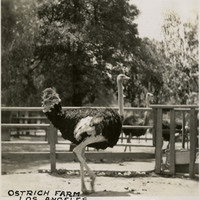
Caption: "Ostrich Farm, Los Angeles," c. 1935. View of several ostriches in a corral at the Cawston Ostrich Farm in Pasadena. Opened by Edward Cawston in 1886, this was the first ostrich farm in the U.S. It became a popular tourist stop along the Pasadena and Los Angeles Electric Railway in the early twentieth century, where visitors could ride an ostrich, or be pulled by one in a light card. They could also buy merchandise made out of ostrich feathers, such as hats and boas. The farm closed in the mid-1930s.
Date: 1935
-
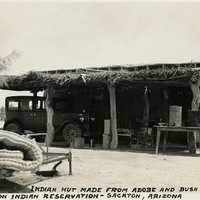
Caption: "Indian Hut Made from Adobe and Bush Branches, Sacaton Indian Reservation - Sacaton, Arizona," c. 1935. View of a small adobe building with a porch area across the length of the façade. The porch is sheltered by a low roof supported by tree trunks or thick tree branches and thatched with grass or sticks. Located south of Phoenix and including the town of Sacaton, the Gila River Indian Reservation is home to members of the Akimel O’odham (Pima) and the Pee-Posh (Maricopa) tribes. The reservation was established in 1859. Eighty years later, in 1939, Congress provided for the self-governance of the reservation via the Gila River Indian Community.
Date: 1935
-
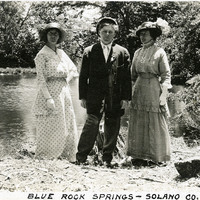
Caption: "Blue Rock Springs -- Solano Co.," c. 1915. Grace McCarthy (far left) and two unidentified friends or relatives at what is now known as Blue Rock Springs. In the 1860s, White Sulphur Springs (in the vicinity of Vallejo) was developed for use as a mineral springs resort, featuring a hotel, several cottages, and an "amusement" building with a dance floor, bar, and billiard room. Manuel Madrid obtained the property around the turn of the twentieth century, and changed the name to Blue Rock Springs. The area is now managed by the Greater Vallejo Recreation District as Blue Rock Springs Park.
Date: 1915
-
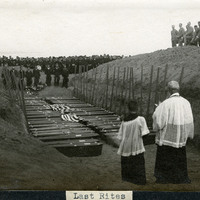
Caption: "Last Rites." Shows a grave site with dozens of caskets ready for burial. A priest and two altar boys stand at one side of the caskets, while a large group of U.S. Navy sailors looks on from the other side. While sailing from port in San Diego on the morning of July 21, 1905, the boiler of the USS Bennington exploded, killing sixty-six of her crew. The victims were laid to rest in the cemetery at Fort Rosecrans. See also 96-07-08-alb05-142 and 96-07-08-alb08-222.
Date: 1905-07-23
-
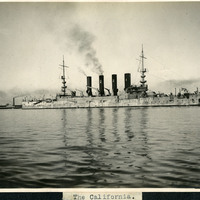
Caption: "The California," c. 1906. This photograph shows the second U.S. Navy ship to bear the Golden State's name. Launched in 1904 and commissioned in 1907, this Pennsylvania-class armored cruiser served in the Pacific fleet. Her name was changed in 1914 to the USS San Diego, in order to free up the name for a new, Tennessee-class battleship. The USS San Diego went on to serve in both the Pacific and Atlantic fleets during World War I, until being sunk off the coast of New York by a German mine in 1918, with a loss of six lives. See also 96-07-08-alb05-009.
Date: 1906
-
Caption: "San Francisco Fire April 8 [sic], 1906." Photograph of a page from the Seattle Daily Times. The headline reads "Photographic Glimpses of the Once Proud City." Several photographs of significant buildings in San Francisco are shown (such as the City Hall), all of which are listed as having been destroyed by the earthquake and fire of April 6th.
Date: 1906
-
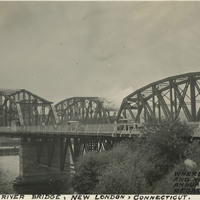
Caption: "Thames River Bridge, New London, Connecticut. Where Harvard and Yale Hold their Annual Rowing Regatta, Sept. 4, 1934." View of two bridges over the Thames River near New London, Connecticut. The drawbridge in the foreground was originally a railroad bridge, built in the late nineteenth century. Later, as automobiles grew in popularity, this bridge was converted to use by vehicles (cars can be seen driving over it in this photograph), and a second bridge was constructed for railroad use (a locomotive can be seen behind the two cars). Neither of these bridges survives today, having been replaced by the Gold Star Memorial Bridge.
Date: 9/4/1934
-
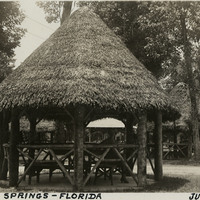
Caption: "Silver Springs -- Florida, June 24, 1934." Grace McCarthy seated in a gazebo with a conical roof sheathed in grass or brush. Silver Springs, a series of artesian springs in Marion County, was Florida's first tourist attraction. The area began to attract visitors after the Civil War, in the late 1860s. In the late 1870s, entrepreneurs started offering glass-bottom boat tours of the springs. The locale became popular in the 1930s with film producers: several of the original Tarzan movies were filmed here, as was the Creature from the Black Lagoon (1954).
Date: 6/24/1934