Search All Items
- Filters:
- Language
- English 6853
- Spanish 18
- ENGLISH 3
- English 2
- census_013 1
- contra_costa_schedule_1_volume_1 1
- Type
- Image 3886
- Still Image 2484
- Text 441
- Text 54
- Textual 2
- Image of the California Census from the records of the office of the California Secretary of State 1
Search Results 2661 to 2670 of 6969
-
Caption: "Portola. King & Queen." Actors portraying explorer Gaspar de Portolà and Queen Vergilia in a parade, part of the San Francisco Portola Festival held October 19-23, 1909. The festival celebrated Portolà as the discoverer of San Francisco Bay. It was held annually until 1913. See also 96-07-08-alb06-162.
Date: 1909-10
-
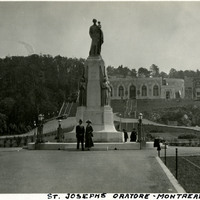
Caption: "St. Josephs Oratore [sic] - Montreal," c. 1925. William and Grace McCarthy pose in front of a bronze statue of St. Joseph placed at the base of the hill upon which St. Joseph's Oratory is under construction. The statue, created by Alfred Laliberté, was erected in 1923.
Date: 1925
-
Caption: "Empire State Building in Center, Lower Manhattan in the Distance. View from Radio City Bldg. New York. Aug. 3, 1934." The Empire State Building dominates this bird's eye view of New York. Construction began on this iconic 102-story building, designed by William F. Lamb, in 1930. Completed by early 1931, it held the title of world's tallest building for almost 40 years, until being surpassed in 1970 by the construction of the World Trade Center's North Tower. It is now the fifth-tallest building in the U.S., and the 28th-tallest in the world.
Date: 8/3/1934
-
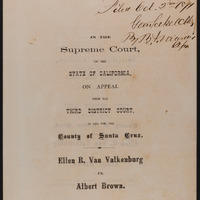
A Brief of Respondent is filed in the appellate court by the party who won in the previous trial and defends the lower court’s original decision. Ellen Van Valkenburg began an important legal battle for women’s enfranchisement in California on July 21, 1871, when she requested that Santa Cruz County Clerk Albert Brown enter her name in the Great Register of voters. After Brown (a willing accomplice in helping her bring the case to court) refused to register her, Van Valkenburg and her lawyer, Santa Cruz Judge Albert Hagan, began legal proceedings by requesting a writ of mandamus, a judicial remedy used to compel agencies to perform ministerial acts, such as registering voters. Van Valkenburg and Hagan argued her case by citing the 14th Amendment of the U.S. Constitution. The new amendment, ratified 3 years earlier in 1868, defined all persons born or naturalized in the U.S. as citizens protected by civil rights. Van Valkenburg and Hagan asserted that American women were considered citizens under this amendment, and that citizenship automatically granted absolute rights, including the right to vote. The case first went to California’s Third District Court. Many of America’s most prominent suffragists, including Elizabeth Cady Stanton and Susan B. Anthony, were with Van Valkenburg in Santa Cruz when the lower court ruled against her on August 16, 1871. Van Valkenburg and Hagan swiftly appealed this decision through the Supreme Court of California. In the end, the Supreme Court of California upheld the lower court’s verdict under the reasoning that as a white American woman, Van Valkenburg already had citizenship and civil rights prior to the passage of the 14th amendment, and that the 14th amendment did not provide her with any additional political rights, such as the right to vote. While Van Valkenburg lost her case, and subsequent lawsuits failed to secure women's suffrage nationwide, the case stands as a critical early example of legal advocacy for women's political rights in California.
Date: October 2, 1871
-
Correspondence from Charles M. Wollenberg (by Ruth E. Rogers) to Beulah L. Lewis regarding resettlement aid
Date: September 10, 1946
-
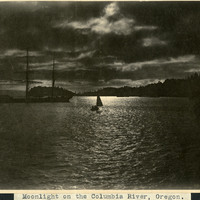
Caption: "Moonlight on the Columbia River, Oregon.," c. 1905. Photograph of the Columbia River at night. A cloudy sky nearly obscures the moon, but allows enough light to see a three-masted schooner and a small sailboat on the river.
Date: 1905
-
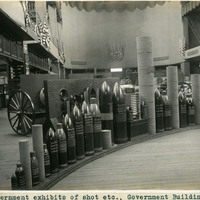
Caption: "Government exhibits of shot etc., Government Building." Exhibit of various types of heavy ordnance shells, including armor piercing shells as well as torpedoes. The exhibit was located in the Government Building of the Lewis and Clark Centennial Exposition, held in Portland, Oregon from June 1st to October 15th, 1905. It celebrated the one-hundred year anniversary of the exploratory expedition of the Louisiana Purchase and what became the northwestern part of the United States, led by Meriwether Lewis and William Clark. Some 1.6 million people visited the fair, viewing exhibits from twenty-one countries. See also 96-07-08-alb05-206.
Date: 1905
-
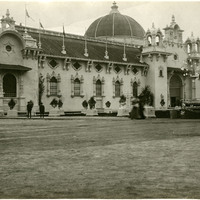
No Caption: See also 96-07-08-alb08-156 with caption: "Agricultural Building, Portland Fair, 1905." View of the Agriculture and Horticulture Building at the Lewis and Clark Centennial Exposition. The exposition was held in Portland, Oregon from June 1st to October 15th, 1905. It celebrated the one-hundred year anniversary of the exploratory expedition of the Louisiana Purchase and what became the northwestern part of the United States, led by Meriwether Lewis and William Clark. Some 1.6 million people visited the fair, viewing exhibits from twenty-one countries.
Date: 1905
-
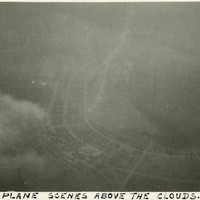
Caption: "Aeroplane [sic] Scenes Above the Clouds.," c. 1915-1920. Photograph taken in an unidentified location, from what appears to have been a biplane (given the small portion of wing that is visible on the left side of the photograph). The locale is unknown.
Date: 1915