Search All Items
- Filters:
- Language
- English 6020
- Spanish 194
- ENGLISH 2
- English 1
- census_013 1
- Type
- Image 3854
- Still Image 1909
- Text 426
- Text 22
- Textual 2
Search Results 2741 to 2750 of 6281
-
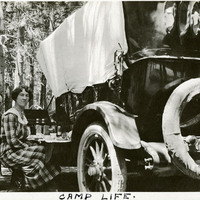
Caption: "Camp Life.," c. 1915-1920. William and Grace McCarthy seated next to automobile at an unidentified campground for a meal. See also 96-07-08-alb04-175, 179, 180, 181, and 182.
Date: 1920
-
Caption: "Night Scene - San Diego Exposition," 1935, a night scene at San Diego's California-Pacific International Exposition shows the Arch of the Future with its multi-colored lights built within the Plaza del Pacifico.
Date: 1935
-
No caption, c. 1915. William and Grace McCarthy posing together in a garden. See also 96-07-08-alb04-250, and 96-07-08-alb05-090, 091, 092, and 096.
Date: 1915
-
Caption: "Railroad and Vehicular Traffic Section of Cleveland, Ohio, Sept. 12, 1934." Bird's eye view of an industrial section of Cleveland, showing rail yard facilities and a busy highway.
Date: 9/12/1934
-
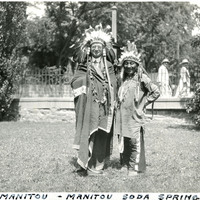
Caption: "Chief Manitou - Manitou Soda Springs," c. 1923. William McCarthy, wearing a Native American headdress and attire, stands next to Pedro Cajete. Mr. Cajete, better known to many as Chief Manitou, was a Native American of the Tewa tribe near Santa Fe, New Mexico, who was hired to promote tourism in the Manitou Springs/Colorado Springs area of Colorado. He often sold trinkets and posed for photographs with tourists near the mouth of Manitou Cave, resulting in his moniker Chief Manitou.
Date: 1923
-
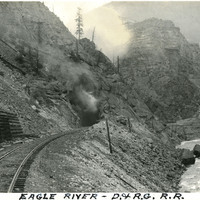
Caption: "Eagle River - D. & R. G. R. R," c. 1923. Denver and Rio Grande Western Railroad tracks run next to the Eagle River at the bottom of a canyon in this photograph, toward a tunnel with steam or smoke coming out of the entry. The Denver and Rio Grande (D&RG) primarily operated railroad lines between Denver, Colorado and Salt Lake City, Utah, with other lines stretching into New Mexico.
Date: 1923
-
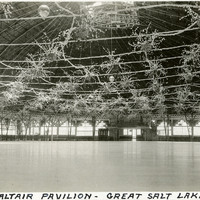
Caption: "Saltair Pavilion - Great Salt Lake," c.1923. Interior of the Saltair Pavilion on Utah's Great Salt Lake. Constructed in 1893 and designed by Richard K.A. Kletting, the Saltair resort set out to be the Western counterpart of Coney Island. The resort was a popular spot for Mormon families, only fifteen miles from Salt Lake City and overseen by Church leaders. The Church sold the building in 1906. It was later destroyed by fire in 1925, but a second pavilion was quickly built.
Date: 1923
-
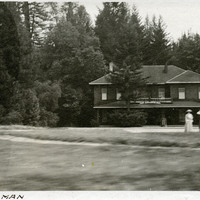
Caption: "Camp Herman," c. 1912-1915. View of the Zayante Inn at Mount Herman. Originally the site of Hotel Tuxedo, in 1906 a group later known as the Mount Herman Association, Inc. purchased the building and surrounding property, and renamed it the Zayante Inn. The inn became a Christian retreat center. Although this building was destroyed by fire in 1921, the retreat center was rebuilt as the Mount Herman Christian Conference Center, still operating today.
Date: 1915
-
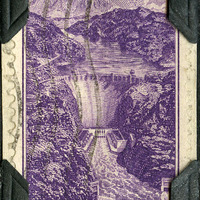
No Caption: A 1935 three-cent U.S. Postage stamp, featuring Boulder Dam, now known as Hoover Dam, which was constructed between 1931 and 1936. The concrete arch-gravity dam is located in the Black Canyon of the Colorado River on the border between Clark County, Nevada, and Mojave County, Arizona. A National Historic Landmark, the dam provides hydroelectric power, water storage, flood control, and recreation at Lake Mead, the reservoir created by the dam's construction.
Date: 1935
-
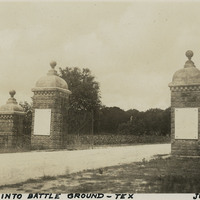
Caption: "San Jacinto Battle Ground -- Tex, June 11 34." View of the gated entry to the San Jacinto Battleground. The site was the location of the Battle of San Jacinto, in which the Texan Army (led by Sam Houston) defeated the Mexican army (led by General Antonio López de Santa Anna), paving the way for the formation of the Republic of Texas. A Texas Historic Site, the battleground was also declared a National Historic Landmark in 1960.
Date: 6/11/1934