Search All Items
- Filters:
- Language
- English 6020
- Spanish 194
- ENGLISH 2
- English 1
- census_013 1
- Type
- Image 3854
- Still Image 1909
- Text 426
- Text 22
- Textual 2
Search Results 2771 to 2780 of 6281
-
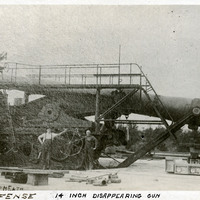
Caption: "Coast Defense: 14 Inch Disappearing Gun." Another copy of a C.D. Heath photograph, this image shows a heavy artillery gun, with two unidentified men standing next to it, at the Sandy Hook Proving Ground. Located at Sandy Hook, New Jersey, the Sandy Hook Proving Ground was used by the U.S. Army to test ordinance and materiel from 1874-1919. See also 96-07-08-alb05-101.
Date: 1910
-
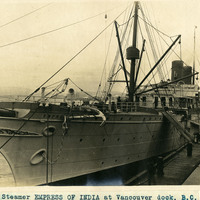
Caption: "Steamer EMPRESS OF INDIA at Vancouver dock, B.C.," c. 1908-1912. View of the Empress of India, built by England's Naval Construction & Armaments Co. in 1890 for the Canadian Pacific Steamships company. The Empress of India could accommodate up to 700 passengers, and was also used to carry mail between Hong Kong and Great Britain. She was sold in 1914 and refitted as a hospital ship for Indian soldiers. She was sold a final time in 1923, for scrap in Bombay.
Date: 1908
-
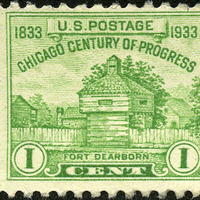
No caption. Commemorative U.S. postage stamp issued in 1933 for Chicago's Century of Progress Exposition, celebrating the one-hundred year anniversary of Chicago's incorporation. This stamp features Fort Dearborn, a fort built in 1803 in what is now Chicago proper. While the original fort was destroyed during the War of 1812, and the second fort which replaced it was destroyed by fires in 1857 and 1871, a replica was constructed for the Exposition.
Date: 1933
-
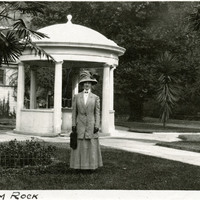
Caption: "Alum Rock," c. 1910. Grace McCarthy standing in front of a gazebo in Alum Rock Park. The park, founded in 1872, is one of California's oldest municipal parks. The gazebo, the park's oldest standing structure (built in about 1890), features a fountain that used to supply water from the mineral springs in the area. Today, the fountain's water comes from the City of San Jose's municipal supply.
Date: 1910
-
Caption: "12 Inch Sea Coast Gun," c. 1908-1912. Group of men operating or maintaining a 12-inch disappearing gun. Retracting or disappearing guns were a form of artillery developed in the nineteenth century in which heavy artillery guns were placed on rotating carriages that allowed retraction of the weapon after firing, to enable reloading while under enemy fire. Such guns were often used in coastal fortifications.
Date: 1908
-
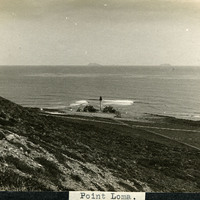
Caption: "Point Loma.," c. 1905. View of Point Loma and the so-called "New Point Loma Lighthouse" in the center. The lighthouse, first lit in 1891, replaced the "Old Point Loma Lighthouse" that had been constructed in 1855. The old lighthouse was often obscured by fog, so a new lighthouse was built at a much lower elevation much closer to sea level. The light was automated in 1973.
Date: 1905
-
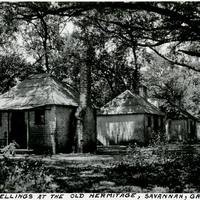
Caption: "Slave Dwellings at the Old Hermitage, Savannah, Ga. July 15, 1934." A row of small brick houses surrounded by trees. The Old Hermitage was a 400-acre plantation on the Savannah River, owned by Henry McAlpin. McAlpin not only conducted farming operations at the plantation, but also manufactured bricks, barrels, cast iron products, and lumber. For that reason, he built the slave quarters for the plantation from brick, rather than wood as was common for most other plantations in the South.
Date: 7/15/1934
-
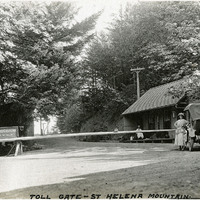
Caption: "Toll Gate -- St Helena Mountain.," c. 1920. Toll gate consists of a long wooden spar across the road, with a small building to the right. Grace McCarthy is standing next to an automobile at the gate. The St. Helena Toll Road, now part of California State Route 29, connected the Napa Valley with Lake County. It was built in 1868, and purchased by the State of California in 1925.
Date: 1920
-
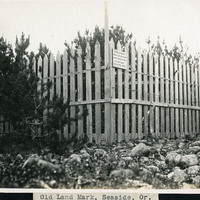
Caption: "Old Landmark, Seaside, Or.," c. 1910. Shows a picket fence erected around what a sign calls "Remains of Cairn where Lewis & Clark made salt from the ocean water Jan. & Feb. 1806." When the famous expedition led by Merriweather Lewis and William Clark reached the Pacific Ocean in late 1805, their supplies had run dangerously low, including their salt supply. Salt, used not only to flavor meat but also to preserve it, was extremely important to the health of the expedition. Three of Lewis and Clark's men traveled to a site on the coast near present-day Seaside, Oregon to set up a small salt-works, boiling ocean water in a series of large kettles and then scraping the resulting salt crust off of the sides. In this manner, the men eventually collected about twenty gallons of salt before Lewis and Clark decided the supply was sufficient for the return journey. In 1910, the property containing the remains of the cairns was deeded to the Oregon Historical Society. In 1955, replica salt cairns were built at the site by the Lions Club to commemorate the expedition's activities.
Date: 1910
-
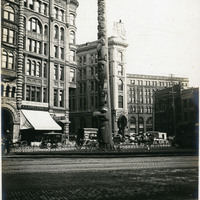
Caption: "Seattle totem pole.," c. 1905. View of the Tlingit totem pole in Seattle's Pioneer Square. The totem pole was stolen in 1899 by a group of businessmen, and erected in the square, then known as Pioneer Place. An arson destroyed this pole in 1938, but it was later replaced by another carved by the Tlingit tribe (who were also finally paid for the original pole).
Date: 1905