Search All Items
- Filters:
- Language
- English 6020
- Spanish 194
- ENGLISH 2
- English 1
- census_013 1
- Type
- Image 3854
- Still Image 1909
- Text 426
- Text 22
- Textual 2
Search Results 2881 to 2890 of 6281
-
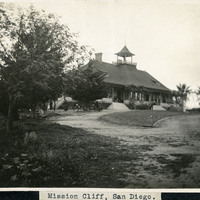
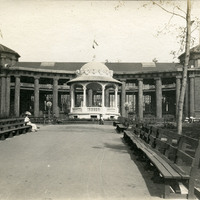
Caption: "Mission Cliff, San Diego.," c. 1905. View of the pavilion in San Diego's Mission Cliff Gardens. Originally opened in the 1880s as the "Bluffs" by the San Diego Cable Railway Company, the owners hoped to entice people to ride the cable cars by providing a recreational destination. The pavilion seen in the photograph was constructed in 1890. A few years later, the Citizens' Traction Company purchased the park and changed its name to Mission Cliff Park. In 1898, the property was sold yet again, this time to J.D. Spreckels and the San Diego Electric Railway Company. Spreckels hoped to transform the property into a quiet, restful, public botanical garden. The name changed again, to Mission Cliff Gardens, to reflect this change in direction for the park. The botanical gardens developed at the park became world-renowned before closing to the public in 1929. The property was subdivided in 1942, into residential lots.
Date: 1905
-
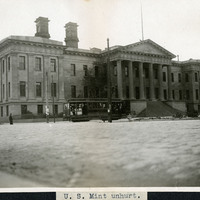
Caption: "U.S. Mint unhurt," c. 1906. Pictured is the U.S. Mint building in San Francisco, which opened in 1874, after the original 1854 building was outgrown, which had been established to serve the gold mines during the California Gold Rush. The building suffered little damage after the 1906 earthquake. The facility served as the San Francisco U.S. Mint until 1937, when workers moved to a larger and more modern building. In 1961, the old U.S. Mint, known as the "Granite Lady," was designated a National Historic Landmark.
Date: 1906
-
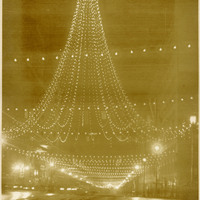
No Caption: The photograph has a hand-written inscription stating: "Portola Electric Bell Copyright 1909 Pillsbury Picture Co. No. 800." Installed on the intersection of Third and Market Streets in San Francisco, the Portola Electric Bell contained two thousand bulbs and rose 125 feet above the street. It was part of the Portola Festival of 1909, a grand celebration devised to commemorate the discovery of San Francisco Bay by Gaspar De Portola, and for the public to celebrate the future of the rebuilt city after the 1906 earthquake and fires.
Date: 1909
-
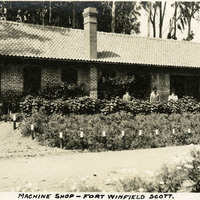
Caption: "Machine Shop -- Fort Winfield Scott," c. 1913. Low brick building with tile roof, with William McCarthy (far left) and two unidentified men standing in front. Fort Winfield Scott, formerly Fort Point, was part of an effort by the U.S. government to protect the Golden Gate, entrance to the San Francisco Bay. Built between 1853-1861, the fort included emplacements for 141 guns but never fired a weapon in defense of the Bay. Its name was officially changed in 1882 to Fort Winfield Scott. This only lasted four years, however, for in 1886 the fort was officially downgraded to a sub-post of the San Francisco Presidio and the name discontinued. It was resurrected in 1912, with the establishment of a coastal artillery fortification at the Presidio, called, once again, Fort Winfield Scott.
Date: 1913
-
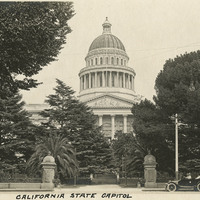
Caption: "California State Capitol." Shows the California State Capitol building and grounds. Located on the west end of Capitol Park, the neoclassical building's construction began in 1860 and was completed in 1874. It houses the state legislature and offices of the governor. The capitol and grounds were listed on the National Register of Historic Places in 1973, and as a California Historical Landmark in 1974. A parked automobile in the foreground has Grace McCarthy at the wheel, with William McCarthy sitting beside her, and two unidentified people in the backseat, Sacramento, c. 1915.
Date: 1915
-
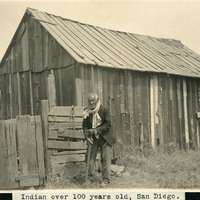
Caption: "Indian over 100 years old," c. 1905. Elderly man, possibly of Native American ethnicity, standing in front of a barn. Taken around 1905 in San Diego near the Old Mission, If William McCarthy's description is accurate, this person was born while California was under Spanish rule. Possibly of the Kumeyaay tribe, whose members had lived in the area long before the Spanish arrived, he may have lived and worked at Mission Basilica San Diego de Alcalá (Mission San Diego) or at a nearby Indian village.
Date: 1905
-
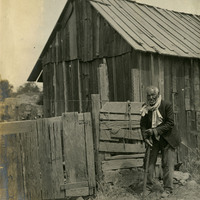
Caption: "INDIAN over 100 years old," c. 1905. Elderly man, possibly of Native American ethnicity, standing in front of a barn. Taken around 1905 in San Diego near the Old Mission, If William McCarthy's description is accurate, this person was born while California was under Spanish rule. Possibly of the Kumeyaay tribe, whose members had lived in the area long before the Spanish arrived, he may have lived and worked at Mission Basilica San Diego de Alcalá (Mission San Diego) or at a nearby Indian village.
Date: 1905
-
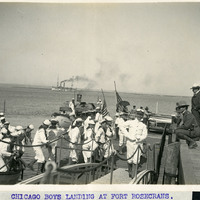
Caption: "CHICAGO BOYS LANDING AT FORT ROSECRANS." View of US Navy sailors coming ashore at Fort Rosecrans. The flagship of the US fleet in the Pacific at the time, the USS Chicago was called to the fort after a boiler explosion on the USS Bennington killed sixty-six and wounded dozens more. A board of inquiry into the cause of the explosion was convened on board the Chicago. The board found that no error on the part of the Bennington's crew contributed to the explosion.
Date: 1905
-
No Caption: View of the Forestry Building at the Alaska-Yukon-Pacific Exposition. Grace McCarthy is seated on a bench in front of the building, in a light-colored dress and hat. Made out of unpeeled logs, the Forestry Building was demolished in the 1930s. Held in Seattle to celebrate the development of the Pacific Northwest, the fair attracted 3.7 million visitors over the course of its run from June to October 1909. Although most of the fair's buildings have since been destroyed, several of them now serve as part of the University of Washington campus.
Date: 1909
-
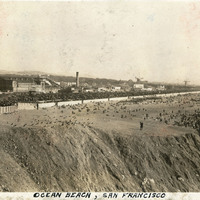
Caption: "Ocean Beach, San Francisco," c. 1925. Panorama of Ocean Beach, showing crowds not only at the beach but also at San Francisco's Playland, a series of seaside attractions and rides including a carousel, Fun House, and the Big Dipper rollercoaster. Entrepreneurs began erecting concessions and "thrill" rides at the location in the late nineteenth century. By 1913 the area was known as Chutes at the Beach. In 1923, brothers George and Leo Whitney began to purchase the attractions, eventually coming to own the entirety of what became known as Playland. The amusement park was torn down in 1972.
Date: 1925