
Search All Items
- Filters:
- Language
- English 6853
- Spanish 18
- ENGLISH 3
- English 2
- census_013 1
- contra_costa_schedule_1_volume_1 1
- Type
- Image 3886
- Still Image 2484
- Text 441
- Text 54
- Textual 2
- Image of the California Census from the records of the office of the California Secretary of State 1
Search Results 2881 to 2890 of 6969
-
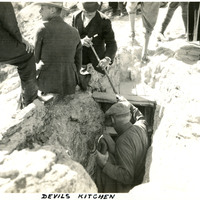
Caption: "Devil's Kitchen," c. 1923. This photograph shows several people descending into and standing around the entry to Devil's Kitchen, an extinct hot spring that left behind a cavern. Once a popular tourist attraction for its small opening that made visitors feel as if they were descending into the underworld, the site was closed in 1939 because the cavern periodically fills with dangerous levels of carbon dioxide.
Date: 1923
-
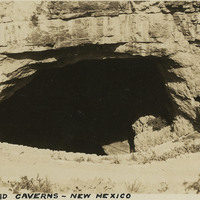
Caption: "Carlsbad Caverns -- New Mexico, May 30, 34." View looking into dark cave mouth of Carlsbad Cavern, a series of natural underground chambers including the "Big Room," the fifth-largest such chamber in North America with a length of 1,000 feet, a width of 625 feet, and a maximum height of 255 feet. The site was named Carlsbad Cave National Monument in 1923, and declared Carlsbad Caverns National Park in 1930.
Date: 5/30/1934
-
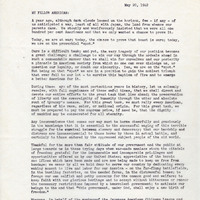
Correspondence from Henry Omoto of San Benito County Japanese American Citizens League regarding statement to the public
Date: May 20, 1942
-
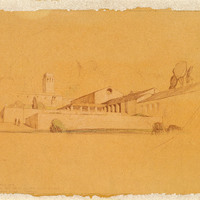
Caption: "View from Main Gate. Administration Bldg. - Boys Dorm - Academic Dining - Kitchen - Primary Dining - Primary School - Terraces." California School for the Deaf at Berkeley; design and drawing by Alfred Eichler. Project for Department of Education.
Date: undated
-
No Caption: A section from an informational tourist brochure describing the National Palace in Mexico City.
Date: 1938
-
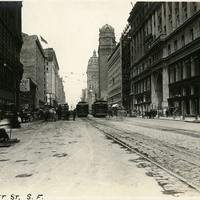
Caption: "Market St. S.F." See also 96-07-08-alb06-197 with caption: "Building up on Market Street, c. 1907. A view of repairs being made to Market Street, after the damage of the 1906 earthquake.
Date: 1907
-
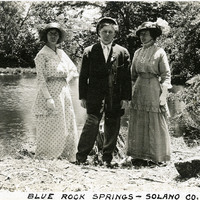
Caption: "Blue Rock Springs -- Solano Co.," c. 1915. Grace McCarthy (far left) and two unidentified friends or relatives at what is now known as Blue Rock Springs. In the 1860s, White Sulphur Springs (in the vicinity of Vallejo) was developed for use as a mineral springs resort, featuring a hotel, several cottages, and an "amusement" building with a dance floor, bar, and billiard room. Manuel Madrid obtained the property around the turn of the twentieth century, and changed the name to Blue Rock Springs. The area is now managed by the Greater Vallejo Recreation District as Blue Rock Springs Park.
Date: 1915
-
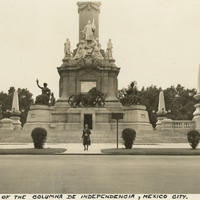
Caption: "A close up of the Columna de Independencia, Mexico City."
Date: 1938