Search All Items
- Filters:
- Language
- English 6020
- Spanish 194
- ENGLISH 2
- English 1
- census_013 1
- Type
- Image 3854
- Still Image 1909
- Text 426
- Text 22
- Textual 2
Search Results 2891 to 2900 of 6281
-
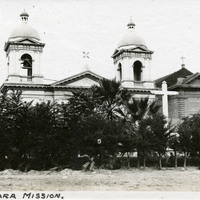
Caption: "Santa Clara Mission," c. 1910. Founded in 1777, Mission Santa Clara featured several different churches over the years. This photograph shows the mission church as it appeared from roughly 1861 to 1926. In the 1860s, Santa Clara College President Burchard Villager decided to rebuild many of the buildings on the campus. In the process, the mission church was renovated in the Italianate style, with a second bell tower. This Italianate-style church burned in 1926. The church was then rebuilt as a modern reconstruction of the fifth church on the site, the original of which was destroyed by fire in 1825.
Date: 1910
-
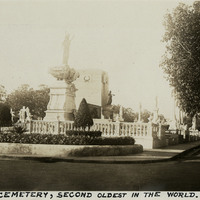
Caption: "Havana Cemetery, Second Oldest in the World. July 4, 34." Several memorials in Colon Cemetery can be seen in this photograph. Founded in 1876, Colon Cemetery replaced Havana's first cemetery, Espada Cemetery, after a cholera epidemic in 1868 revealed the need for a new, larger facility. Today, the Colon Cemetery holds more than 800,000 graves. It is not known where William McCarthy found reference to this being the "second oldest" cemetery in the world, as California State Archives staff could not verify that statistic.
Date: 7/4/1934
-
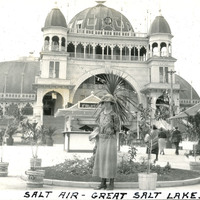
Caption: "Salt Air - Great Salt Lake," c.1923. Grace McCarthy poses in front of the Saltair resort complex on Utah's Great Salt Lake. Constructed in 1893 and designed by Richard K.A. Kletting, the Saltair set out to be the Western counterpart of Coney Island. The resort was a popular spot for Mormon families, only fifteen miles from Salt Lake City and overseen by Church leaders. The Church sold the building in 1906. It was later destroyed by fire in 1925, but a second pavilion was quickly built.
Date: 1923
-
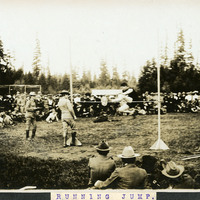
Caption: "R U N N I N G J U M P.," c. 1917. Image of an early high jumper in mid-leap, with men clad in military uniforms watching, as well as civilian men and women. In the high jump, athletes attempt to leap over a horizontal bar without the benefit of a pole (as in pole vaulting). The technique shown here is an early one with the jumper upright rather than in the "Fosbury Flop" position, developed later in the century. The uniforms and surrounding vegetation in the photograph suggest that that event may have taken place at Camp Lewis, Washington.
Date: 1917
-
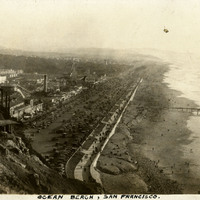
Caption: "Ocean Beach, San Francisco," c. 1925. Panorama of Ocean Beach, showing crowds not only at the beach but also at San Francisco's Playland, a series of seaside attractions and rides including a carousel, Fun House, and the Big Dipper rollercoaster. Entrepreneurs began erecting concessions and "thrill" rides at the location in the late nineteenth century. By 1913 the area was known as Chutes at the Beach. In 1923, brothers George and Leo Whitney began to purchase the attractions, eventually coming to own the entirety of what became known as Playland. The amusement park was torn down in 1972.
Date: 1925
-
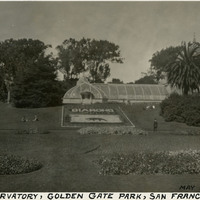
Caption: "Conservatory, Golden Gate Park, San Francisco, May 14, 1934." View of one wing of the Conservatory of Flowers in Golden Gate Park. A planting bed in front of the wing has been planted with flowers in such a way as to portray the California flag and the letters "California Diamond Jubilee, 1850-1925." The date on this photograph may not be accurate, given the dates included in the flower bed. The Conservatory of Flowers is the oldest building in Golden Gate Park, dating to 1879. The Victorian-style building has housed rare and exotic plants since its completion.
Date: 5/14/1934
-
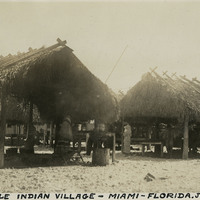
Caption: "Seminole Indian Village -- Miami -- Florida. June, [sic] 30, 1934." Several shelters with roofs of thatched grass or brush, with several unidentified women and children scattered throughout the photograph. The Seminoles are a Native American tribe from Florida, although most of the tribe had been forcibly relocated from Florida to Oklahoma by 1842. Fewer than 200 remained in Florida after the Third Seminole War ended in 1858, but a resurgence of the tribe occurred in the early to mid twentieth century. The Florida Seminole tribe received federal recognition in 1957.
Date: 6/30/1934
-
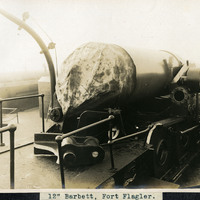
Caption: "12" Barbett [sic], Fort Flagler.," c. 1908-1912. View of a 12" disappearing gun at Fort Flagler. The coastal artillery fortification Fort Flagler was established in 1897 and activated in 1899. Most of the fort's buildings and batteries had been completed by 1907. Fort Flagler was part of the "triangle of fire," three coastal defense fortifications (Fort Casey, Fort Worden, and Fort Flagler) guarding the entrance to Puget Sound. Fort Flagler was decommissioned in 1953, and purchased by the State of Washington in 1955 for use as a state park.
Date: 1908
-
Caption: "City Hall - Detroit," c. 1925. Grace McCarthy poses in front of Detroit's City Hall. The Italian Renaissance Revival-style building, designed by architect James Anderson, was constructed between 1867 and 1871. It housed Detroit's city government until 1955, when a new facility was ready for occupation. This building was subsequently demolished in 1961.
Date: 1925