
Search All Items
- Filters:
- Type
- Image 3670
- Still Image 1106
- Text 405
- Text 19
- Image of the California Census from the records of the office of the California Secretary of State 1
- Language
- English 5178
- Spanish 28
- ENGLISH 2
- English 1
- census_013 1
- contra_costa_schedule_1_volume_1 1
Search Results 3001 to 3010 of 5257
-
Office Memorandum from Beryl E. Cox to Bertha Underhill regarding resettlement program in Los Angeles County
Date: July 18, 1945
-
Caption: "Ponciana [sic] and Whitehall Hotels. Ponciana {sic] is the Largest Frame Bldg. Hotel in the World. Palm Beach, Florida. July 8, 1934." Both the Royal Poinciana Hotel (center) and the Whitehall Hotel (far right) can be seen in this photograph, taken from across Lake Worth. The Royal Poinciana, built by Henry Flagler as a resort retreat for wealthy guests, opened in 1894. Renovations eventually enlarged the hotel to a length of 1,800 feet, with over three miles of corridors and hallways, and rooms for over 1,000 guests. At one point, it was reputed to be the largest wood structure in the world. Attendance declined in the 1920s, however, as tourists were attracted to more modern facilities. Damage by a hurricane and the Great Depression combined to close the hotel in 1934. The building was razed a year later. The Whitehall Hotel started its existence as a mansion, also built by Flagler, as a present for his wife. After Flagler's death in 1913, the home was sold to a group of investors who erected an eleven-story tower and converted the entire complex to use as a resort hotel. In 1959, the Henry Morrison Flagler Museum purchased the building. It now serves as a museum.
Date: 7/8/1934
-
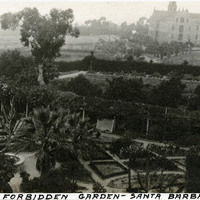
Caption: "Forbidden Garden -- Santa Barbara Mission," c. 1910. View of the gardens associated with Santa Barbara Mission. The gardens initially served as the location for instructing neophytes (Native American converts living at the mission) in trades and skills deemed necessary to life in European civilization. Later, the garden was used for meditation. The garden was often dubbed "forbidden" because it was closed to female visitors, as were many enclosures in active missions.
Date: 1910
-
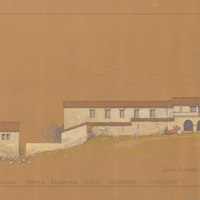
Caption: "Administration Building Santa Barbara State Teachers College." Riviera Campus. Design and drawing by Alfred Eichler. Built. Project for Department of Education. The image, eichler_f3274_191, is inset on the image, eichler_f3274_190.
Date: 1925
-
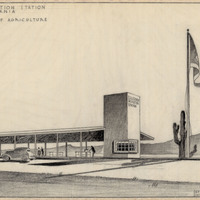
Caption: "Quarantine Inspection Station, Blythe, California, State Department of Agriculture. Department of Public Works, Division of Architecture-Sacramento." Design and drawing by Alfred Eichler. Built in 1939. Situated in desert country. Project for Department of Agriculture.
Date: 1939