Search All Items
- Filters:
- Language
- English 3825
- Spanish 4
- ENGLISH 1
- contra_costa_schedule_1_volume_1 1
- Type
- Image 2628
- Still Image 826
- Text 361
- Text 12
- Textual 2
- Image of the California Census from the records of the office of the California Secretary of State 1
Search Results 3011 to 3020 of 3868
-
Caption: "El Portal," c. 1917. Grace McCarthy poses with two unidentified people in front of the Hotel del Portal (or Del Portal Hotel) in El Portal, California. The resort hotel was constructed in 1908 by the Yosemite Terminal Company, a subsidiary of the Yosemite Valley Railroad Company, to provide accommodations for visitors to the park who arrived by train. The hotel burned to the ground in late October of 1917.
Date: 1917
-
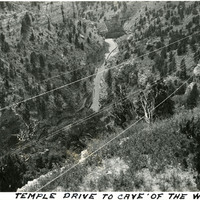
Caption: "Temple Drive to Cave of the Winds," c. 1923. Bird's eye view of a road at the bottom of a canyon, on a drive to Cave of the Winds. Two brothers discovered the entrance to the large cave system in 1880, in Williams Canyon just outside of Manitou Springs. Further exploration resulted in opening more caverns within the system, and the site became a tourist attraction, with guided tours having been on offer since 1881.
Date: 1923
-
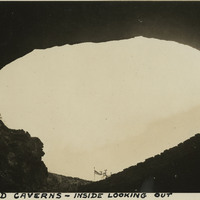
Caption: "Carlsbad Caverns -- Inside Looking Out, May, 30, 34." View looking out of the mouth of Carlsbad Cavern, a series of natural underground chambers including the "Big Room," the fifth-largest such chamber in North America with a length of 1,000 feet, a width of 625 feet, and a maximum height of 255 feet. The site was named Carlsbad Cave National Monument in 1923, and declared Carlsbad Caverns National Park in 1930.
Date: 5/30/1934
-
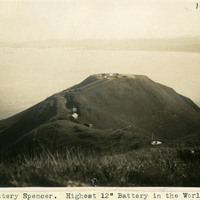
Caption: "Battery Spencer. Highest 12" Battery in the World." With construction begun in 1893, Battery Spencer, located at Fort Baker in Marin County on the north side of the Golden Gate Bridge, was one of the main protection points for the San Francisco harbor from 1897 until it was deactivated in 1942. It was named for Major General Joseph Spencer of the Continental Army during the Revolutionary War.
Date: 1908
-
No Caption: Pale green ribbon with red circle at the top, commemorating the participation of Japan in the Lewis and Clark Centennial Exposition. The exposition was held in Portland, Oregon from June 1st to October 15th, 1905. It celebrated the one-hundred year anniversary of the exploratory expedition of the Louisiana Purchase and what became the northwestern part of the United States, led by Meriwether Lewis and William Clark. Some 1.6 million people visited the fair, viewing exhibits from twenty-one countries.
Date: 1905
-
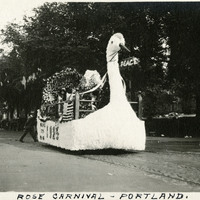
Caption: "Rose Carnival -- Portland." Features a parade float shaped as a swan, with roses, an American flag, and a sign reading "peace." The Portland Rose Festival began in 1907 as the Rose Carnival. It is now an annual festival featuring three parades, including the Grand Floral Parade, the second-largest all-floral parade in the nation (the largest being the Tournament of Roses held each New Year in Pasadena, California).
Date: 1925
-
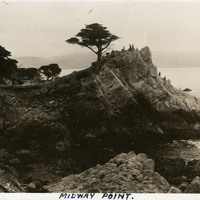
Caption: "Midway Point.," c. 1920. Now-iconic image of a rocky outcropping near Pebble Beach, extending into the Pacific Ocean, with a single cypress tree near the top. This tree, sometimes referred to as the "Lone Cypress," has been photographed extensively over the past century. This tree and outcropping can still be seen as part of the 17-Mile Drive, a scenic road tour of the Pebble Beach Resort area in Monterey County.
Date: 1920
-
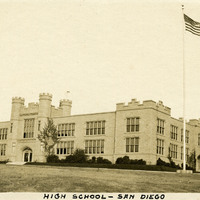
Caption: "High School -- San Diego," c. 1910. By 1902 San Diego's schools had become overcrowded enough to warrant the construction of a new high school building. Completed in 1907 and designed by F.S. Allen, the new building was quickly nicknamed the "Grey Castle on the Hill" in reference to its castle-like parapets and towers. The Grey Castle was torn down in 1975 to make way for a facility in compliance with new earthquake safety laws.
Date: 1910
-
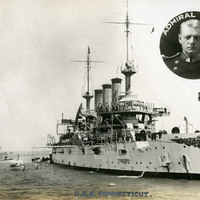
Caption: "USS Connecticut, Admiral Evans," c. 1908. View of the USS Connecticut, with an inset circular photograph of Admiral Evans. The USS Connecticut was commissioned on September 29, 1906 as the most advanced ship in the U.S. Navy. Because the provisions of the Washington Naval Treaty of 1922 stipulated that older battleships would be disposed of, the Connecticut was decommissioned and sold for scrap in 1923.
Date: 1908