
Search All Items
- Filters:
- Language
- English 6020
- Spanish 194
- ENGLISH 2
- English 1
- census_013 1
- Type
- Image 3854
- Still Image 1909
- Text 426
- Text 22
- Textual 2
Search Results 3031 to 3040 of 6281
-
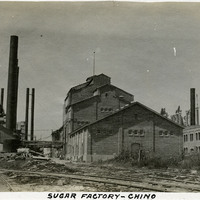
Caption: "Sugar Factory -- Chino," c. 1915. View of Chino's sugar beet factory, established in 1891 by Robert and Henry Oxnard. Henry later established a larger factory in the town that now bears his name (Oxnard, in Ventura County). The factory operated for more than twenty-five years before closing in October 1917.
Date: 1915
-
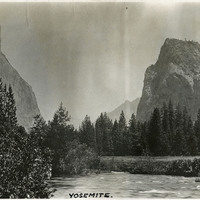
Caption: "Yosemite.," c. 1920. View of the Yosemite Valley from the valley floor, with the Merced River in the foreground, and El Capitan (left) and the Cathedral Rocks (right) in the background. Bridalveil Fall cascades down a cliff face beneath the Cathedral Rocks.
Date: 1917
-
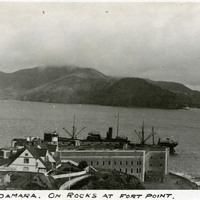
Caption: "Steamer Damara. On Rocks at Fort Point." On October 8, 1910, the British steam ship Damara, loaded with a cargo of barley bound for England, ran onto the rocks below Fort Point at the entrance to the San Francisco Bay. It took eleven days to refloat the ship.
Date: 1910
-
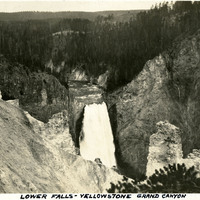
Caption: "Lower Falls - Yellowstone Grand Canyon," c. 1923. As the Yellowstone River flows north from Yellowstone Lake it passes over two waterfalls (Upper and Lower Yellowstone Falls) before reaching the Yellowstone Grand Canyon. This photograph shows the 308-foot Lower Yellowstone Falls, as seen from a nearby mountain top or bluff. It carries more water volume than any other waterfall in the Rocky Mountains.
Date: 1923
-
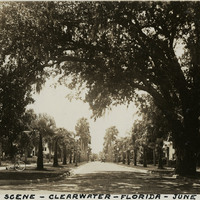
Caption: "Street Scene -- Clearwater -- Florida -- June 27, 1934." Residential street in Clearwater, Florida (incorporated in 1891). The street is lined by palm trees and has wide grass verges on either side. A bicycle has been temporarily forgotten at the left-hand side of the photograph.
Date: 6/27/1934
-
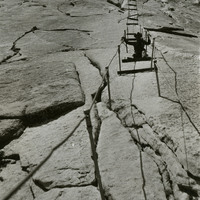
No caption, c. 1935. William McCarthy on the steep trail to the summit of the iconic Half Dome, in the Yosemite Valley. The cables used to assist hikers follow a route laid down by George Anderson, who reached the summit in 1875.
Date: 1935
-
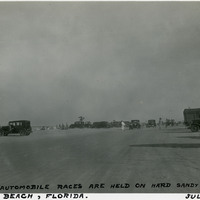
Caption: "Where Automobile Races are Held on Hard Sandy Beach, Daytona Beach, Florida. July 9, 1934." This photograph illustrates the wide, hard-packed sands of the beach at Daytona Beach, used by early motorists as a race track and testing ground for new vehicles. Bathers enjoy the surf to the left, while many automobiles are visible in the rest of the photograph.
Date: 7/9/1934
-
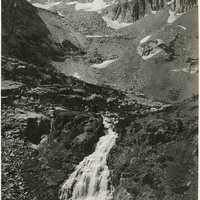
Caption: "Sierra Summit Scene - Tioga Pass," c. 1917. Patches of snow litter the walls of Tioga Pass, while a small stream cascades down the hillside. California State Route 120 runs through the pass, providing an eastern entry into Yosemite National Park.
Date: 1917
-
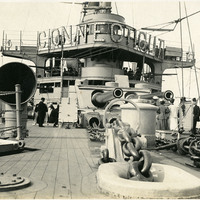
No caption. A view of the deck of the USS Connecticut, c. 1908. The Connecticut was commissioned on September 29, 1906 as the most advanced ship in the U.S. Navy. Because the provisions of the Washington Naval Treaty of 1922 stipulated that older battleships would be disposed of, the USS Connecticut was decommissioned and sold for scrap in 1923.
Date: 1908
-
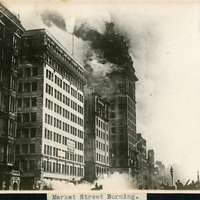
Caption: "Market Street Burning." A view of the Call Building on Market and 3rd Streets on fire after the 1906 earthquake, with people and horses in the foreground. Considered one of the worst natural disasters in the country's history, the 1906 San Francisco earthquake and resulting fires killed an estimated 3,000 people and destroyed over 500 city blocks, leaving approximately 200,000 residents homeless.
Date: 1906