
Search All Items
- Filters:
- Language
- English 6020
- Spanish 194
- ENGLISH 2
- English 1
- census_013 1
- Type
- Image 3854
- Still Image 1909
- Text 426
- Text 22
- Textual 2
Search Results 3061 to 3070 of 6281
-
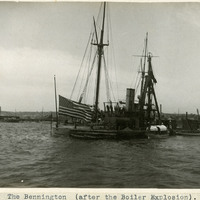
Caption: "The Bennington (after the Boiler Explosion)." View of the USS Bennington, a U.S. Navy gunboat, Yorktown class, launched in 1890. She had tours of duty in South America, the Mediterranean, North and Central America, Hawaii, and the Philippines. On July 21, 1905, while in San Diego Harbor, the Bennington's boiler exploded, killing sixty-six men and injuring many more. Taken after the explosion, in this photograph the Bennington sits low in the water.
Date: 1905
-
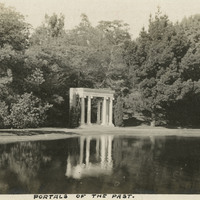
Caption: "Portals of the Past," c. 1915, on the shore of Lake Lloyd in Golden Gate Park, was originally the entranceway to the Nob Hill mansion of railroad tycoon, A.N. Towne. The entranceway was the only part of the home that was not destroyed by the 1906 earthquake and was moved to Golden Gate Park in 1909 as a reminder of much that was lost. See also 96-07-08-alb05-065.
Date: 1915
-
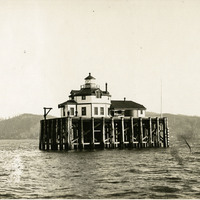
No Caption: c. 1910. View of the Desdemona Lighthouse, constructed in 1901 or 1902 on wood pilings over a group of shoals at the mouth of the Columbia River. The shoals carry the same name as the lighthouse, both of which are named for the bark Desdemona which ran aground and was destroyed by the shoals in 1857. The lighthouse was automated in 1934, and its light eventually removed in 1965.
Date: 1910
-
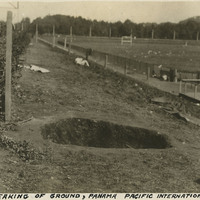
Caption: "Breaking of Ground, Panama-Pacific International Exposition." See also 96-07-08-alb01-006, which includes the same caption. San Francisco, Oct 14, 1911. The 1915 Panama Pacific International Exposition was held to celebrate the completion of the Panama Canal, as well as inventive technologies and new industries from around the world. It was also a chance for San Francisco to show the world how the great city had rebuilt and thrived after the devastation of the 1906 earthquake and fire.
Date: 1911
-
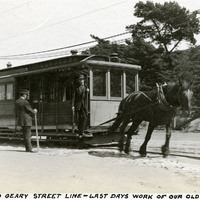
Caption: "Old Geary Street Line -- Last Days Work of our Old Faithful Friend." Photograph of a horse-drawn cable car, on the last day of operation of the Geary Street, Park and Ocean Railway. One of the first railways established in San Francisco, the line operated from 1880 until May 1912 when it was taken over by the city and converted to an electric streetcar line.
Date: 1912-05
-
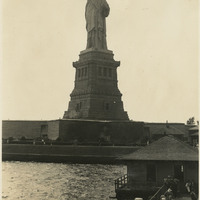
Caption: "Statue of Liberty, New York." View of the Statue of Liberty on Bedloe Island (now called Liberty Island). Designed by French sculptor Frédéric Auguste Bartholdi, the now-iconic statue was a gift from the people of France to the U.S. Built in segments in France by Gustave Eiffel (also famous for building the Eiffel Tower in Paris), the pieces were shipped from Paris to New York in 1885 and assembled. The Statue of Liberty was subsequently dedicated on October 28, 1886.
Date: 1934
-
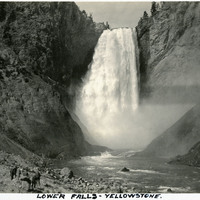
Caption: "Lower Falls - Yellowstone," c. 1923. This photograph features the massive Lower Yellowstone Falls, as seen from the falls' base. A group of unidentified people standing to one side provides some sense of scale. As the Yellowstone River flows north from Yellowstone Lake it passes over two waterfalls (Upper and Lower Yellowstone Falls) before reaching the Yellowstone Grand Canyon. The 308-foot Lower Yellowstone Falls carries more water volume than any other waterfall in the Rocky Mountains.
Date: 1923
-
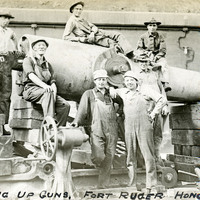
Caption: "Setting Up Guns, Fort Ruger Honolulu," c. 1909-1915. Group of unidentified men gathered around unassembled pieces of what appears to be a 12-inch mortar at Fort Ruger, Island of O'ahu, Hawaii. Fort Ruger was established by the U.S. in 1906 as the Diamond Head Reservation. Its name was changed to Fort Ruger in 1909. See also 96-07-08-alb05-099 and 100.
Date: 1915
-
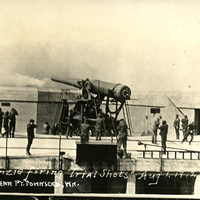
Caption: "Battery Kinzie firing 'Trial Shots' Aug 1, 1912" and "No 10 Near Pt. Townsend, WA." Battery Kinzie was a coastal defense battery designed to include two 12-inch disappearing guns, installed at Fort Worden. Construction began in 1908. It was turned over to the U.S. Army's Coast Artillery Corps in 1912 for use in defending the entrance to Puget Sound. This postcard shows one of the 12-inch guns firing, with several unidentified men standing nearby holding their hands to their ears.
Date: 8/1/1912
-
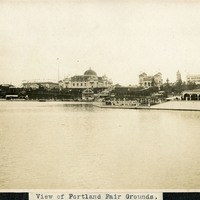
Caption: "View of Portland Fair Grounds." This photograph shows a panoramic view of the fair grounds where the Lewis and Clark Centennial Exposition was held in Portland, Oregon, from June 1st to October 15th, 1905. The international exposition celebrated the one-hundred year anniversary of the exploratory expedition of the Louisiana Purchase and what became the northwestern part of the United States, led by Meriwether Lewis and William Clark. Some 1.6 million people visited the fair, viewing exhibits from twenty-one countries.
Date: 1905