
Search All Items
- Filters:
- Language
- English 4767
- Spanish 11
- ENGLISH 2
- English 1
- census_013 1
- contra_costa_schedule_1_volume_1 1
- Type
- Image 3783
- Still Image 592
- Text 377
- Text 22
- Textual 2
- Image of the California Census from the records of the office of the California Secretary of State 1
Search Results 3061 to 3070 of 4830
-
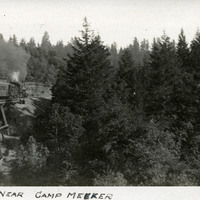
Caption: "Scenery Near Camp Meeker," c. 1906. Train crossing trestle at left side of photograph, with trees and other vegetation occupying most of the photograph's area. Camp Meeker, in Sonoma County north of San Francisco, is in the California Coast Ranges. Established by lumber baron Melvin Cyrus Meeker in 1866, by the turn of the twentieth century the area primarily served as a vacation and resort destination.
Date: 1906
-
No Caption: See also 96-07-08-alb03-065 with caption: "Fort Casey Lighthouse, Washington," c. 1910. Fort Casey was part of the "triangle of fire," three coastal defense fortifications (Fort Casey, Fort Worden, and Fort Flagler) guarding the entrance to Puget Sound. Construction began on the fort in 1897, and the U.S. Army used the facility until the 1950s, when the fort was decommissioned. The area is now a state park.
Date: 1910
-
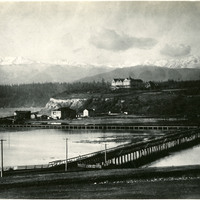
No Caption: See also 96-07-08-alb08-082 with caption: "The Olympic Snow-capped Mountains," Washington, c. 1908. Vista of the Olympic Mountains in the distance. In the middle distance to the right can be seen the Eisenbeis Castle (now known as the Manresa Castle Restaurant and Lounge), built in 1892 by Charles Eisenbeis, a businessman and Port Townsend's first mayor. The photograph is centered around what appears to be a resort hotel situated a short distance from the Eisenbeis Castle.
Date: 1908
-
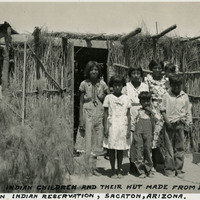
Caption: "Pima Indian Children and their hut made from bush branches, Sacaton Indian Reservation, Sacaton, Arizona," c. 1935. Located south of Phoenix and including the town of Sacaton, the Gila River Indian Reservation is home to members of the Akimel O’odham (Pima) and the Pee-Posh (Maricopa) tribes. The reservation was established in 1859. Eighty years later, in 1939, Congress provided for the self-governance of the reservation via the Gila River Indian Community.
Date: 1935
-
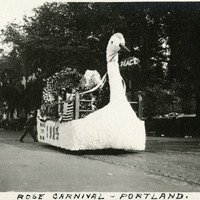
Caption: "Rose Carnival -- Portland." Features a parade float shaped as a swan, with roses, an American flag, and a sign reading "peace." The Portland Rose Festival began in 1907 as the Rose Carnival. It is now an annual festival featuring three parades, including the Grand Floral Parade, the second-largest all-floral parade in the nation (the largest being the Tournament of Roses held each New Year in Pasadena, California).
Date: 1925
-
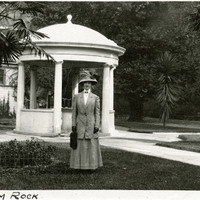
Caption: "Alum Rock," c. 1910. Grace McCarthy standing in front of a gazebo in Alum Rock Park. The park, founded in 1872, is one of California's oldest municipal parks. The gazebo, the park's oldest standing structure (built in about 1890), features a fountain that used to supply water from the mineral springs in the area. Today, the fountain's water comes from the City of San Jose's municipal supply.
Date: 1910
-
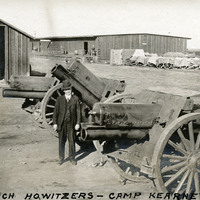
Caption: "6 inch Howitzers -- Camp Kearney," c. 1917. View of several 6" Howitzers, as well as several outbuildings and a line of artillery weapons under canvas covers. William McCarthy is standing next to the middle Howitzer. Camp Kearney was established by the U.S. Army in 1917 just north of San Diego. The post was largely abandoned by the government in 1920, used as a military and civilian airfield. It did not see increased military service again until the 1930s.
Date: 1917
-
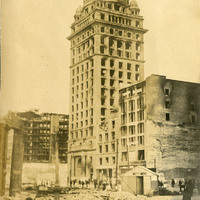
Caption: "Call Building," c. 1906. Completed in 1898 and designed by civic leader Claus Spreckels, the Call building on the corner of 3rd and Market streets was one of the first skyscrapers in San Francisco, built to house the San Francisco Call newspaper offices. While the structure withstood the 1906 earthquake, the interior caught fire and sustained considerable damage. After major renovations, the building is today known as The Central Tower.
Date: 1906