
Search All Items
- Filters:
- Language
- English 6020
- Spanish 194
- ENGLISH 2
- English 1
- census_013 1
- Type
- Image 3854
- Still Image 1909
- Text 426
- Text 22
- Textual 2
Search Results 3081 to 3090 of 6281
-
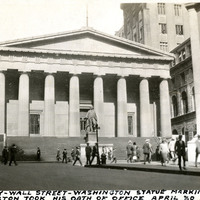
Caption: "Subtreasury - Wall Street - Washington Statue Marking Spot Where Washington Took His Oath of Office April 30 1789." The original building on this site, constructed in 1700, served as New York's city hall, then as the Capitol for the newly-created United States under the Constitution of 1789, and was the site of George Washington's inauguration as the first U.S. President. The original building was demolished in 1812, but a new building, designed to house the U.S. Custom House for the Port of New York, was opened in 1842. It is this building that is seen in the photograph. The new building subsequently housed one of six U.S. sub-treasuries between 1862 and 1920. A statue of George Washington (John Quincy Adams Ward, sculptor) was erected in front of the building in 1882, to commemorate the approximate site of Washington's inauguration. See also 96-07-08-alb11-204.
Date: 8/6/1934
-
Caption: "400 Pound Turtles Ready for Shipment -- Key West July 2, 1934." Several slaughtered sea turtles on a wharf in Key West. Turtle meat and eggs were popular food items in the early-to-mid twentieth century; turtle fat was especially prized for making turtle soup. Turtle kraals (corrals) and a cannery were built as the Key West area began to develop. However, the turtle population plummeted in the Florida Keys and surrounding areas as the twentieth century progressed and demand for turtle meat, eggs, and fat increased. The Key West turtle fishing industry halted after the Endangered Species Act was passed in 1971. Turtle populations have since started to recover. The cannery now serves as the Key West Turtle Museum.
Date: 7/2/1934
-
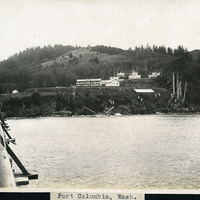
Caption: "Fort Columbia, Wash.," c. 1910. Fort Columbia, built between 1896 and 1904, sits on Chinook Point overlooking the Columbia River. It is part of the Three Fort Harbor Defense System protecting the mouth of the river from enemy incursion or attack (the other forts being Oregon's Fort Stevens and Washington's Fort Canby). Fort Columbia was decommissioned after World War II, and is now the site of a Washington State Park.
Date: 1910
-
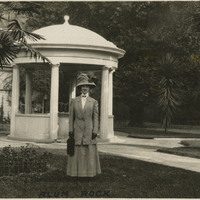
Caption: "Alum Rock", c. 1910. Grace McCarthy standing in front of the gazebo of Alum Rock Park. The park, founded in 1872, is one of California's oldest municipal parks. The gazebo, the park's oldest standing structure (built in about 1890), features a fountain that used to supply water from the mineral springs in the area. Today, the fountain's water comes from the City of San Jose's municipal supply. See also 96-07-08-alb05-116.
Date: 1910
-
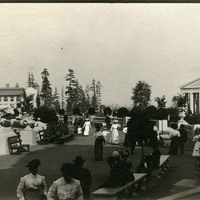
No Caption: View of a portion of the fairgrounds of the Alaska-Yukon-Pacific Exposition in Seattle, showing elegantly attired fairgoers strolling pathways and resting on benches. Held in Seattle to celebrate the development of the Pacific Northwest, the fair attracted 3.7 million visitors over the course of its run from June to October 1909. Although most of the fair's buildings have since been destroyed, several of them now serve as part of the University of Washington campus.
Date: 1909
-
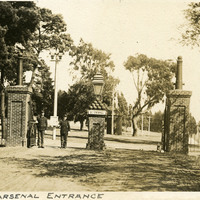
Caption: "Benicia Arsenal Entrance," c. 1915. View of the gateway to Benicia Arsenal, where William McCarthy worked (starting in 1903). Established in 1851, the Benicia Arsenal was the primary ordnance facility of the U.S. Army on the West Coast. The facility was deactivated in 1963, and closed completely the following year. The area now serves a vastly different function, providing work and retail space for artists and artisans.
Date: 1915
-
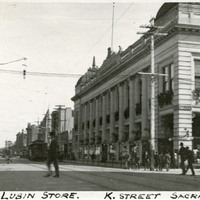
Caption: "Weinstock Lubin Store. K. Street Sacramento.," c. 1906. Street scene along Sacramento's K Street, with the Weinstock Lubin flagship store prominently featured at the right side of the photograph. Weinstock's opened as Lubin's at 4th and K Street in 1874, growing over the years into a downtown landmark. The company opened stores throughout California, as well as Nevada and Utah. The building pictured here replaced the original store, which burned to the ground in 1903. The site is now occupied by Macy's.
Date: 1906
-
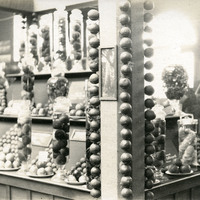
No Caption: Photograph of a display of lemons at the Alaska-Yukon-Pacific Exposition. Held in Seattle to celebrate the development of the Pacific Northwest, the fair attracted 3.7 million visitors over the course of its run from June to October 1909. Although most of the fair's buildings have since been destroyed, several of them now serve as part of the University of Washington campus.
Date: 1909
-
Caption: "Old State Capitol-Benicia," c. 1918, shows the Benicia State Capitol building, built in 1852, the third location of the state capital from February 1853 to February 1854, before it was moved permanently to Sacramento. The historic building was listed as a California State Historic Landmark in 1935, and added to the National Register of Historic Places in 1971. Today the site is known as the Benicia Capitol State Historic Park.
Date: 1918
-
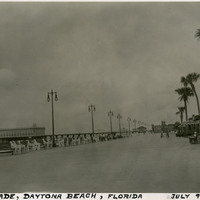
Caption: "Promenade, Daytona Beach, Florida, July 9, 1934." Wide promenade along the beach at Daytona Beach, featuring a row of benches at the left (seaside) and covered seating areas on the right, with palm trees. Daytona Beach was created when the neighboring towns of Daytona, Daytona Beach, Kingston, and Seabreeze merged in 1926. The area's beach was already well-known in both tourist and automobile circles
Date: 7/9/1934