
Search All Items
- Filters:
- Language
- English 5827
- Spanish 62
- ENGLISH 2
- English 1
- census_013 1
- contra_costa_schedule_1_volume_1 1
- Type
- Image 3871
- Still Image 1544
- Text 447
- Text 22
- Textual 2
- Image of the California Census from the records of the office of the California Secretary of State 1
Search Results 291 to 300 of 5968
-
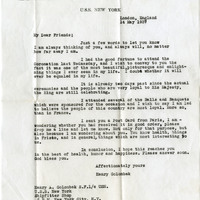
No caption. Letter from Henry Golombeck of the U.S. Navy to William and Grace McCarthy, on the letterhead of the USS New York, dated May 14, 1937, and sent from London England.
Date: 5/14/1937
-
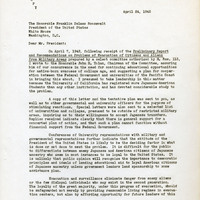
Correspondence from Robert G. Sproul to Franklin Delano Roosevelt regarding a plan for Japanese college and university students during the evacuation; See "Proposal for the Continued Collegiate Training…" (F3729_145_003a-F3729_145_003b)
Date: April 24, 1942
-
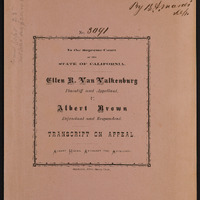
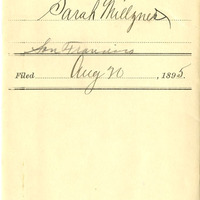
A Transcript of Appeal is the official written record of a trial, used by a higher court to review the lower court's proceedings. Ellen Van Valkenburg began an important legal battle for women’s enfranchisement in California on July 21, 1871, when she requested that Santa Cruz County Clerk Albert Brown enter her name in the Great Register of voters. After Brown (a willing accomplice in helping her bring the case to court) refused to register her, Van Valkenburg and her lawyer, Santa Cruz Judge Albert Hagan, began legal proceedings by requesting a writ of mandamus, a judicial remedy used to compel agencies to perform ministerial acts, such as registering voters. Van Valkenburg and Hagan argued her case by citing the 14th Amendment of the U.S. Constitution. The new amendment, ratified 3 years earlier in 1868, defined all persons born or naturalized in the U.S. as citizens protected by civil rights. Van Valkenburg and Hagan asserted that American women were considered citizens under this amendment, and that citizenship automatically granted absolute rights, including the right to vote. The case first went to California’s Third District Court. Many of America’s most prominent suffragists, including Elizabeth Cady Stanton and Susan B. Anthony, were with Van Valkenburg in Santa Cruz when the lower court ruled against her on August 16, 1871. Van Valkenburg and Hagan swiftly appealed this decision through the Supreme Court of California. In the end, the Supreme Court of California upheld the lower court’s verdict under the reasoning that as a white American woman, Van Valkenburg already had citizenship and civil rights prior to the passage of the 14th amendment, and that the 14th amendment did not provide her with any additional political rights, such as the right to vote. While Van Valkenburg lost her case, and subsequent lawsuits failed to secure women's suffrage nationwide, the case stands as a critical early example of legal advocacy for women's political rights in California.
Date: September 23, 1871
-
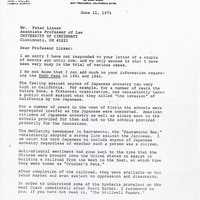
Correspondence from James Purcell to Peter Linzer regarding case of Mitsuye Endo
Date: June 11, 1975
-
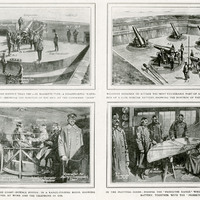
No Caption: Photograph of part of a print from the Illustrated London News, regarding placement and operation of coastal artillery defense methods. See also 96-07-08-alb05-095.
Date: 1910-09-03
-
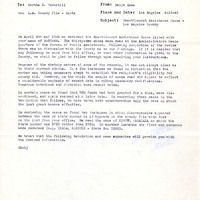
Office Memorandum from Ralph Enos to Bertha S. Underhill regarding individual case summaries and statistics
Date: April 16, 1946
-
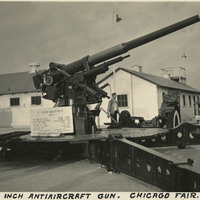
Caption: "U.S. 3 Inch Antiaircraft [sic] Gun. Chicago Fair. Sept, [sic] 19, 1934." View of a 3"/50 caliber anti-aircraft gun, a heavy artillery weapon used by the US Navy and Coast Guard. The weapon was part of a display at Chicago's Century of Progress Exposition. The Exposition, a world fair attended by thirty-nine million people, celebrated Chicago's one-hundred year anniversary of incorporation. Originally planned to only run from May to November in 1933, it was such a success that its organizers decided to keep it running for a second season from May through October the following year. The central theme of the Exposition was technological innovation, with a motto of "Science Finds, Industry Applies, Man Conforms."
Date: 9/19/1934