Search All Items
- Filters:
- Language
- English 6020
- Spanish 194
- ENGLISH 2
- English 1
- census_013 1
- Type
- Image 3854
- Still Image 1909
- Text 426
- Text 22
- Textual 2
Search Results 3101 to 3110 of 6281
-
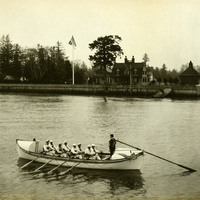
No Caption: c. 1910. View of the Point Adams Lifesaving Station near Hammond, Oregon, including a rowboat ("Point Adams") manned by eight rowers, with one man at the rudder. The Point Adams Lifesaving Station was established in 1889 by the federal government, in response to growing numbers of merchant, fishing, and other sailing vessels along the Columbia River. The stationhouse, visible in the center of the photograph, was demolished in 1939 to make way for a new building. The two-bay boathouse visible at the right had to be moved in 1913-1915 due to erosion of the bank upon which it stood. The U.S. Coastguard took over operation of the station in 1915. The station remained operational until 1967. The remaining buildings now house the Point Adams Research Facility of the Northwest Fisheries Science Center.
Date: 1910
-
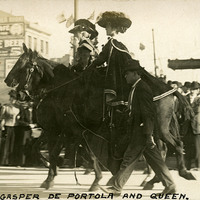
Caption: "Don Gasper [sic] de Portola and Queen," 1909. Participants at the Portola Festival on horseback and dressed in period costume as Don Gaspar De Portola and Queen. The Portola Festival was a grand celebration devised to commemorate the discovery of San Francisco Bay by Gaspar De Portola, and for the public to celebrate the future of the rebuilt city after the 1906 earthquake and fires.
Date: 1909
-
Caption: "Burnt Arlington Dock, Seattle." This photograph shows the result of a fire at Seattle's Arlington Dock on May 7, 1906. Heavy fire damage can be seen on the building pictured. Its roof and the central portion of the façade collapsed, and burn marks appear at all windows. Thousands of dollars' worth of supplies were destroyed in the fire. At the time, Arlington Dock was the primary shipping facility for the city.
Date: 1906
-
No Caption: Seattle street scene dominated by a banner welcoming fairgoers to the Alaska-Yukon-Pacific Exposition. Held in Seattle to celebrate the development of the Pacific Northwest, the fair attracted 3.7 million visitors over the course of its run from June to October 1909. Although most of the fair's buildings have since been destroyed, several of them now serve as part of the University of Washington campus.
Date: 1909
-
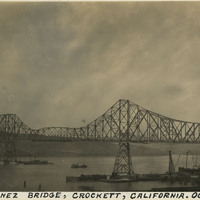
Caption: "Carquinez Bridge, Crockett, California. Oct. 9, 1934." This photograph shows the original Carquinez Bridge, built to span the Carquinez Strait and thereby contribute to a direct route between Sacramento and San Francisco. The steel cantilevered bridge, designed by Robinson & Steinman, was constructed in 1927. It is no longer extant, having been replaced by two parallel bridges constructed in 1958 and 2003. The structure of the original bridge was removed in 2007. See also 96-07-08-alb04-004.
Date: 10/9/1934
-
Caption: "Home of Mary Clark -- Movie Star -- New Orleans, June 17, 1934." View of large, two-story residence in New Orleans. William McCarthy described this as the home of Helen Marguerite Clark, a silent film actress who married Louisiana businessman Harry Palmerston Williams. California State Archives staff were not able to confirm that this house was one of the New Orleans-area residences owned by the couple.
Date: 6/17/1934
-
No Caption: This postcard shows a view of the façade of the Government Building at the Alaska-Yukon-Pacific Exposition. Held in Seattle to celebrate the development of the Pacific Northwest, the fair attracted 3.7 million visitors over the course of its run from June to October 1909. Although most of the fair's buildings have since been destroyed, several of them now serve as part of the University of Washington campus.
Date: 1909
-
Caption: "Delaware & Hudson R.R. Exhibit. Chicago. Sept. 21, 1934. First Locomotive to Operate on an American Railroad, August 8, 1829." View of a replica of the Stourbridge Lion, the first steam locomotive to operate in the U.S., on lines built by the Delaware and Hudson Railway (formerly the Delaware and Hudson Canal Company). The replica was displayed at the 1934 Century of Progress Exposition, celebrating Chicago's one-hundred year anniversary of incorporation. This photograph was loose in the box with Album 11.
Date: 9/21/1934
-
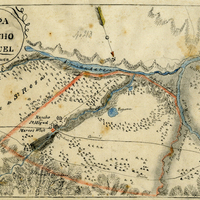
Hand-drawn sketch map of San Miguel or Chisino boundaries. Volume 1, page 578.
Date: 1840
-
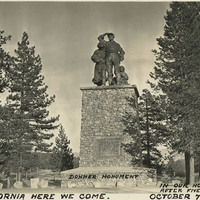
Caption: "California Here We Come. Donner Monument. In Our Home State Again After Five Months Tour. October 7, 1934." William and Grace McCarthy took this photograph of the Pioneer Monument when they arrived back in California after a five month road trip to the East Coast. The Pioneer Monument, featuring a pair of pioneers with their two children looking west, was first dedicated on June 6, 1918 to commemorate those who emigrated to California in the mid 1800s. Today, the monument and surrounding area is known as Donner Memorial State Park. The park was established in memory of the ill-fated Donner Party, a group of emigrants whose wagon train was caught in the Sierra Nevada Mountains during the winter of 1846-47. The Pioneer Monument's stone pedestal stands twenty-two feet high, the height of the snow that the party had to contend with. Of the eighty-seven people in the wagon train, only forty-eight survived to be rescued the following spring. Some of the survivors are said to have resorted to cannibalism in order to survive.
Date: 10/7/1934