
Search All Items
- Filters:
- Type
- Image 3668
- Still Image 1101
- Text 405
- Text 19
- Image of the California Census from the records of the office of the California Secretary of State 1
- Language
- English 5171
- Spanish 28
- ENGLISH 2
- English 1
- census_013 1
- contra_costa_schedule_1_volume_1 1
Search Results 3121 to 3130 of 5250
-
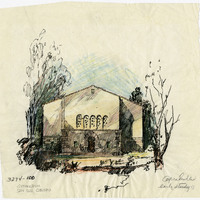
Caption: "Gymnasium, San Luis Obispo." Early study of gymnasium, California State Polytechnic College, San Luis Obispo; design and color drawing by Alfred Eichler. Built. Project for Department of Education.
Date: 1936
-
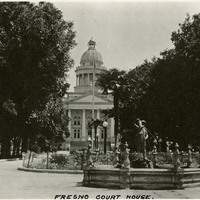
Caption: "Fresno Court House.," c. 1920. Shows the historic Fresno County Courthouse, built in 1875, as well as a small fountain. This courthouse was torn down in 1966 to make way for a more modern facility.
Date: 1920
-
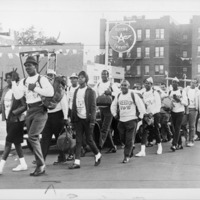
This item has no description.
Date: 1963
-
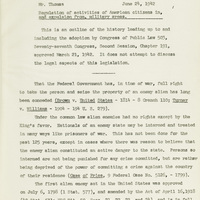
Narrative by J. M. Thomas to Mr. Wenig regarding the history leading up to and including the adoption of Public Law 503, 77th Congress
Date: June 24, 1942
-
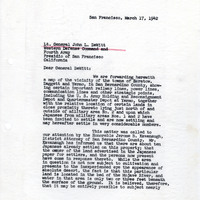
Correspondence from Earl Warren (by Warren Olney) to John L. DeWitt regarding strategic military points in the vicinity of San Bernardino County
Date: March 17, 1942
-
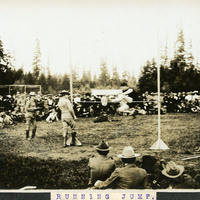
Caption: "R U N N I N G J U M P.," c. 1917. Image of an early high jumper in mid-leap, with men clad in military uniforms watching, as well as civilian men and women. In the high jump, athletes attempt to leap over a horizontal bar without the benefit of a pole (as in pole vaulting). The technique shown here is an early one with the jumper upright rather than in the "Fosbury Flop" position, developed later in the century. The uniforms and surrounding vegetation in the photograph suggest that that event may have taken place at Camp Lewis, Washington.
Date: 1917
-
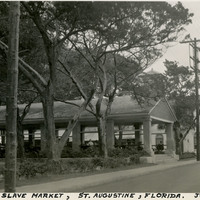
Caption: "Spanish Slave Market, St. Augustine, Florida. July 10, 1934." An open-air pavilion with a gabled roof and six bays appears in the center of this photograph, somewhat obscured by surrounding trees and vegetation. The waterfront site on which the pavilion sits has served St. Augustine as a marketplace since the city's founding in the sixteenth century, for food, commercial goods, and for slaves. The pavilion in the photograph was constructed in 1888, after a fire burned down the previous structure. In the twentieth century, entrepreneurs used the slave market aspect of the site's history as a hook to entice northern tourists into St. Augustine's historic quarter. The market has often served as a rallying site for protestors, from suffragettes to protestors of the war in Iraq. Various civil rights marches held around the market in the 1960s attracted such luminaries as Dr. Martin Luther King, Jr. and Andrew Young.
Date: 7/10/1934
-
Various selections from handbook distributed to county representatives explaining policy
Date: Various dates