
Search All Items
- Filters:
- Type
- Image 3668
- Still Image 1101
- Text 405
- Text 19
- Image of the California Census from the records of the office of the California Secretary of State 1
- Language
- English 5171
- Spanish 28
- ENGLISH 2
- English 1
- census_013 1
- contra_costa_schedule_1_volume_1 1
Search Results 3141 to 3150 of 5250
-
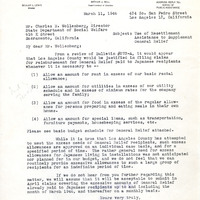
Correspondence from Beulah L. Lewis to Charles M. Wollenberg regarding resettlement assistance; Attachment: General Relief Basic Budget Table No. 33
Date: March 11, 1946
-
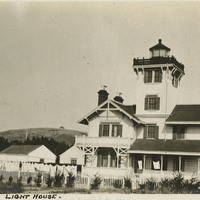
Caption: "Point Firmin [sic] Lighthouse," c. 1915, shows the Point Fermin lighthouse, built in 1874 in San Pedro Bay, which was the first navigational light into the bay. It served as a federally-operated lighthouse until 1927, when its operations were turned over to the City of Los Angeles. After the bombing of Pearl Harbor in 1941, the west coast was blacked out for fear of being an easy target to enemy forces. It was never lit again, but during WWII it served the U.S. Navy as a lookout tower and signaling station for ships coming into the San Pedro Bay. In 2003, the lighthouse was opened after being restored, retrofitted, and rehabilitated for public use. It is listed on the National Register of Historic Places and managed by the Department of Recreation and Parks of the City of Los Angeles.
Date: 1915
-
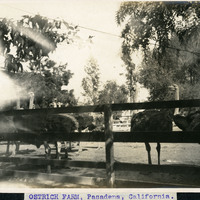
Caption: "OSTRICH FARM, Pasadena, California.," c. 1905. View of several ostriches in a corral at the Caswston Ostrich Farm in Pasadena. Opened by Edward Cawston in 1886, this was the first ostrich farm in the U.S. It became a popular tourist stop along the Pasadena and Los Angeles Electric Railway in the early twentieth century, where visitors could ride an ostrich, or be pulled by one in a light card. They could also buy merchandise made out of ostrich feathers, such as hats and boas. The farm closed in the mid-1930s.
Date: 1905
-
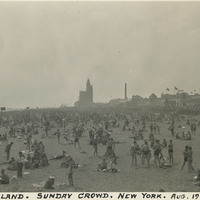
Caption: "Coney Island. Sunday Crowd. New York. Aug. 19, 1934." Very crowded beach scene on New York's Coney Island. The construction of several resort hotels on the island in the 1870s and 1880s encouraged construction of amusement parks to provide tourist destinations. Coney Island has hosted several large amusement parks over the years, including one of the world's first roller coasters (built in 1884). Numerous smaller attractions were available as well. The island's popularity peaked in the mid-twentieth century, in the World War II era, but despite some decline is still a world-renowned recreation area.
Date: 8/19/1934
-
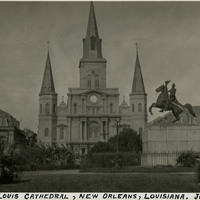
Caption: "Saint Louis Cathedral, New Orleans, Louisiana. June 16, 1934." St. Louis Cathedral anchors one end of Jackson Square in New Orleans' French Quarter. The structure of the cathedral largely dates to the 1850 restoration and expansion of an older cathedral built on the site in 1793. Very little of the older church survived, although the central bell tower (added on to the older church in 1819) was reused in the new structure and is still extant today. A statue of Andrew Jackson mounted on a rearing horse (Clark Mills, sculptor) stands in the square in front of the cathedral. The sculpture was erected in 1856. See also 96-07-08-alb09-231.
Date: 6/15/1934
-
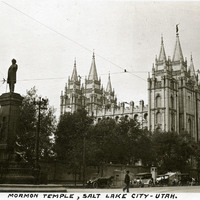
Caption: "Mormon Temple, Salt Lake City -- Utah.," c. 1916. View of the temple of the Church of Jesus Christ of Latter Day Saints (Truman O. Angell, architect) in Salt Lake City, Utah, dedicated in 1893. The Brigham Young Monument (also known as the Pioneer Monument) stands at the left. Designed by Cyrus Edwin Dallin, this statue commemorating one of the founders of the Church of Jesus Christ and the Latter Day Saints was first displayed at the Chicago World's Fair in 1893, and moved to its post at Main and South Temple Streets in Salt Lake City in 1897.
Date: 1916
-
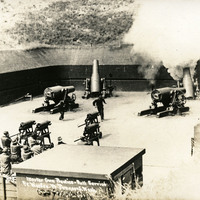
Caption: "Mortar Gun Practice -- Full Service, Fort Worden, Pt Townsend, Wash," c. 1910. The postcard shows several Howitzers, one of which is firing, as well as a group of men standing to the side with their hands over their ears. Construction began on Fort Worden in 1898, and by 1902 it was serving as an active U.S. Army base. Fort Worden was part of the "triangle of fire," three coastal defense fortifications (Fort Casey, Fort Worden, and Fort Flagler) guarding the entrance to Puget Sound. The U.S. sold the property to the state of Washington in 1957. In 1973, the fort and surrounding area opened as Fort Worden State Park.
Date: 1910
-
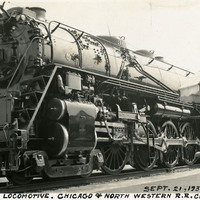
Caption: "Modern Locomotive. Chicago & North Western R.R. Chicago Fair, Sept. 21, 1934." Grace McCarthy is seated next to a large locomotive of the Chicago and North Western Railroad while visiting the Century of Progress Exposition in Chicago. The locomotive was one of the new Class H 4-8-4 engines, capable of pulling either freight or passenger trains. These locomotives were among the heaviest of their class produced in America, and were dubbed the "Zeppelins of the Rails." This photograph was loose in the box with Album 11.
Date: 9/21/1934