
Search All Items
- Filters:
- Type
- Image 3670
- Still Image 1106
- Text 405
- Text 19
- Image of the California Census from the records of the office of the California Secretary of State 1
- Language
- English 5178
- Spanish 28
- ENGLISH 2
- English 1
- census_013 1
- contra_costa_schedule_1_volume_1 1
Search Results 3151 to 3160 of 5257
-
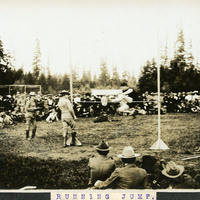
Caption: "R U N N I N G J U M P.," c. 1917. Image of an early high jumper in mid-leap, with men clad in military uniforms watching, as well as civilian men and women. In the high jump, athletes attempt to leap over a horizontal bar without the benefit of a pole (as in pole vaulting). The technique shown here is an early one with the jumper upright rather than in the "Fosbury Flop" position, developed later in the century. The uniforms and surrounding vegetation in the photograph suggest that that event may have taken place at Camp Lewis, Washington.
Date: 1917
-
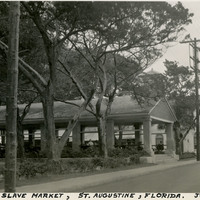
Caption: "Spanish Slave Market, St. Augustine, Florida. July 10, 1934." An open-air pavilion with a gabled roof and six bays appears in the center of this photograph, somewhat obscured by surrounding trees and vegetation. The waterfront site on which the pavilion sits has served St. Augustine as a marketplace since the city's founding in the sixteenth century, for food, commercial goods, and for slaves. The pavilion in the photograph was constructed in 1888, after a fire burned down the previous structure. In the twentieth century, entrepreneurs used the slave market aspect of the site's history as a hook to entice northern tourists into St. Augustine's historic quarter. The market has often served as a rallying site for protestors, from suffragettes to protestors of the war in Iraq. Various civil rights marches held around the market in the 1960s attracted such luminaries as Dr. Martin Luther King, Jr. and Andrew Young.
Date: 7/10/1934
-
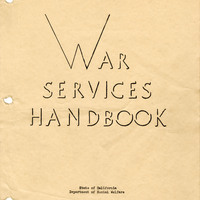
Various selections from handbook distributed to county representatives explaining policy
Date: Various dates
-
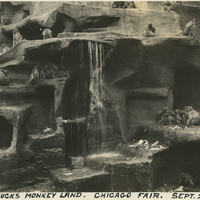
Caption: "Frank Bucks [sic] Monkey Land. Chicago Fair. Sept. 20, 1934." View of a rocky cliff populated by a species of monkey. This was part of a display at Frank Buck's Jungle Camp, an exhibition at Chicago's Century of Progress Exposition. The Exposition, a world fair attended by thirty-nine million people, celebrated Chicago's one-hundred year anniversary of incorporation. Originally planned to only run from May to November in 1933, it was such a success that its organizers decided to keep it running for a second season from May through October the following year. The central theme of the Exposition was technological innovation, with a motto of "Science Finds, Industry Applies, Man Conforms."
Date: 9/20/1934
-
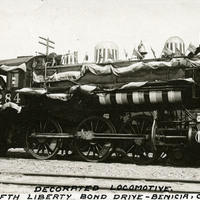
Caption: "Decorated Locomotive. Fifth Liberty Bond Drive -- Benicia, Calif." During World War I, the U.S. government raised funds for the war by issuing "liberty bonds." Citizens who purchased the bonds could later redeem them for the purchase price plus interest. Liberty Bond Drives were held to encourage people to purchase the bonds. This photograph shows a locomotive employed in the fifth Liberty Bond Drive, held in 1919. Decorated with bunting and flags to inspire patriotic feeling, Liberty Bond Trains crisscrossed the U.S. to round up funding.
Date: 1919
-
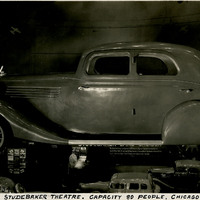
Caption: "Sept. 20, 1934, The Big Studebaker Theatre. Capacity 80 People. Chicago Fair." This giant replica of a 1934 Studebaker Land Cruiser at the Century of Progress Exposition, made of plaster over a wood frame, sat above a small theater capable of sitting eighty people. The Exposition, a world fair attended by thirty-nine million people, celebrated Chicago's one-hundred year anniversary of incorporation. Originally planned to only run from May to November in 1933, it was such a success that its organizers decided to keep it running for a second season from May through October the following year. The central theme of the Exposition was technological innovation, with a motto of "Science Finds, Industry Applies, Man Conforms."
Date: 9/20/1934