
Search All Items
- Filters:
- Type
- Image 3670
- Still Image 1106
- Text 405
- Text 19
- Image of the California Census from the records of the office of the California Secretary of State 1
- Language
- English 5178
- Spanish 28
- ENGLISH 2
- English 1
- census_013 1
- contra_costa_schedule_1_volume_1 1
Search Results 3161 to 3170 of 5257
-
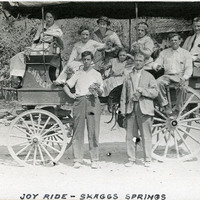
Caption: "Joy Ride -- Skaggs Springs," c. 1914. William (standing in front to the right) and Grace (third from the left in the wagon) McCarthy and a group of unidentified people all holding bunches of grapes, either getting ready for or coming back from a ride in a horse-drawn wagon. Skaggs Springs was a resort area along the Russian River in Sonoma County, known for its hot springs. The area now lies beneath the waters of Lake Sonoma, flooded after construction of the Warm Springs Dam, completed in 1982.
Date: 1914
-
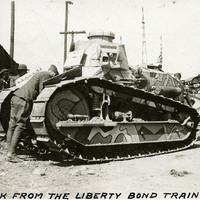
Caption: "A Tank from the Liberty Bond Train." Shows a Renault FT Tank, a small French tank with caterpillar-style propulsion used during World War I. This tank was displayed as part of the fifth Liberty Bond Drive, held in 1919. During World War I, the U.S. government raised funds for the war by issuing "liberty bonds." Liberty Bond Trains crisscrossed the country to encourage purchase of the bonds. Citizens who purchased the bonds could later redeem them for the purchase price plus interest.
Date: 1919
-
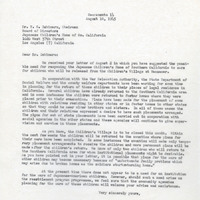
Correspondence from Charles M. Wollenberg to T. G. Ishimaru regarding possible reopening of the Japanese Children's Home of Southern California after the closure of the Children's Village at Manzanar
Date: August 10, 1945
-
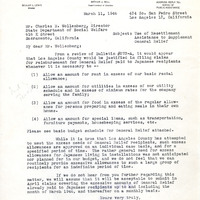
Correspondence from Beulah L. Lewis to Charles M. Wollenberg regarding resettlement assistance; Attachment: General Relief Basic Budget Table No. 33
Date: March 11, 1946
-
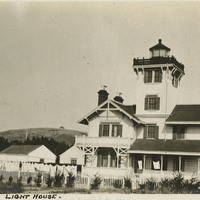
Caption: "Point Firmin [sic] Lighthouse," c. 1915, shows the Point Fermin lighthouse, built in 1874 in San Pedro Bay, which was the first navigational light into the bay. It served as a federally-operated lighthouse until 1927, when its operations were turned over to the City of Los Angeles. After the bombing of Pearl Harbor in 1941, the west coast was blacked out for fear of being an easy target to enemy forces. It was never lit again, but during WWII it served the U.S. Navy as a lookout tower and signaling station for ships coming into the San Pedro Bay. In 2003, the lighthouse was opened after being restored, retrofitted, and rehabilitated for public use. It is listed on the National Register of Historic Places and managed by the Department of Recreation and Parks of the City of Los Angeles.
Date: 1915
-
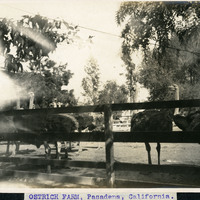
Caption: "OSTRICH FARM, Pasadena, California.," c. 1905. View of several ostriches in a corral at the Caswston Ostrich Farm in Pasadena. Opened by Edward Cawston in 1886, this was the first ostrich farm in the U.S. It became a popular tourist stop along the Pasadena and Los Angeles Electric Railway in the early twentieth century, where visitors could ride an ostrich, or be pulled by one in a light card. They could also buy merchandise made out of ostrich feathers, such as hats and boas. The farm closed in the mid-1930s.
Date: 1905