
Search All Items
- Filters:
- Language
- English 5827
- Spanish 62
- ENGLISH 2
- English 1
- census_013 1
- contra_costa_schedule_1_volume_1 1
- Type
- Image 3871
- Still Image 1544
- Text 447
- Text 22
- Textual 2
- Image of the California Census from the records of the office of the California Secretary of State 1
Search Results 301 to 310 of 5968
-
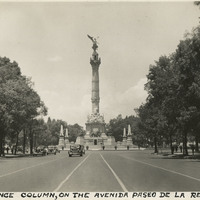
Caption: "Independence column, on the Avenida Paseo de la Reforma." Unofficially known as El Angel (The Angel), and officially as Monumento a la Indenpendencia (Monument to Independence), located in Mexico City.
Date: 1938
-
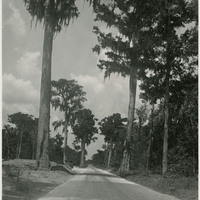
Caption: "Florida Highway. June 26, 1934." Tall trees, many hung with Spanish moss, line this unidentified Florida highway.
Date: 6/26/1934
-
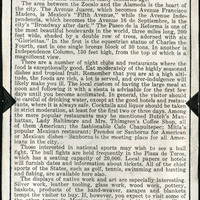
No Caption: A page from an informational tourist brochure describing Mexico City.
Date: 1938
-
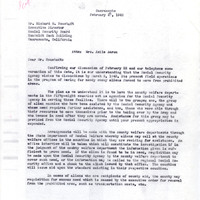
Correspondence from Martha A. Chickering to Richard M. Neustadt regarding county takeover of relocation program
Date: February 26, 1942
-
Mis Dos Medallas Habana J. V., Primera La Oda De J. V. Habana, etc.
Date: 1865
-
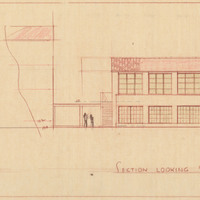
Caption: "Section Looking North and Section Looking South." Color drawing of intermediate girls' dormitory, California School for the Deaf at Berkeley. Design and drawing by Alfred Eichler, 1944; built in 1946. Project for Department of Education.
Date: 1944
-
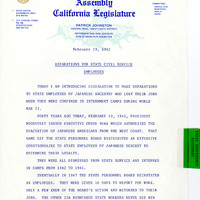
Press Conference Statement by Patrick Johnston on introduction on legislation
Date: February 19, 1982
-
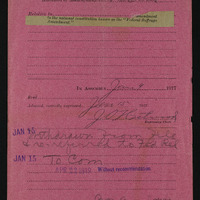
In addition to granting women the right to vote, the 1911 women’s suffrage amendment also paved the way for women to hold political office in California. In 1918, Esto B. Broughton, Elizabeth Hughes, Anna L. Saylor, and Grace S. Dorris became the first four women elected to the California State Assembly. Though fifteen states had already granted women full voting rights, a federal amendment was required to secure nationwide suffrage. To push for this national change, two almost identical resolutions were introduced on January 9, 1919 to urge the U.S. Congress to move forward with “the amendment to the National Constitution known as ‘The Federal Suffrage Amendment.’". On just her third day in office, newly elected Assemblywoman Grace S. Dorris introduced Assembly Joint Resolution No. 1. Simultaneously, Senate Joint Resolution No. 3 was introduced by Senator Burnett, a male colleague in the State Senate. While Dorris's historic Assembly bill ultimately died in committee, its twin Senate resolution successfully advanced, passing both chambers on January 17, 1919.
Date: January 1919