
Search All Items
- Filters:
- Type
- Image 3607
- Still Image 935
- Text 401
- Text 19
- Image of the California Census from the records of the office of the California Secretary of State 1
- Language
- English 4941
- Spanish 26
- ENGLISH 2
- English 1
- census_013 1
- contra_costa_schedule_1_volume_1 1
Search Results 3571 to 3580 of 5013
-
Hand-drawn sketch map of Punta del Monte or Rincon de la Punta del Monte boundaries. Volume 1, page 406.
Date: 1826
-
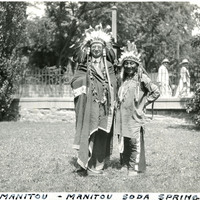
Caption: "Chief Manitou - Manitou Soda Springs," c. 1923. William McCarthy, wearing a Native American headdress and attire, stands next to Pedro Cajete. Mr. Cajete, better known to many as Chief Manitou, was a Native American of the Tewa tribe near Santa Fe, New Mexico, who was hired to promote tourism in the Manitou Springs/Colorado Springs area of Colorado. He often sold trinkets and posed for photographs with tourists near the mouth of Manitou Cave, resulting in his moniker Chief Manitou.
Date: 1923
-
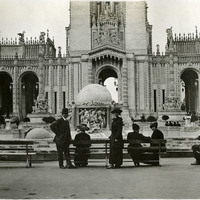
No Caption: William and Grace McCarthy (standing and looking at the camera) at the Panama-Pacific International Exposition, 1915. The Panama Pacific International Exposition was held to celebrate the completion of the Panama Canal, as well as inventive technologies and new industries from around the world. It was also a chance for San Francisco to show the world how the great city had rebuilt and thrived after the devastation of the 1906 earthquake and fire.
Date: 1915
-
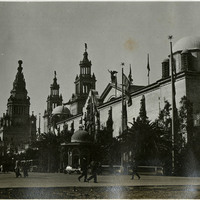
No Caption: Educational Building on the left, with Tower of Jewels in the background, at the Panama-Pacific International Exposition, 1915. The Panama Pacific International Exposition was held to celebrate the completion of the Panama Canal, as well as inventive technologies and new industries from around the world. It was also a chance for San Francisco to show the world how the great city had rebuilt and thrived after the devastation of the 1906 earthquake and fire.
Date: 1915
-
Caption: "San Diego Fair Grounds." and "39-9, U.S. Naval Training Station, Balboa Park, San Diego," c. 1917. With the advent of World War I, the U.S. Navy needed additional training grounds for sailors. In 1917, the City of San Diego offered to lease the Navy a portion of Balboa Park as a temporary training site until a new, more permanent facility could be constructed. This postcard shows groups of sailors drilling in formation while a small crowd watches.
Date: 1917
-
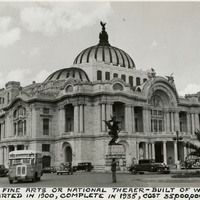
Caption: "Palace of Fine Arts or National Theater [sic] - built of white marble. Work started in 1900, complete in 1935, cost 35,000,000 pesos." The Palacio de Bellas Artes, is considered the cultural center of Mexico City. It houses the Museum of Architecture, and the National Theater, a performance space for music, dance, and theatre. Murals by renown Mexican artists such as Diego Rivera, Rufino Tamayo, Jose Clemente Orozco, and others are exhibited on the top floor and other galleries throughout the building.
Date: 1938
-
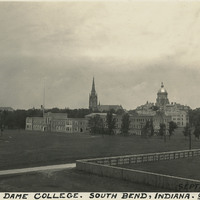
Caption: "Notre Dame College. South Bend, Indiana. Sept. 14, 1734 [sic], Sept. 14, 1934." Founded in 1842 and officially chartered in 1844, the University of Notre Dame is a Catholic research university famous world-wide for the quality of the education it provides. This photograph shows the Main Building's domed tower, (just to the right of center), and the steeple of the Basilica of the Sacred Heart (center), the university's on-site Catholic Church.
Date: 9/14/1934
-
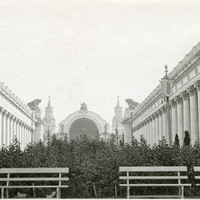
No Caption: Colonnades at the Panama-Pacific International Exposition, 1915. The Panama Pacific International Exposition was held to celebrate the completion of the Panama Canal, as well as inventive technologies and new industries from around the world. It was also a chance for San Francisco to show the world how the great city had rebuilt and thrived after the devastation of the 1906 earthquake and fire.
Date: 1915
-
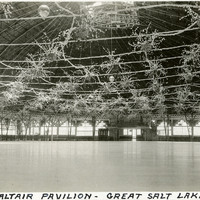
Caption: "Saltair Pavilion - Great Salt Lake," c.1923. Interior of the Saltair Pavilion on Utah's Great Salt Lake. Constructed in 1893 and designed by Richard K.A. Kletting, the Saltair resort set out to be the Western counterpart of Coney Island. The resort was a popular spot for Mormon families, only fifteen miles from Salt Lake City and overseen by Church leaders. The Church sold the building in 1906. It was later destroyed by fire in 1925, but a second pavilion was quickly built.
Date: 1923
-
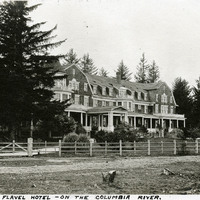
Caption: "Flavel Hotel -- on the Columbia River.," c. 1905-1909. Built at the turn of the century, the Flavel Hotel housed passengers waiting to board steamships of the Great Northern Pacific Steamship Company bound for San Francisco and other ports. The Flavel family constructed the hotel as part of an effort to establish the town of Flavel on Tansy Point along the Columbia River. The town failed to attract sufficient residents, however, and was annexed into Warrenton by 1918.
Date: 1905