Search All Items

Note: Check the about page for more information on the data sources used in this search

Search Results 3761 to 3770 of 3850

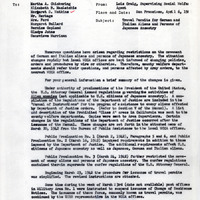
  • Statement to the Press Issued by Major General H. C. Pratt

    Press Release by H. C. Pratt announcing the issuance of Public Proclamation No. 21, which terminates certain exclusions

    Date: Undated

  • Old Series Trademark No. 1346

    Spider Leg

    Date: 1885

  • Old Series Trademark No. 3117

    Western Star

    Date: 1897

  • Old Series Trademark No. 3469

    Mustavit

    Date: 1899

  • McCarthy Album 11, Photograph 173

    Caption: "Jefferson Davis Highway. U.S. No. 1. Virginia. July 20, 34." Grace McCarthy is standing next to a U.S. Route 1 sign along a highway in Virginia. The Jefferson Davis Highway project was begun by the United Daughters of the Confederacy (UDC). As auto tourism increased across the U.S., so to did the need for roads on which to drive. Private interests such as the UDC began to develop routes across the country, but with no central administrating organization the routes were haphazard and confusing. The UDC planned a route that was to stretch from Virginia across the southern U.S. to San Diego, but the entire route never materialized. The federal government stepped in to impose a numbering system on various routes across the nation. That portion of the planned Jefferson Davis Highway through Virginia was numbered as U.S. Route 1.

    Date: 7/20/1934

  • McCarthy Album 11, Photograph 277

    Caption: "Government Building. Chicago Fair. Sept. 18, 1934." View of the Federal Building at Chicago's Century of Progress Exposition, as seen from across the harbor. The three tall towers represent the three branches of the federal government. This building, towering over the Exposition, was featured on a commemorative US Postage Stamp issued in honor of the Exposition. A world fair attended by thirty-nine million people, the Expo celebrated Chicago's one-hundred year anniversary of incorporation. Originally planned to only run from May to November in 1933, it was such a success that its organizers decided to keep it running for a second season from May through October the following year. The central theme of the Exposition was technological innovation, with a motto of "Science Finds, Industry Applies, Man Conforms."

    Date: 9/18/1934

  • McCarthy Album 03, Photograph 065

    Caption: "Fort Casey Light House, Wash." c. 1905. Located on Whidbey Island in Puget Sound, the Admiralty Head Lighthouse was built overlooking Admiralty Inlet in 1903. It replaced an earlier structure that had to be moved in 1890 to accommodate the construction of Fort Casey. The second lighthouse, shown here, was built with thick walls in order to withstand earthquakes and the concussion of guns at Fort Casey. The man shown in the photograph is likely Charles H. Davis, who was appointed keeper of the lighthouse in 1900 and served until his death in 1914. The lighthouse, deactivated in 1922, has since been restored by Washington State Parks, and is part of the Fort Casey State Park.

    Date: 1905

  • McCarthy Album 11, Photograph 283

    Caption: "Union Pacific Streamline Train. Chicago Fair. Sept. 22, 1934." View of the engine on the Union Pacific's new M-10000, on exhibit at Chicago's Century of Progress Exposition. The M-10000 was the first lightweight express passenger train powered by an internal combustion engine in the U.S. The train went on an exhibition tour of the US in 1934, which included a stop at the Exposition. The Exposition, a world fair attended by thirty-nine million people, celebrated Chicago's one-hundred year anniversary of incorporation. Originally planned to only run from May to November in 1933, it was such a success that its organizers decided to keep it running for a second season from May through October the following year. The central theme of the Exposition was technological innovation, with a motto of "Science Finds, Industry Applies, Man Conforms."

    Date: 9/22/1934

  • McCarthy Album 11, Photograph 228

    Caption: "Jones's [sic] Beach Tower, New York. Aug. 26 1934." The large tower in the center of this photograph was a 188-foot-tall water tower in Jones Beach, built in 1930 in imitation of the Italianate-style bell tower of St. Mark's Basilica in Venice, Italy. The Long Island State Park Commission began to develop what is now the Jones Beach area for a park in the 1920s, dredging enough sand to connect several of the barrier islands south of Long Island and raising the elevation of the islands by fourteen feet to create one large park. It opened to the public in 1929. It is now a state park, with an estimated six million visitors each year.

    Date: 8/26/1934

  • McCarthy Album 11, Photograph 088

    Caption: "Ringling Museum -- Sarasota -- Florida, June 28 1934." Entrance to the John and Mable Ringling Museum of Art, Florida's state art museum established by John and Mable Ringling in 1927. John was a promoter and part-owner of the famous Ringling Brothers Circus, along with four of his brothers. When John and Mable built a winter home in Sarasota in 1926, they also explored the possibility of establishing an art gallery on the same property. Architect John H. Phillips designed the building, which opened to the public in 1931. John Ringling willed the facility and the art collection to the state of Florida upon his death in 1936. The museum, now known simply as "The Ringling," is under the jurisdiction of the University of Florida.

    Date: 6/28/1934