
Search All Items
- Filters:
- Language
- English 3825
- Spanish 4
- ENGLISH 1
- contra_costa_schedule_1_volume_1 1
- Type
- Image 2628
- Still Image 826
- Text 361
- Text 12
- Textual 2
- Image of the California Census from the records of the office of the California Secretary of State 1
Search Results 3811 to 3820 of 3868
-
Memo from William G. Pierce to All WCCA Control Station Managers regarding evacuees bringing belongings to the Assembly and Reception Centers
Date: May 7, 1942
-
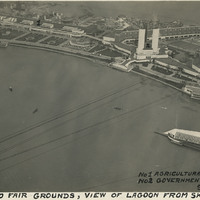
Caption: "Chicago Fair Grounds, View of Lagoon from Sky Ride. No 1 Agricultural Building. No2 Government Building. Sept. 17, 1934." Bird's eye view of a portion of the fair grounds for Chicago's Century of Progress Exposition. Two of the fair's structures have been labeled in this photograph, including the Agriculture Building, a long low structure, and the Federal Building, featuring three towers representing the three branches of the federal government. The Exposition, a world fair attended by thirty-nine million people, celebrated Chicago's one-hundred year anniversary of incorporation. Originally planned to only run from May to November in 1933, it was such a success that its organizers decided to keep it running for a second season from May through October the following year. The central theme of the Exposition was technological innovation, with a motto of "Science Finds, Industry Applies, Man Conforms." None of the buildings constructed for the fair are still extant today, having been built as temporary facilities.
Date: 9/17/1934
-
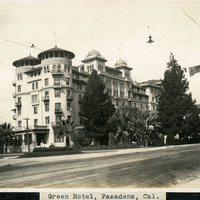
Caption: "Green Hotel, Pasadena, Cal.," c. 1905. View of Castle Green, built as an annex to the Hotel Green in 1899. The original Hotel Green opened for business as a lavish resort in 1894. Its success prompted owner George Gill Green to expand the hotel and build the additional facility shown here, connected to the original hotel by an elaborate enclosed pedestrian bridge (seen at the far right of this photograph). This second building, designed by architect Frederick I. Roehrig with Spanish, Moorish, and Victorian elements, became known as "Castle Green." Business declined in the 1910s, and the complex was sold to a series of investors. In the mid-1920s, Castle Green was subdivided into fifty residential apartments. It remains a residential complex today.
Date: 1905
-
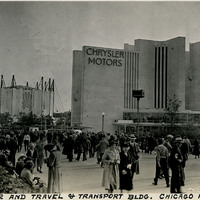
Caption: "Chrysler and Travel & Transport Bldg. Chicago Fair. Sept. 16, 1934." View of two buildings at the Century of Progress Exposition in Chicago. The Chrysler Motors building dominates the photograph, while the Travel and Transport Building can be seen at the left. The latter building featured a catenary roof, the first one built in the US. The Exposition, a world fair attended by thirty-nine million people, celebrated Chicago's one-hundred year anniversary of incorporation. Originally planned to only run from May to November in 1933, it was such a success that its organizers decided to keep it running for a second season from May through October the following year. The central theme of the Exposition was technological innovation, with a motto of "Science Finds, Industry Applies, Man Conforms." None of the buildings constructed for the fair are still extant today, having been built as temporary facilities.
Date: 9/16/1934
-
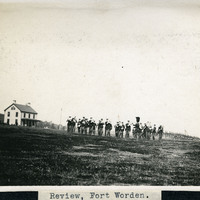
Caption: "Review, Fort Worden.," c. 1908-1912. Shows a military band playing or preparing to play, with rows of troops assembled in the background on the right side of the photograph. Fort Worden is located in Port Townsend, Washington, on Admiralty Inlet of Puget Sound. Construction began on the fort in 1898, and by 1902 it was serving as an active U.S. Army base. Fort Worden was part of the "triangle of fire," three coastal defense fortifications (Fort Casey, Fort Worden, and Fort Flagler) guarding the entrance to Puget Sound. The U.S. sold the property to the State of Washington in 1957. In 1973, the fort and surrounding area opened as Fort Worden State Park.
Date: 1908