
Search All Items
- Filters:
- Language
- English 3825
- Spanish 4
- ENGLISH 1
- contra_costa_schedule_1_volume_1 1
- Type
- Image 2628
- Still Image 826
- Text 361
- Text 12
- Textual 2
- Image of the California Census from the records of the office of the California Secretary of State 1
Search Results 3821 to 3830 of 3868
-
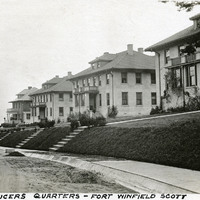
Caption: "Officers Quarters -- Fort Winfield Scott," c. 1912. Shows a row of multi-story homes along a landscaped street. Fort Winfield Scott was a coastal artillery post at the San Francisco Presidio. Originally named Fort Point, it was part of an effort by the U.S. government to protect the Golden Gate, entrance to the San Francisco Bay. Built between 1853-1861, the fort included emplacements for 141 guns but never fired a weapon in defense of the Bay. Its name was officially changed in 1882 to Fort Winfield Scott. This only lasted four years, until 1886 when the fort was officially downgraded to a sub-post of the San Francisco Presidio and the name discontinued. It was resurrected in 1912, with the establishment of a coastal artillery fortification at the Presidio, called, once again, Fort Winfield Scott.
Date: 1912
-
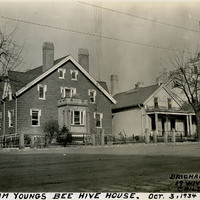
Caption: "Brigham Youngs [sic] Bee Hive House. Brigham Young had 19 Wives and 52 Children. Oct. 3, 1934." Street scene in Salt Lake City, Utah. Brigham Young, founder of the Church of Jesus Christ of Latter Day Saints built the so-called "Beehive House" in 1854 to house himself and several of his wives (Young practiced polygamy). The Beehive House is visible in the photograph at the far right, with a widow's walk featured on its roofline. Designed by Salt Lake Temple architect Truman O. Angell, the Beehive House has since been used as a residence for several dignitaries of the Mormon Church, as well as a boarding home for young Mormon women. The house was restored in the late 1950s and is now a museum. See also 96-07-08-alb11-301.
Date: 10/3/1934
-
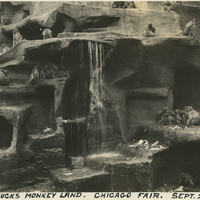
Caption: "Frank Bucks [sic] Monkey Land. Chicago Fair. Sept. 20, 1934." View of a rocky cliff populated by a species of monkey. This was part of a display at Frank Buck's Jungle Camp, an exhibition at Chicago's Century of Progress Exposition. The Exposition, a world fair attended by thirty-nine million people, celebrated Chicago's one-hundred year anniversary of incorporation. Originally planned to only run from May to November in 1933, it was such a success that its organizers decided to keep it running for a second season from May through October the following year. The central theme of the Exposition was technological innovation, with a motto of "Science Finds, Industry Applies, Man Conforms."
Date: 9/20/1934
-
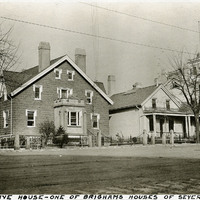
Caption: "The Bee Hive House -- One of Brighams Houses of Several Wives." Street scene in Salt Lake City, Utah. Brigham Young, founder of the Church of Jesus Christ of Latter Day Saints (the followers of which are known as Mormons) built the so-called "Beehive House" in 1854 to house himself and several of his wives (Young practiced polygamy). The Beehive House is visible in the photograph at the far right, with a widow's walk featured on its roofline. Designed by Salt Lake Temple architect Truman O. Angell, the Beehive House has since been used as a residence for several dignitaries of the Mormon Church, as well as a boarding home for young Mormon women. The house was restored in the late 1950s and now operates as a museum. See also 96-07-08-alb11-301.
Date: 1934-10-03
-
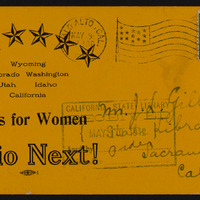
This postcard from our ephemera collection, sent by California suffragist Alice Locke Park to State Librarian James L. Gillis on May 9, 1912, features 6 stars, representing the only states that had granted women full suffrage by 1912: Wyoming (1869), Colorado (1893), Utah (1896), Idaho (1896), Washington (1910), and California (1911). Printed by the National American Woman Suffrage Association, the postcard reflects the desire to keep momentum going after California’s 1911 win by shifting the focus to Ohio's state suffrage amendment, which was ultimately defeated by male voters in both 1912 and 1914. Women in Ohio, along with millions of others nationwide, had to wait until the federal ratification of the 19th Amendment to finally gain the right to vote.
Date: May 9, 1912