
Search All Items
- Filters:
- Language
- English 3825
- Spanish 4
- ENGLISH 1
- contra_costa_schedule_1_volume_1 1
- Type
- Image 2628
- Still Image 826
- Text 361
- Text 12
- Textual 2
- Image of the California Census from the records of the office of the California Secretary of State 1
Search Results 3841 to 3850 of 3868
-
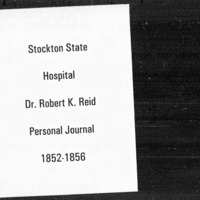
A series of short notations about hospital patients under the supervision of Dr. Reid. Volumes one through four in this series run chronologically, starting in 1852 and ending in 1856. The entries include details such as patient name, nationality, and age, as well as mental disposition. A researcher with an interest in a particular hospital patient may find Reidà¿s journals useful. Dr. Robert K. Reid's medical journals do not include private thoughts about the medical profession or details about Reid's role as a physician at Stockton State Hospital. The fifth volume in the series contains Dr. Reid's Meteorological Observations. Beginning in 1850, Reid recorded daily meteorological observations, including three daily temperature recordings, taken at 8 a.m., 2 p.m., and 8 p.m.. He also recorded cloud, wind, and rain observations, and in 1853, began recording daily barometric pressures. Dr. Robert K. Reid's Meteorological Observations journal continues through 1856.
Date: 1850-1856
-
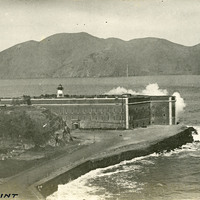
Caption: "Fort Point," c. 1910. This postcard shows a view of Fort Point, at the entrance to San Francisco Bay. The facilities at Fort Point were part of an effort by the U.S. government to protect the Golden Gate, entrance to the San Francisco Bay. Built between 1853-1861, the fort included emplacements for 141 guns but never fired a weapon in defense of the Bay. Its name was officially changed in 1882 to Fort Winfield Scott, but in 1886 the fort was officially downgraded to a sub-post of the San Francisco Presidio and the name discontinued. It was resurrected in 1912, with the establishment of a coastal artillery fortification at the Presidio, called, once again, Fort Winfield Scott.
Date: 1910
-
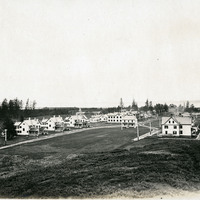
No Caption: See also 96-07-08-alb08-139 with caption: "Fort Stevens, Or," c. 1910. A view of buildings at Fort Stevens, part of the Three Fort Harbor Defense System protecting the mouth of the Columbia River from enemy incursion or attack (the other forts being Fort Columbia and Fort Canby, both in Washington). Built during the Civil War, the fort remained active until after World War II. In June 1942, Fort Stevens gained the dubious distinction of being the only military installation in the continental United States to come under enemy fire when a Japanese submarine surfaced off the coast and fired seventeen missiles at the fort. The missiles destroyed the backstop to the fort's baseball field, but otherwise did little harm. Fort Stevens was decommissioned in 1947. It was later turned over to the Oregon Parks and Recreation Department, and currently is the site of an Oregon State Park.
Date: 1910