Search All Items
Search Results 381 to 390 of 5365
-
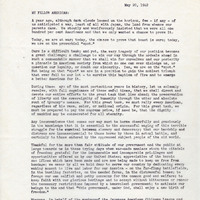
Correspondence from Henry Omoto of San Benito County Japanese American Citizens League regarding statement to the public
Date: May 20, 1942
-
Office Memorandum from Mary F. LeHane (by Elizabeth Parmley) to Margaret S. Watkins regarding housing relocated Japanese in Mono County
Date: December 31, 1941
-
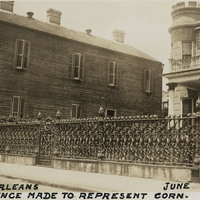
Caption: "New Orleans Iron Fence Made to Represent Corn. June 16, 34." The iron pickets and vertical rails of the fence in this photograph have been shaped to look like stalks of corn, complete with ears and leaves.
Date: 6/16/1934
-
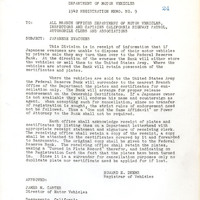
Memorandum from Howard E. Deems regarding deposit of vehicles to the Federal Reserve Bank for storage or sale
Date: April 20, 1942
-
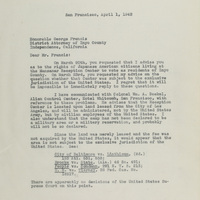
Correspondence from Earl Warren (by Chas. W. Johnson) to George Francis regarding voting rights of incarcerated Japanese
Date: April 1, 1942
-
Form to inventory personal belongings that will be stored by the Federal Reserve Bank of San Francisco
Date: Undated
-
Office Memorandum from Gladys C. Johns (by Kathryn M. Larmore) to Margaret S. Watkins regarding completion and population of Manzanar
Date: April 3, 1942
-
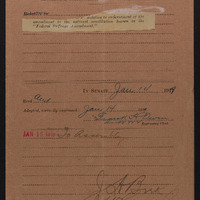
In addition to granting women the right to vote, the 1911 women’s suffrage amendment also paved the way for women to hold political office in California. In 1918, Esto B. Broughton, Elizabeth Hughes, Anna L. Saylor, and Grace S. Dorris became the first four women elected to the California State Assembly. Though fifteen states had already granted women full voting rights, a federal amendment was required to secure nationwide suffrage. To push for this national change, two almost identical resolutions were introduced on January 9, 1919 to urge the U.S. Congress to move forward with “the amendment to the National Constitution known as ‘The Federal Suffrage Amendment.’". On just her third day in office, newly elected Assemblywoman Grace S. Dorris introduced Assembly Joint Resolution No. 1. Simultaneously, Senate Joint Resolution No. 3 was introduced by Senator Burnett, a male colleague in the State Senate. While Dorris's historic Assembly bill ultimately died in committee, its twin Senate resolution successfully advanced, passing both chambers on January 17, 1919.
Date: January 1919
-
Correspondence from Alice B. Guess to Bertha Underhill regarding difficulties in indexing public assistance recipients in Los Angeles County
Date: May 1, 1945
-
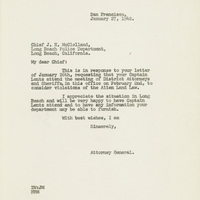
Correspondence from Earl Warren to J. H. McClelland requesting attendance for the District Attorney and Sheriffs meeting
Date: January 27, 1942