
Search All Items
- Filters:
- Language
- English 4330
- Spanish 107
- ENGLISH 1
- census_013 1
- Type
- Image 3891
- Still Image 286
- Text 236
- Text 19
- Textual 2
Search Results 4381 to 4390 of 4452
-
The Census of 1852 collection includes enumerations of California's 32 counties, arranged into 126 volumes. Schedule I enumerated the county's inhabitants, while schedule II enurmerated economic production. Many pages of this volume are damaged.
Date: 1852
-
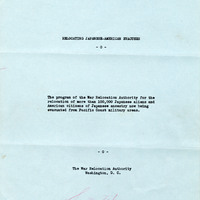
"The program of the War Relocation Authority for the relocation of more than 100,000 Japanese aliens and American citizens of Japanese ancestry now being evacuated from Pacific Coast military areas"; Sections: Chronology, Evacuation-A Military Necessity, The Relocation Program, The War Relocation Work Corps
Date: July 9, 1942-Received
-
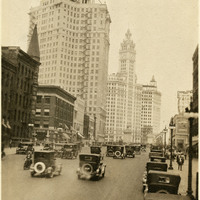
Caption: "London Guarantee & Wrigley Bldg. Chicago," c. 1923. This photograph, taken at street level, features the London Guarantee Building (with the small cupola still under construction at its top) and the Wrigley Building (just to the right of the London Guarantee Building). The London Guarantee Building (also called the London Guaranty and Accident Building), designed by Alfred S. Alschuler, was completed in 1923. The Wrigley Building, constructed by the famous chewing gum magnate William Wrigley, Jr., consists of two towers. The south tower was completed in 1921, while the north tower was finished in 1924 (you can make out construction scaffolding on the top of the tower in this photograph).
Date: 1923
-
The Census of 1852 collection includes enumerations of California's 32 counties, arranged into 126 volumes. Schedule I enumerated the county's inhabitants, while schedule II enurmerated economic production. Many pages of this volume are damaged.
Date: 1852
-
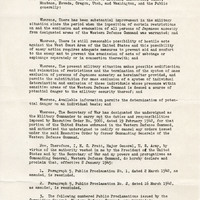
Public proclamation issued by H. C. Pratt of the Western Defense Command regarding rescission of various exclusions
Date: December 17, 1945
-
List of Japanese applying for reinstatment of licenses and description of circumstances or application
Date: September 3, 1952
-
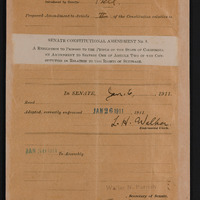
Absent of terms such as “women” or “sex”, the language for Senate Constitutional Amendment No. 8 appears intentionally neutral, labeled as “A Resolution to Propose to the People of the State of California an Amendment to Section One of Article Two of the Constitution in Relation to the Rights of Suffrage.” However, feelings about the amendment were decidedly strong. The arguments for and against Senate Constitutional Amendment No. 8 were closely watched by suffrage organizations, with crowds of onlookers filling the gallery and the lobby of the Capitol. Authored by Republican State Senator Charles W. Bell from Pasadena, Senate Constitutional Amendment No. 8 was passed by the Senate on February 2, 1911, receiving 66 ayes and 12 noes. Senate Constitutional Amendment No. 8 would be introduced to the public as Proposition 4 on the ballot for the special election scheduled for October 10, 1911, along with a variety of other reform amendments passed by the Senate.
Date: January 6, 1911
-
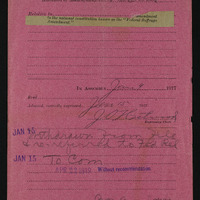
In addition to granting women the right to vote, the 1911 women’s suffrage amendment also paved the way for women to hold political office in California. In 1918, Esto B. Broughton, Elizabeth Hughes, Anna L. Saylor, and Grace S. Dorris became the first four women elected to the California State Assembly. Though fifteen states had already granted women full voting rights, a federal amendment was required to secure nationwide suffrage. To push for this national change, two almost identical resolutions were introduced on January 9, 1919 to urge the U.S. Congress to move forward with “the amendment to the National Constitution known as ‘The Federal Suffrage Amendment.’". On just her third day in office, newly elected Assemblywoman Grace S. Dorris introduced Assembly Joint Resolution No. 1. Simultaneously, Senate Joint Resolution No. 3 was introduced by Senator Burnett, a male colleague in the State Senate. While Dorris's historic Assembly bill ultimately died in committee, its twin Senate resolution successfully advanced, passing both chambers on January 17, 1919.
Date: January 1919
-
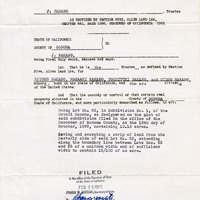
Second report by trustee, J. Nakano on behalf of Kiyoko, Masaaki, Toshiyuki, and Hideo Nakano regarding property in Sonoma Coutny, California; This report comes from incarceration camp
Date: Filed February 26, 1943
-
Second report by trustee, J. Nakano on behalf of Kiyoko, Masaaki, Toshiyuki, and Hideo Nakano regarding property in Sonoma Coutny, California; This report comes from incarceration camp
Date: Filed February 26, 1943