
Search All Items
- Filters:
- Language
- English 4330
- Spanish 107
- ENGLISH 1
- census_013 1
- Type
- Image 3891
- Still Image 286
- Text 236
- Text 19
- Textual 2
Search Results 4411 to 4420 of 4452
-
Correspondence from Etha L. Skouden (by Helen I. Clemensen) to Margaret Billings regarding report of individual cases
Date: May 7, 1942
-
Item in meeting minutes regarding a continuance of hearings
Date: December 29, 1943
-
Summary of proclamations dated December 7 and 8, 1941 and January 14, 1942, which describes instructions for aliens; Attached to "Notice to Enemy Nationalities: Certificates of Identification" (F3729_144_002b)
Date: Undated
-
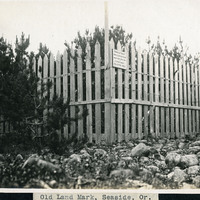
Caption: "Old Landmark, Seaside, Or.," c. 1910. Shows a picket fence erected around what a sign calls "Remains of Cairn where Lewis & Clark made salt from the ocean water Jan. & Feb. 1806." When the famous expedition led by Merriweather Lewis and William Clark reached the Pacific Ocean in late 1805, their supplies had run dangerously low, including their salt supply. Salt, used not only to flavor meat but also to preserve it, was extremely important to the health of the expedition. Three of Lewis and Clark's men traveled to a site on the coast near present-day Seaside, Oregon to set up a small salt-works, boiling ocean water in a series of large kettles and then scraping the resulting salt crust off of the sides. In this manner, the men eventually collected about twenty gallons of salt before Lewis and Clark decided the supply was sufficient for the return journey. In 1910, the property containing the remains of the cairns was deeded to the Oregon Historical Society. In 1955, replica salt cairns were built at the site by the Lions Club to commemorate the expedition's activities.
Date: 1910
-
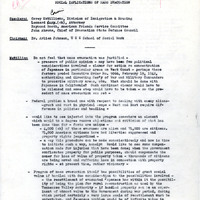
Unrevised transcript of forum discussion regarding effect of relocation; Speakers: Carey McWilliams, Leonard Corwin, Raymond Booth, John Abrams
Date: April 13, 1942
-
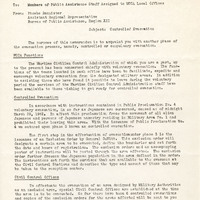
Memorandum from Phoebe Bannister to Members of the Public Assistance Staff Assigned to WCCA Local Offices regarding relocation process; Sections: WCCA Functions; Controlled Evacuation; Civil Control Offices
Date: April 9, 1942
-
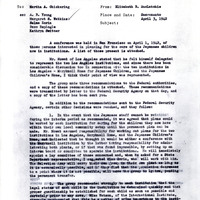
Office Memorandum from Elizabeth B. MacLatchie to Martha A. Chickering regarding Japanese children in institutions
Date: April 3, 1942
-
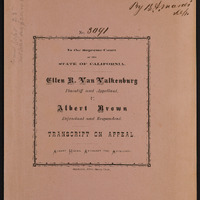
A Transcript of Appeal is the official written record of a trial, used by a higher court to review the lower court's proceedings. Ellen Van Valkenburg began an important legal battle for women’s enfranchisement in California on July 21, 1871, when she requested that Santa Cruz County Clerk Albert Brown enter her name in the Great Register of voters. After Brown (a willing accomplice in helping her bring the case to court) refused to register her, Van Valkenburg and her lawyer, Santa Cruz Judge Albert Hagan, began legal proceedings by requesting a writ of mandamus, a judicial remedy used to compel agencies to perform ministerial acts, such as registering voters. Van Valkenburg and Hagan argued her case by citing the 14th Amendment of the U.S. Constitution. The new amendment, ratified 3 years earlier in 1868, defined all persons born or naturalized in the U.S. as citizens protected by civil rights. Van Valkenburg and Hagan asserted that American women were considered citizens under this amendment, and that citizenship automatically granted absolute rights, including the right to vote. The case first went to California’s Third District Court. Many of America’s most prominent suffragists, including Elizabeth Cady Stanton and Susan B. Anthony, were with Van Valkenburg in Santa Cruz when the lower court ruled against her on August 16, 1871. Van Valkenburg and Hagan swiftly appealed this decision through the Supreme Court of California. In the end, the Supreme Court of California upheld the lower court’s verdict under the reasoning that as a white American woman, Van Valkenburg already had citizenship and civil rights prior to the passage of the 14th amendment, and that the 14th amendment did not provide her with any additional political rights, such as the right to vote. While Van Valkenburg lost her case, and subsequent lawsuits failed to secure women's suffrage nationwide, the case stands as a critical early example of legal advocacy for women's political rights in California.
Date: September 23, 1871
-
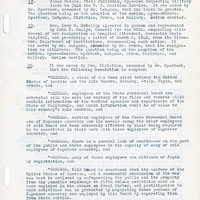
Resolution passed by the State Personnel Board regarding dissmissal of State Personnel Board employees of Japanese descent
Date: March 5, 1942