
Search All Items
- Filters:
- Type
- Image 3607
- Still Image 937
- Text 401
- Text 19
- Image of the California Census from the records of the office of the California Secretary of State 1
- Language
- English 4943
- Spanish 26
- ENGLISH 2
- English 1
- census_013 1
- contra_costa_schedule_1_volume_1 1
Search Results 4511 to 4520 of 5015
-
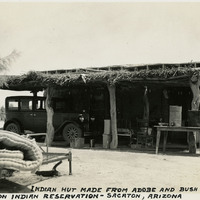
Caption: "Indian Hut Made from Adobe and Bush Branches, Sacaton Indian Reservation - Sacaton, Arizona," c. 1935. View of a small adobe building with a porch area across the length of the façade. The porch is sheltered by a low roof supported by tree trunks or thick tree branches and thatched with grass or sticks. Located south of Phoenix and including the town of Sacaton, the Gila River Indian Reservation is home to members of the Akimel O’odham (Pima) and the Pee-Posh (Maricopa) tribes. The reservation was established in 1859. Eighty years later, in 1939, Congress provided for the self-governance of the reservation via the Gila River Indian Community.
Date: 1935
-
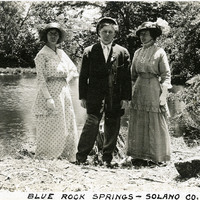
Caption: "Blue Rock Springs -- Solano Co.," c. 1915. Grace McCarthy (far left) and two unidentified friends or relatives at what is now known as Blue Rock Springs. In the 1860s, White Sulphur Springs (in the vicinity of Vallejo) was developed for use as a mineral springs resort, featuring a hotel, several cottages, and an "amusement" building with a dance floor, bar, and billiard room. Manuel Madrid obtained the property around the turn of the twentieth century, and changed the name to Blue Rock Springs. The area is now managed by the Greater Vallejo Recreation District as Blue Rock Springs Park.
Date: 1915
-
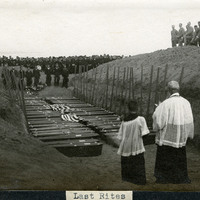
Caption: "Last Rites." Shows a grave site with dozens of caskets ready for burial. A priest and two altar boys stand at one side of the caskets, while a large group of U.S. Navy sailors looks on from the other side. While sailing from port in San Diego on the morning of July 21, 1905, the boiler of the USS Bennington exploded, killing sixty-six of her crew. The victims were laid to rest in the cemetery at Fort Rosecrans. See also 96-07-08-alb05-142 and 96-07-08-alb08-222.
Date: 1905-07-23
-
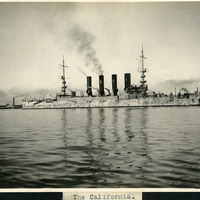
Caption: "The California," c. 1906. This photograph shows the second U.S. Navy ship to bear the Golden State's name. Launched in 1904 and commissioned in 1907, this Pennsylvania-class armored cruiser served in the Pacific fleet. Her name was changed in 1914 to the USS San Diego, in order to free up the name for a new, Tennessee-class battleship. The USS San Diego went on to serve in both the Pacific and Atlantic fleets during World War I, until being sunk off the coast of New York by a German mine in 1918, with a loss of six lives. See also 96-07-08-alb05-009.
Date: 1906
-
Caption: "Mexican home and family - Bozo, near Monterey [sic], Mexico." Six children of the Bozo family standing outside their home near Monterrey. ** PLEASE NOTE: The electronic image derived from Album 10, Photograph 374 of the William McCarthy Photograph Collection (96-07-08-alb10-374) contains content that may not be appropriate for online distribution, and has therefore been withheld. The image has also been removed from the Secretary of State’s digital storage systems, including hard drives, shared drives, cloud and other online storage, and digital backup systems. To view the original photograph, please contact the California State Archives Reference Desk.
Date: 1938
-
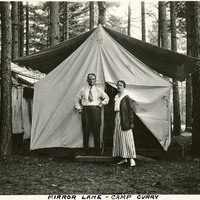
Caption: "Mirror Lane - Camp Curry," c. 1917. William and Grace McCarthy pose in front of their tent at what was then called Camp Curry. Yosemite's Half Dome Village, established by David and Jennie Curry in 1899, was originally called Camp Curry, and then later Curry Village. It was designed to provide cheaper accommodations for Yosemite tourists than the resort hotels. The couple rented out furnished tents and provided amenities such as a dining tent. As time progressed, the amenities increased, and some hard-sided cabins created.
Date: 1917
-
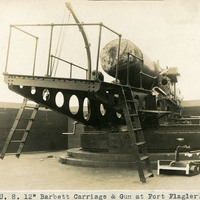
Caption: "U. S. 12" Barbett [sic] Carriage & Gun at Fort Flagler.," c. 1908-1912. View of a 12" disappearing gun installed at Fort Flagler. The coastal artillery fortification Fort Flagler was established in 1897 and activated in 1899. Most of the fort's buildings and batteries had been completed by 1907. Fort Flagler was part of the "triangle of fire," three coastal defense fortifications (Fort Casey, Fort Worden, and Fort Flagler) guarding the entrance to Puget Sound. Fort Flagler was decommissioned in 1953, and purchased by the State of Washington in 1955 for use as a state park.
Date: 1908
-
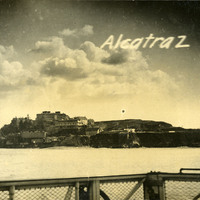
Caption: "Alcatraz," c. 1906. View of Alcatraz Island in San Francisco Bay. The building on the highest part of the island, just to the left of center in the photograph, is the Alcatraz Citadel (also known as Fort Alcatraz). Built in 1859 by the U.S. Army for coastal defense purposes, the Citadel began serving as a prison in 1861. It ceased function as a defense fortification and became the Pacific Branch of the U.S. Military Prison in 1907. The Citadel was demolished in 1909. Over the next two decades the facilities on the island were modified and modernized, becoming a federal penitentiary in 1934.
Date: 1906
-
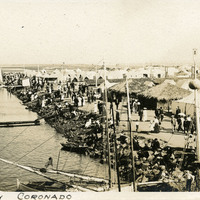
Caption: "Tent City Coronado," c. 1910-1913. View of rows of tents and sheds thatched in palm fronds along the coast near Coronado Hotel, with people strolling along the roadways. Established in 1900 for travelers who could not afford to stay in the resort hotel, the Coronado Tent City consisted of a grid of streets lined with furnished tents, near the sea shore. It also featured restaurants, a library, soda fountain, theater, bandstand, and other recreational facilities. See also 96-07-08-alb08-210, and 263.
Date: 1910
-
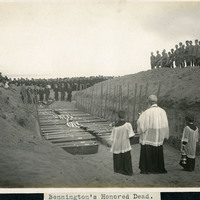
Caption: "Bennington's Honored Dead." Shows a grave site with dozens of caskets ready for burial. A priest and two altar boys stand at one side of the caskets, while a large group of U.S. Navy sailors looks on from the other side. While sailing from port in San Diego on the morning of July 21, 1905, the boiler of the USS Bennington exploded, killing sixty-six of her crew. The victims were laid to rest in the cemetery at Fort Rosecrans. See also 96-07-08-alb05-142 and 96-07-08-alb08-217.
Date: 1905-07-23