
Search All Items
- Filters:
- Type
- Image 3607
- Still Image 937
- Text 401
- Text 19
- Image of the California Census from the records of the office of the California Secretary of State 1
- Language
- English 4943
- Spanish 26
- ENGLISH 2
- English 1
- census_013 1
- contra_costa_schedule_1_volume_1 1
Search Results 4571 to 4580 of 5015
-
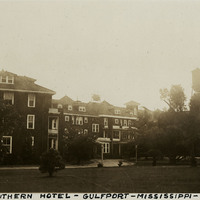
Caption: "Great Southern Hotel -- Gulfport -- Mississippi -- June 19, 34." The Great Southern Hotel, built in 1902-1903 by entrepreneur Joseph T. Jones (also the founder of Gulfport), offered luxurious amenities such as telephones in each room, baths, hot and cold running water, billiards, gardens, and a tennis court. The hotel was hit hard by the Great Depression in the 1930s, even closing briefly. After a short-lived revival in the 1940s, the hotel was demolished in 1951 to make way for U.S. Highway 90.
Date: 6/19/1934
-
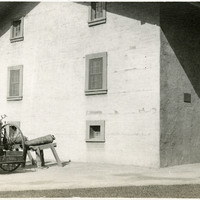
No Caption: c. 1920. Image of the main building of Sutter's Fort. John Sutter established the fort in 1839, calling it New Helvetia. After the discovery of gold at one of Sutter's mills (at Coloma, on the American River), almost all of the fort's inhabitants left for the gold fields in the foothills. The fort deteriorated until being restored from 1891-1893. The Native Sons of the Golden West were influential in the restoration. The fort is now the site of a State Historic Park. See also 96-07-08-alb05-117 and 118.
Date: 1920
-
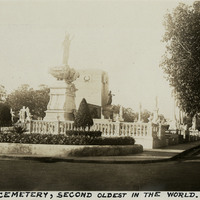
Caption: "Havana Cemetery, Second Oldest in the World. July 4, 34." Several memorials in Colon Cemetery can be seen in this photograph. Founded in 1876, Colon Cemetery replaced Havana's first cemetery, Espada Cemetery, after a cholera epidemic in 1868 revealed the need for a new, larger facility. Today, the Colon Cemetery holds more than 800,000 graves. It is not known where William McCarthy found reference to this being the "second oldest" cemetery in the world, as California State Archives staff could not verify that statistic.
Date: 7/4/1934
-
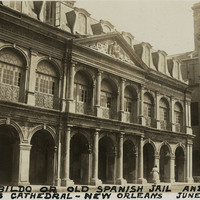
Caption: "Cabildo or Old Spanish Jail and St. Louis Cathedral -- New Orleans, June 16, 34." The façade of the Cabildo dominates this photograph, while the corner of St. Louis Cathedral is visible at the right. The Cabildo was the seat of government for New Orleans while the area was under Spanish jurisdiction. The building was also the site of the transfer ceremonies when the U.S. purchased the Louisiana Territory from France in 1803. Although damaged by fire in 1988, the restored Cabildo survived Hurricane Katrina in 2005 with only minor damage.
Date: 6/16/1934
-
Nevada Pioneer, Rubber Paint, Pacific Rubber Paint Co., Star, etc.
Date: 1879