
Search All Items
- Filters:
- Type
- Image 3670
- Still Image 1106
- Text 405
- Text 19
- Image of the California Census from the records of the office of the California Secretary of State 1
- Language
- English 5178
- Spanish 28
- ENGLISH 2
- English 1
- census_013 1
- contra_costa_schedule_1_volume_1 1
Search Results 4581 to 4590 of 5257
-
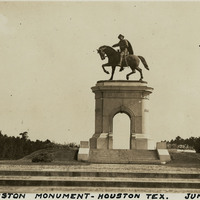
Caption: "Sam Houston Monument -- Houston Tex. June 8, 34." View of the San Houston Monument, a twenty-foot-tall bronze sculpture designed by Enrico Cerracchio and dedicated in 1925. The sculpture commemorates Sam Houston, a prominent soldier and politician who served as the first and third President of the Republic of Texas before its annexation to the U.S. Houston also served as Governor of Texas and as a U.S. Senator for both Texas and Tennessee.
Date: 6/8/1934
-
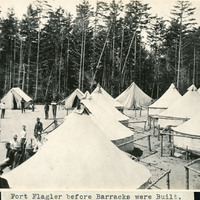
Caption: "Fort Flagler before Barracks were Built.," c. 1899-1906. The coastal artillery fortification Fort Flagler was established in 1897 and activated in 1899. Most of the fort's buildings and batteries had been completed by 1907. Fort Flagler was part of the "triangle of fire," three coastal defense fortifications (Fort Casey, Fort Worden, and Fort Flagler) guarding the entrance to Puget Sound. Fort Flagler was decommissioned in 1953, and purchased by the State of Washington in 1955 for use as a state park.
Date: 1899
-
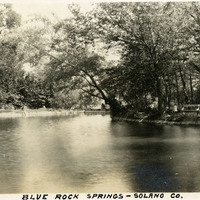
Caption: "Blue Rock Springs - Solano Co." c. 1915. In the 1860s, White Sulphur Springs (in the vicinity of Vallejo) was developed for use as a mineral springs resort, featuring a hotel, several cottages, and an "amusement" building with a dance floor, bar, and billiard room. Manuel Madrid obtained the property around the turn of the twentieth century, and changed the name to Blue Rock Springs. The area is now managed by the Greater Vallejo Recreation District as Blue Rock Springs Park.
Date: 1915
-
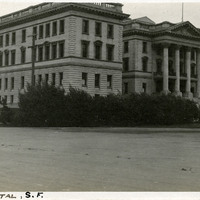
Caption: "S.P. Hospital, S.F.," c. 1910. Constructed in 1908 and designed by architect Daniel J. Patterson, the hospital treated Southern Pacific Railroad workers from across the American West, as well as passengers injured while riding. As the twentieth century progressed and automobiles supplanted trains as the premier method of transportation for people and goods, the hospital entered a period of decline, closing in 1974. It has since been renovated and now serves as a senior housing complex.
Date: 1910
-
Office Memorandum from Bertha S. Underhill to Mary LeHane regarding reopening the Japanese Children's Home; Attachments: F3729_111_008b, F3729_111_008c-F3729_111_008d
Date: August 10, 1945