Search All Items

Note: Check the about page for more information on the data sources used in this search

Search Results 4711 to 4720 of 6524

  • Schedule I & II Volume I

    The Census of 1852 collection includes enumerations of California's 32 counties, arranged into 126 volumes. Schedule I enumerated the county's inhabitants, while schedule II enurmerated economic production. Many pages of this volume are damaged.

    Date: 1852

  • Memo on Conversation About Ammunitions

    Memorandum from O. J. Jahnsen regarding a conversation about ammunitions on a train

    Date: December 16, 1941

  • McCarthy Album 03, Photograph 003

    Caption: "Cliff S.F." The Cliff House and Ocean Beach in San Francisco shows people on the beach and walking up the road to the Cliff House, c. 1910. The photograph shows the third Cliff House built on this site, which opened in 1909, and was built with steel-reinforced concrete. The original Cliff House was built in 1863 and was destroyed by fire on Christmas day in 1894. The second, Victorian- style Cliff House was completed in 1896, and although it survived the 1906 earthquake and fires, it burned to the ground in 1907 (see 96-07-08-alb06-280).

    Date: 1910

  • Old Series Trademark No. 0392

    Oakland Laundry

    Date: 1877

  • McCarthy Album 05, Photograph 221

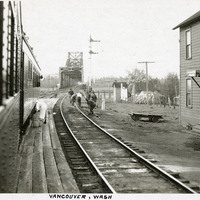
    Caption: "Vancouver, Wash," c. 1905-1909. Train tracks in Vancouver, Washington running by a train station. One set of tracks is being worked on by a crew of six men, while on another track a man is working on cleaning or maintaining a rail car.

    Date: 1905

  • McCarthy Album 11, Photograph 127

    Caption: "Havana Cemetery, Second Oldest in the World. July 4, 34." Several memorials in Colon Cemetery can be seen in this photograph. Founded in 1876, Colon Cemetery replaced Havana's first cemetery, Espada Cemetery, after a cholera epidemic in 1868 revealed the need for a new, larger facility. Today, the Colon Cemetery holds more than 800,000 graves. It is not known where William McCarthy found reference to this being the "second oldest" cemetery in the world, as California State Archives staff could not verify that statistic.

    Date: 7/4/1934

  • Schedule II Volume II

    The Census of 1852 collection includes enumerations of California's 32 counties, arranged into 126 volumes. Schedule I enumerated the county's inhabitants, while schedule II enurmerated economic production. Many pages of this volume are damaged.

    Date: 1852

  • McCarthy Album 09, Photograph 271

    Caption: "Sentinel Hotel," c. 1917. The Sentinel Hotel at Yosemite Village. Construction of this hotel began in 1876, and at the turn of the century it was the only hotel operating in the valley. Increased attendance as the twentieth century progressed resulted in the construction of other tourist areas such as Curry Village, and the Sentinel gradually became obsolete. The Sentinel and the complex of buildings that had grown up around it were torn down in the late 1930s.

    Date: 1917

  • McCarthy Album 11, Photograph 216

    Caption: "Empire State Bldg. in the Distance. Height 1250 Feet, 102 Stories. 34th St. New York. Aug. 16, 1934." Street scene dominated by the Empire State Building rising a few blocks away. Construction began on this iconic 102-story building, designed by William F. Lamb, in 1930. Completed by early 1931, it held the title of world's tallest building for almost 40 years, until being surpassed in 1970 by the construction of the World Trade Center's North Tower. It is now the fifth-tallest building in the U.S., and the 28th-tallest in the world.

    Date: 8/16/1934

  • McCarthy Album 08, Photograph 145

    Caption: "Pile Driver in the Breakers, Columbia River Jetty.," c. 1910. View of a large pile driver used in the construction of the jetty system at the mouth of the Columbia River. This is likely at the end of the so-called South Jetty, extending more than six miles into the ocean from Point Adams on the Oregon side of the river mouth. The jetty system at the mouth of the Columbia River was constructed between 1885 and 1917. Designed to funnel water from the Columbia River in a more concentrated fashion into the Pacific Ocean, the jetty system helped create a deeper, more stable shipping channel.

    Date: 1910