
Search All Items
- Filters:
- Language
- English 4786
- Spanish 11
- ENGLISH 2
- English 1
- census_013 1
- contra_costa_schedule_1_volume_1 1
- Type
- Image 3785
- Still Image 609
- Text 377
- Text 22
- Textual 2
- Image of the California Census from the records of the office of the California Secretary of State 1
Search Results 4741 to 4750 of 4849
-
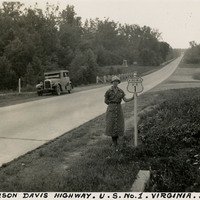
Caption: "Jefferson Davis Highway. U.S. No. 1. Virginia. July 20, 34." Grace McCarthy is standing next to a U.S. Route 1 sign along a highway in Virginia. The Jefferson Davis Highway project was begun by the United Daughters of the Confederacy (UDC). As auto tourism increased across the U.S., so to did the need for roads on which to drive. Private interests such as the UDC began to develop routes across the country, but with no central administrating organization the routes were haphazard and confusing. The UDC planned a route that was to stretch from Virginia across the southern U.S. to San Diego, but the entire route never materialized. The federal government stepped in to impose a numbering system on various routes across the nation. That portion of the planned Jefferson Davis Highway through Virginia was numbered as U.S. Route 1.
Date: 7/20/1934
-
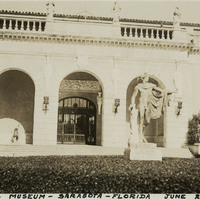
Caption: "Ringling Museum -- Sarasota -- Florida, June 28 1934." Entrance to the John and Mable Ringling Museum of Art, Florida's state art museum established by John and Mable Ringling in 1927. John was a promoter and part-owner of the famous Ringling Brothers Circus, along with four of his brothers. When John and Mable built a winter home in Sarasota in 1926, they also explored the possibility of establishing an art gallery on the same property. Architect John H. Phillips designed the building, which opened to the public in 1931. John Ringling willed the facility and the art collection to the state of Florida upon his death in 1936. The museum, now known simply as "The Ringling," is under the jurisdiction of the University of Florida.
Date: 6/28/1934
-
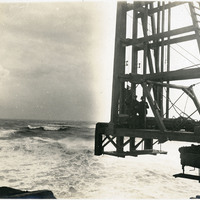
No Caption: See also 96-07-08-alb08-145 with caption: "Pile Driver in the Breakers, Columbia River Jetty," c. 1910. View of a large pile driver used in the construction of the jetty system at the mouth of the Columbia River. This is likely at the end of the so-called South Jetty, extending more than six miles into the ocean from Point Adams on the Oregon side of the river mouth. The jetty system at the mouth of the Columbia River was constructed between 1885 and 1917. Designed to funnel water from the Columbia River in a more concentrated fashion into the Pacific Ocean, the jetty system helped create a deeper, more stable shipping channel.
Date: 1910
-
King of the Forest, Bear Leaf , Young Hyson, The Bamboo Grove
Date: 1885
-
Correspondence from Charles M. Wollenberg to Beulah L. Lewis regarding eligibility for CWA
Date: September 20, 1946
-
Correspondence from Alice B. Guess to Bertha Underhill regarding difficulties in indexing public assistance recipients in Los Angeles County
Date: May 1, 1945
-
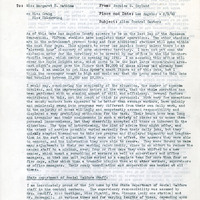
Office Memorandum from Bernice G. Copland to Margaret S. Watkins regarding evacuation process in Los Angeles County; Sections: State Department of Social Welfare Staff; Housing Facilities of WCCA Stations; Clientele; Animals; Relief; Time Involved by Supervising Agents; Reports
Date: May 9, 1942
-
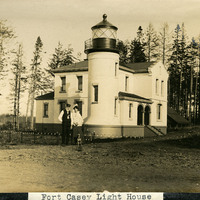
Caption: "Fort Casey Light House [sic]," c. 1905. Located on Whidbey Island in Puget Sound, the Admiralty Head Lighthouse was built overlooking Admiralty Inlet in 1903. It replaced an earlier structure that had to be moved in 1890 to accommodate the construction of Fort Casey. The second lighthouse, shown here, was built with thick walls in order to withstand earthquakes and the concussion of guns at the fort. The man and woman shown in the photograph (standing with a dog) are likely Charles H. Davis and his second wife Delia (Overton) Davis. Charles Davis was appointed keeper of the lighthouse in 1900 and served until his death in 1914. The lighthouse, deactivated in 1922, has since been restored by Washington State Parks, and is part of the Fort Casey State Park. See also 96-07-08-alb02-057.
Date: 1905