Search All Items

Note: Check the about page for more information on the data sources used in this search

Search Results 4791 to 4800 of 4807

  • Old Series Trademark No. 0301

    Golden

    Date: 1875

  • Memo on Difficulties During Operation of Control Stations

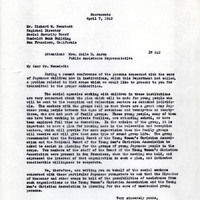
    Office Memorandum from Genevieve Murrican to Margaret S. Watkins regarding difficulties with understanding responsibilities at various Control Stations

    Date: May 20, 1942

  • Old Series Trademark No. 0103

    Sainsevain Extra White Wine

    Date: 1868

  • State Employee Questionnaire

    Questionnaire given to State Employees of Japanese descent

    Date: Undated

  • Old Series Trademark No. 2308

    Dr. Brown's Quinine Bitters

    Date: 1893

  • Old Series Trademark No. 2775

    The Household

    Date: 1896

  • Memo on Manzanar

    Office Memorandum from Gladys C. Johns (by Kathryn M. Larmore) to Margaret S. Watkins regarding conditions at Manzanar Assembly Center

    Date: July 6, 1942

  • Old Series Trademark No. 1025

    Tropical Bird, The Villard, etc

    Date: 1883

  • McCarthy Album 08, Photograph 088

    Caption: "Fort Ward, Wash.," c. 1908-1912. View from Puget Sound of a wharf and other buildings of Fort Ward. Originally known as Bean Point, Fort Ward was established by the U.S. Army Coastal Artillery Corps in 1890. Re-named Fort Ward in 1903, the facility included four coastal batteries designed to assist in protecting Puget Sound and the nearby Naval Shipyard from enemy attack. Fort Ward was placed on inactive status in the 1920s, but was revived by the U.S. Navy during World War II. The Navy discovered the fort's location was ideal for listening to radio communications from Japan, and it subsequently became a top secret listening post with a link directly to Washington, D.C. The Navy continued the fort's use as a listening post until 1956, when it was again taken over by the U.S. Army. The Army subsequently stopped all activity in 1958, ultimately selling portions of the fort to the Washington State Park System in 1960. It is now a state park.

    Date: 1908

  • McCarthy Album 11, Photograph 304

    Caption: "California Here We Come. Donner Monument. In Our Home State Again After Five Months Tour. October 7, 1934." William and Grace McCarthy took this photograph of the Pioneer Monument when they arrived back in California after a five month road trip to the East Coast. The Pioneer Monument, featuring a pair of pioneers with their two children looking west, was first dedicated on June 6, 1918 to commemorate those who emigrated to California in the mid 1800s. Today, the monument and surrounding area is known as Donner Memorial State Park. The park was established in memory of the ill-fated Donner Party, a group of emigrants whose wagon train was caught in the Sierra Nevada Mountains during the winter of 1846-47. The Pioneer Monument's stone pedestal stands twenty-two feet high, the height of the snow that the party had to contend with. Of the eighty-seven people in the wagon train, only forty-eight survived to be rescued the following spring. Some of the survivors are said to have resorted to cannibalism in order to survive.

    Date: 10/7/1934