
Search All Items
- Filters:
- Language
- English 5827
- Spanish 62
- ENGLISH 2
- English 1
- census_013 1
- contra_costa_schedule_1_volume_1 1
- Type
- Image 3871
- Still Image 1544
- Text 447
- Text 22
- Textual 2
- Image of the California Census from the records of the office of the California Secretary of State 1
Search Results 5021 to 5030 of 5968
-
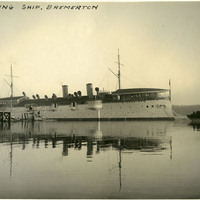
Caption: "Training Ship. Bremerton," Washington, c. 1908 - 1912. See also 96-07-08-alb08-086. View of the USS Philadelphia (C-4). The fourth ship to bear the name, the Philadelphia first launched in September 1889. She sailed as part of the U.S. Navy's Atlantic Squadron until 1893. She then sailed into the Pacific Ocean, where she served until being decommissioned and docked in Puget Sound in 1902. In 1904, the Navy "housed over" the ship (adding the roofed quarters visible on the upper deck in the photograph) and designated her a receiving ship for new sailors not yet assigned to a crew. The Philadelphia served in this capacity until 1912. After a brief stint as a prison ship, the Philadelphia again became a receiving ship in 1916. The Navy sold her in 1927.
Date: 1908
-
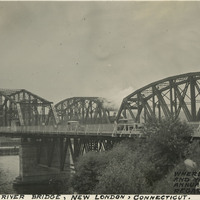
Caption: "Thames River Bridge, New London, Connecticut. Where Harvard and Yale Hold their Annual Rowing Regatta, Sept. 4, 1934." View of two bridges over the Thames River near New London, Connecticut. The drawbridge in the foreground was originally a railroad bridge, built in the late nineteenth century. Later, as automobiles grew in popularity, this bridge was converted to use by vehicles (cars can be seen driving over it in this photograph), and a second bridge was constructed for railroad use (a locomotive can be seen behind the two cars). Neither of these bridges survives today, having been replaced by the Gold Star Memorial Bridge.
Date: 9/4/1934
-
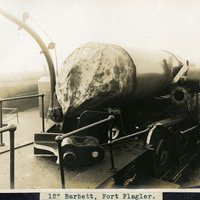
Caption: "12" Barbett [sic], Fort Flagler.," c. 1908-1912. View of a 12" disappearing gun at Fort Flagler. The coastal artillery fortification Fort Flagler was established in 1897 and activated in 1899. Most of the fort's buildings and batteries had been completed by 1907. Fort Flagler was part of the "triangle of fire," three coastal defense fortifications (Fort Casey, Fort Worden, and Fort Flagler) guarding the entrance to Puget Sound. Fort Flagler was decommissioned in 1953, and purchased by the State of Washington in 1955 for use as a state park.
Date: 1908
-
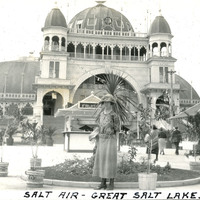
Caption: "Salt Air - Great Salt Lake," c.1923. Grace McCarthy poses in front of the Saltair resort complex on Utah's Great Salt Lake. Constructed in 1893 and designed by Richard K.A. Kletting, the Saltair set out to be the Western counterpart of Coney Island. The resort was a popular spot for Mormon families, only fifteen miles from Salt Lake City and overseen by Church leaders. The Church sold the building in 1906. It was later destroyed by fire in 1925, but a second pavilion was quickly built.
Date: 1923
-
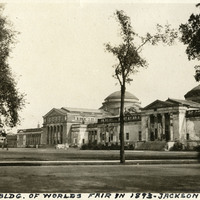
Caption: "Fine Arts Bldg. of Worlds Fair in 1893 - Jackson Park - Chicago," c. 1923. The Palace of Fine Arts building shown in this photograph was originally constructed for the World's Columbian Exposition held in Chicago in 1893. After the fair's completion, the building housed the Columbian Museum, which eventually became the Field Museum of Natural History. In 1920, that museum moved to a new building, and the Palace of Fine Arts building was left vacant. After renovations in the late 1920s, the Museum of Science and Industry opened at the site.
Date: 1923
-
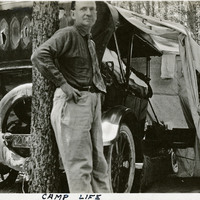
Caption: "Camp Life.," c. 1915-1920. William and Grace McCarthy standing next to automobile at an unidentified campground. See also 96-07-08-alb04-175, 180, 181, and 182.
Date: 1920
-
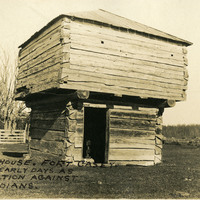
Caption: " Block House, Fort Casey. Used in Early Days as Protection Against the Indians." Washington, c. 1909. View of a blockhouse, a timber structure built by European settlers to guard against attack during the Indian Wars of 1855-1857.
Date: 1909
-
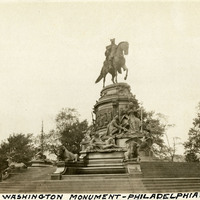
Caption: "Washington Monument -- Philadelphia." c. 1920. Philadelphia's Washington Monument Fountain (Rudolf Siemering, sculptor) features a bronze and granite statute of George Washington on horseback. Dedicated at Fairmount Park in 1897, it was moved to Philadelphia's Eakins Oval in 1928.
Date: 1920