
Search All Items
- Filters:
- Language
- English 5827
- Spanish 62
- ENGLISH 2
- English 1
- census_013 1
- contra_costa_schedule_1_volume_1 1
- Type
- Image 3871
- Still Image 1544
- Text 447
- Text 22
- Textual 2
- Image of the California Census from the records of the office of the California Secretary of State 1
Search Results 5041 to 5050 of 5968
-
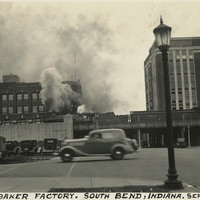
Caption: "Studebaker Factory. South Bend, Indiana. Sept. 13, 1934." Two buildings of the Studebaker Factory in South Bend are visible in this photograph. The Studebaker brothers started operations in South Bend in 1852, when they established a blacksmith shop and foundry. They soon began building wagons and carriages, demand for which soared with the advent of the Civil War and an increase in migration toward and into the American West. The company gradually phased out wagon production in favor of automobile manufacture in the early twentieth century. Sales declined after World War II, leading to the eventual closure of the factory in 1963.
Date: 9/13/1934
-
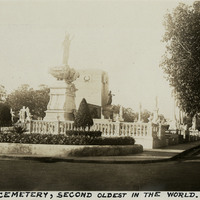
Caption: "Havana Cemetery, Second Oldest in the World. July 4, 34." Several memorials in Colon Cemetery can be seen in this photograph. Founded in 1876, Colon Cemetery replaced Havana's first cemetery, Espada Cemetery, after a cholera epidemic in 1868 revealed the need for a new, larger facility. Today, the Colon Cemetery holds more than 800,000 graves. It is not known where William McCarthy found reference to this being the "second oldest" cemetery in the world, as California State Archives staff could not verify that statistic.
Date: 7/4/1934
-
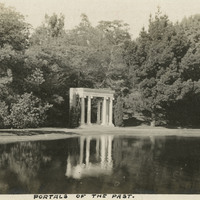
Caption: "Portals of the Past," c. 1915, on the shore of Lake Lloyd in Golden Gate Park, was originally the entranceway to the Nob Hill mansion of railroad tycoon, A.N. Towne. The entranceway was the only part of the home that was not destroyed by the 1906 earthquake and was moved to Golden Gate Park in 1909 as a reminder of much that was lost. See also 96-07-08-alb05-065.
Date: 1915
-
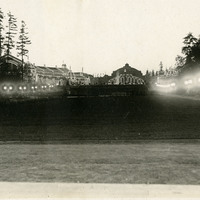
No Caption: View of the Alaska-Yukon-Pacific Exposition at dusk, with pathways defined by globe lights. The Government Building can be seen in the center of the photograph. Held in Seattle to celebrate the development of the Pacific Northwest, the fair attracted 3.7 million visitors over the course of its run from June to October 1909. Although most of the fair's buildings have since been destroyed, several of them now serve as part of the University of Washington campus.
Date: 1909
-
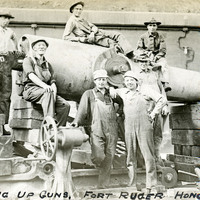
Caption: "Setting Up Guns, Fort Ruger Honolulu," c. 1909-1915. Group of unidentified men gathered around unassembled pieces of what appears to be a 12-inch mortar at Fort Ruger, Island of O'ahu, Hawaii. Fort Ruger was established by the U.S. in 1906 as the Diamond Head Reservation. Its name was changed to Fort Ruger in 1909. See also 96-07-08-alb05-099 and 100.
Date: 1915
-
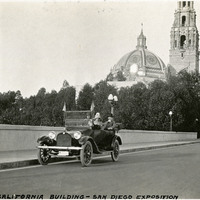
*Caption: "California Building -- San Diego Exposition," c. 1915-1916. Automobile parked along road to the Panama-California Exposition entrance, with California Building's tower and dome in the background. The Panama-California Exposition was held in San Diego in 1915 and 1916 to celebrate the opening of the Panama Canal. It was smaller in scale and less well-funded than the Panama-Pacific International Exposition held in 1915 in San Francisco. See also 96-07-08-alb05-071.
Date: 1915
-
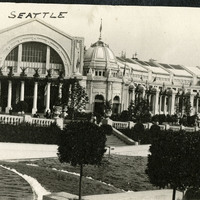
Caption: "A.Y.P.E. Seattle." Exposition building at the Alaska-Yukon-Pacific Exposition. The Alaska-Yukon-Pacific Exposition was held in Seattle, Washington in 1909 to celebrate the development of the Pacific Northwest. The fair attracted 3.7 million visitors over the course of its run from June to October 1909. Although most of the fair's buildings have since been destroyed, several of them now serve as part of the University of Washington campus.
Date: 1909